







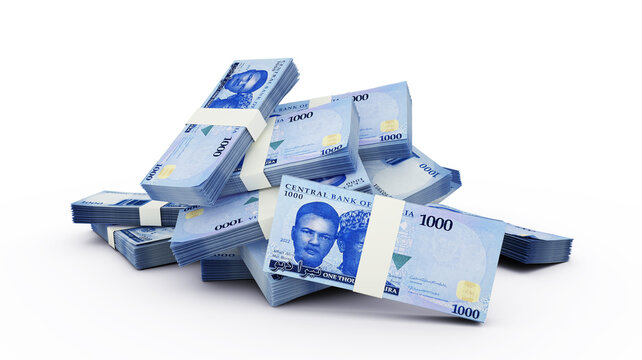
The naira began the new trading week on a weaker note, closing at ₦1,533.67 to the US dollar at the Nigerian Foreign Exchange Market on Monday. The figure represents a 0.08 per cent depreciation from Friday’s rate of ₦1,532.51/$.
During intraday trading, the local currency hit a high of ₦1,535/$ and a low of ₦1,532/$. In the parallel market, it settled at ₦1,543/$, slightly stronger than last week’s average of ₦1,545/$.

Market watchers had expected a steadier performance this week, supported by the Central Bank of Nigeria’s (CBN) intervention measures and rising foreign exchange inflows. Analysts suggest the naira could remain relatively stable unless disrupted by global shocks or external market pressures.
However, a stronger US dollar and softening crude oil prices remain downside risks for the local currency.
The International Monetary Fund (IMF) recently commended the CBN’s reforms to deepen financial inclusion and capital market development. It also urged the regulator to strengthen oversight in mortgage lending, consumer finance, fintech, and cryptocurrency operations.
Nigeria’s foreign reserves and investor confidence have seen some improvement, while oil production has provided additional support for the naira. OPEC data showed that Nigeria pumped an average of 1.5 million barrels of crude per day in July—7,000 barrels above its approved quota. This marked the second consecutive month Africa’s top oil producer exceeded its output ceiling.
Production reached its highest this year in January at 1.54 million barrels per day, before sliding to 1.4 million barrels in March and recovering to 1.48 million barrels in April. July’s figure of 1.507 million barrels per day was a marginal increase from 1.505 million barrels recorded in June.
CBN Moves Against New Naira Note Trading
Meanwhile, the CBN has urged citizens to report banks or staff involved in the illicit sale of new naira notes at social functions. Paul Onuoha, the bank’s Head of Currency Operations and Branch Management, warned that such practices persist largely due to insider collaboration within commercial banks. He encouraged the public to notify regulators or security agencies of any misconduct.
Dollar Remains Firm
Globally, the US dollar maintained its bullish run at the start of the week, with the US Dollar Index (DXY)—which tracks the currency against six peers—closing above 98 points. The Greenback’s strength was buoyed by geopolitical developments as US President Donald Trump disclosed plans for a trilateral meeting with Russian President Vladimir Putin and Ukrainian President Volodymyr Zelenskyy to discuss possible security guarantees.
While US economic data on producer inflation and retail sales beat expectations, markets remain focused on monetary policy signals. Despite dollar strength, traders are pricing in an 84 per cent probability of a 25-basis-point interest rate cut by the Federal Reserve in September, according to CME’s FedWatch tool.
Attention is now on Fed Chair Jerome Powell’s address at the Jackson Hole Economic Policy Symposium later this week. The event, themed “Labour Markets in Transition: Demographics, Productivity, and Macroeconomic Policy,” is expected to offer fresh clues on the Fed’s next policy direction.