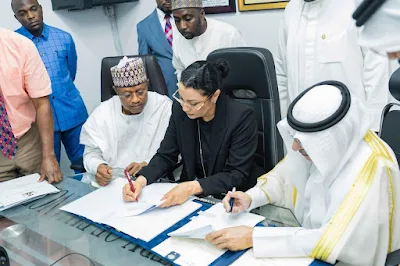
In a landmark move to combat Nigeria’s out-of-school children crisis, the Federal Government has signed a $62.8 million Memorandum of Understanding (MoU) with the Kuwait Fund for Arab Economic Development (KFAED) to support the Reaching Out-of-School Children (ROOSC) initiative in Kaduna State.
The agreement—described as the first of its kind by the Kuwait Fund in Nigeria—was formalised in Abuja with Dr Doris Uzoka-Anite, Minister of State for Finance, signing on behalf of Nigeria, and Dr Waleed Al-Bahar, Director General of the Kuwait Fund, representing the donor agency.

Witnessing the signing, Kaduna State Governor, Senator Uba Sani, hailed the development as a “bold and historic step” in advancing inclusive education in the country.
“This historic partnership marks a bold step toward addressing Nigeria’s out-of-school children crisis,” the governor said, adding that it aligns with global commitments under Sustainable Development Goal 4 (SDG 4) on quality education.
Unprecedented Commitment to Education
Governor Sani highlighted Kaduna’s unwavering commitment to education reform, revealing that the state allocated 25% of its 2024 budget and 26.14% of its proposed 2025 budget to the education sector—among the highest in the country.
Since assuming office on May 29, 2023, his administration has:
- Constructed 60 new secondary schools
- Built 700 classrooms and renovated 1,049 others
- Reduced tuition fees in tertiary institutions by 50%
- Established three modern vocational institutes aligned with the federal Technical and Vocational Education and Training (TVET) agenda
What the ROOSC Project Will Deliver
The ROOSC initiative, developed in collaboration with international partners, targets the estimated 18 million out-of-school children in Nigeria, with Kaduna State at the forefront of intervention efforts.
With the state already fulfilling 100% of its counterpart funding obligations, the project will:
- Construct 102 climate-resilient schools
- Rehabilitate 170 existing learning centres across all 23 local government areas of Kaduna
- Prioritise inclusive education for girls, children with disabilities, and internally displaced persons
- Promote safe school environments and reintegration support for marginalised learners
Governor Sani emphasised that the project design reflects a multi-stakeholder approach, involving local and international organisations, and reaffirmed Kaduna’s commitment to transparent and efficient implementation.
Broad Coalition of Partners
He extended appreciation to development partners and donors supporting the ROOSC programme, including:
- Kuwait Fund for Arab Economic Development
- Islamic Development Bank
- Global Partnership for Education
- Education Above All Foundation
- Save the Children International
- UNICEF
He also acknowledged the Federal Ministries of Finance and Education for their role in facilitating the partnership.
“We are committed to delivering on every aspect of this programme to ensure that no child in Kaduna is left behind,” the governor said.
The ROOSC initiative is widely seen as a scalable model that could be replicated across other states in Nigeria battling high rates of out-of-school children.