






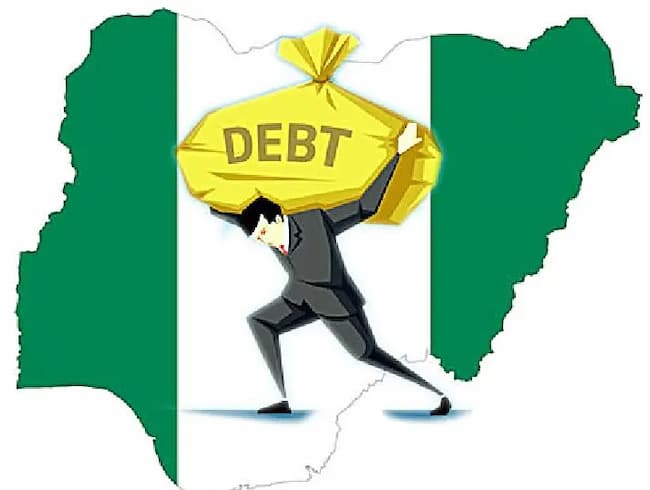
Nigeria’s public debt has reached an unprecedented high of N149.39 trillion as of March 31, 2025, marking a significant year-on-year surge of N27.72 trillion or 22.8%, when compared to the N121.67 trillion recorded during the same period in 2024.
This development was revealed in the latest debt profile report published by the Debt Management Office (DMO) on Friday. The DMO’s data further showed a quarter-on-quarter increase of N4.72 trillion, or 3.3%, compared to the N144.67 trillion reported at the close of 2024.
The escalation in Nigeria’s debt burden continues to be fueled by the Federal Government’s sustained borrowing activities, coupled with the continuous depreciation of the naira, which has significantly inflated the naira-equivalent of the country’s external debts.
Against the backdrop of persistent fiscal challenges, Nigeria has leaned heavily on both domestic and external borrowing to support its expenditure framework. According to the report, external debt obligations stood at N70.63 trillion (equivalent to $45.98 billion) at the end of Q1 2025. This represents a jump from N56.02 trillion ($42.12 billion) in Q1 2024 — a 26.1% increase year-on-year.
Quarter-on-quarter, external debt showed a slight rise from N70.29 trillion in December 2024 — a modest increase of N344 billion, or 0.5%. While the actual increment in dollar terms was limited to $3.86 billion, the depreciation of the naira exaggerated the growth when converted into local currency.
The DMO disclosed that the Central Bank of Nigeria (CBN) had applied an exchange rate of N1,330.26 per dollar in Q1 2024 to calculate the local value of external loans. While the rate used in Q1 2025 was not publicly disclosed, the increase in naira value signals a further weakening of the domestic currency.
Nigeria’s external debt portfolio includes obligations to multilateral lenders like the World Bank and African Development Bank, bilateral creditors, and commercial instruments such as Eurobonds. The rising cost of servicing these debts, exacerbated by currency devaluation, has triggered concerns over fiscal sustainability and the growing pressure on Nigeria’s already tight finances.
On the domestic side, the country’s debt stock reached N78.76 trillion (approximately $51.26 billion) in March 2025 — a leap from N65.65 trillion ($49.35 billion) in March 2024. This reflects a year-on-year increase of N13.11 trillion or 20%. When compared to Q4 2024, domestic borrowing increased by N4.38 trillion or 5.9%, up from N74.38 trillion.
Out of the total domestic liabilities, the Federal Government accounted for N74.89 trillion, while the debts held by state governments and the Federal Capital Territory (FCT) amounted to N3.87 trillion. This marks a marginal reduction from N3.97 trillion in Q4 2024 and N4.07 trillion in Q1 2024, suggesting either improved debt repayment practices or reduced borrowing activity at the subnational level.
Domestic borrowings are structured through various instruments, including Federal Government Bonds, Treasury Bills, Sukuk, and Green Bonds — all of which are used to plug fiscal deficits. While they are shielded from exchange rate shocks, they also carry high interest obligations and may limit credit access for private sector players.
The overall composition of Nigeria’s debt structure has undergone slight adjustments. As of March 2025, domestic debt made up 52.7% of the total debt portfolio, while external debt accounted for 47.3%. This represents a change from March 2024’s split of 54% domestic and 46% external, underlining the growing vulnerability of Nigeria’s debt exposure to currency fluctuations.
At the same time, the steady uptick in domestic borrowing reflects the Federal Government’s increasing dependence on the local capital market — a trend that persists despite high interest rates and growing caution among investors.