








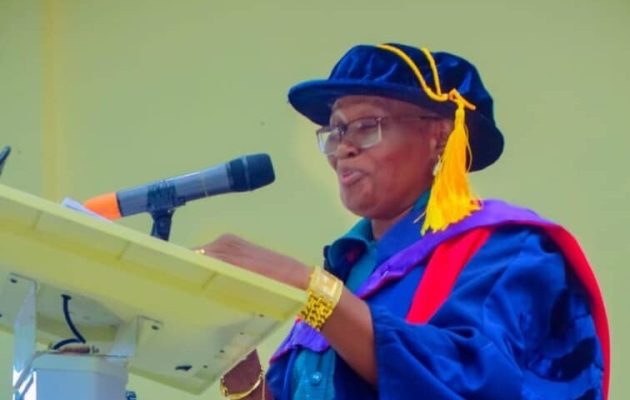
A Professor of Media and Educational Technology at Ajayi Crowther University, Oyo State, Ronke Ogunmakin, has called on the Nigerian government to significantly improve the quality of teaching and learning resources across all levels of education.
Delivering the institution’s 21st inaugural lecture titled “The Message Delivered in a Multimedia Context for Teaching and Learning”, Prof. Ogunmakin emphasised the urgent need for robust educational infrastructure, particularly digital and multimedia tools, to enhance the teaching profession and improve student outcomes.

Ogunmakin, who also serves as Dean of the Faculty of Education, stressed that quality education is rooted in structured pedagogy, well-trained teachers, and the availability of modern instructional resources.
“There is a need to prioritise learning by starting with clear learning objectives and selecting appropriate technologies for their delivery,” she said.
The seasoned academic, drawing on her over four decades of experience in media and education, highlighted the transformative power of multimedia in the classroom. She noted that when properly integrated, multimedia tools can increase student engagement, support interactive and inclusive learning, and cater to diverse learning styles.
According to her, “Multimedia fosters inclusivity by delivering development messages to disadvantaged and socially excluded groups, including students with special needs. It is a powerful tool for addressing educational inequality.”
Prof. Ogunmakin also pointed out the infrastructural challenges hampering the effective use of multimedia in schools, particularly in rural areas, where the lack of electricity remains a major barrier. She advocated for alternative power solutions such as solar and microhydro systems to ensure uninterrupted learning.
In light of recent educational challenges, including the dismal performance of over 4,000 teachers in the 2025 Batch ‘A’ Professional Qualifying Examination (PQE) conducted by the Teachers Registration Council of Nigeria (TRCN), the professor underscored the need for continuous teacher training and capacity development in digital pedagogy.
She further recommended upgrading the bandwidth of major online education platforms, including enhancing the capacity of the National Education Research Network, to support the growing demand for online learning. She also urged partnerships with telecom operators and digital platforms to strengthen online security and ensure sustainable access to digital education.
“The integration of blended learning using sustainable technologies is key—not just during emergencies, but also as a long-term solution for resilient education,” she concluded.
Her lecture sparked renewed calls among education stakeholders for urgent reforms in Nigeria’s teaching sector, with many agreeing that embracing technology and prioritising teacher training are essential to addressing the systemic challenges facing the country’s educational system.