







Nigeria’s fixed income market witnessed a sharp pivot as treasury and OMO bills recorded a significant rally, triggering a widespread decline in yields amid new Open Market Operation (OMO) auction announcements by the Central Bank of Nigeria (CBN).
The apex bank moved aggressively to sterilize excess liquidity, targeting N600 billion through two mid-tenor OMO offerings. Demand surged as commercial banks and foreign portfolio investors aggressively chased the high-yielding instruments.

Simultaneously, the Debt Management Office (DMO) reopened two Federal Government bonds maturing in 2029 and 2033, seeking to raise N300 billion. However, with modest investor interest, the DMO trimmed rates and ultimately under-allocated the bond sale.
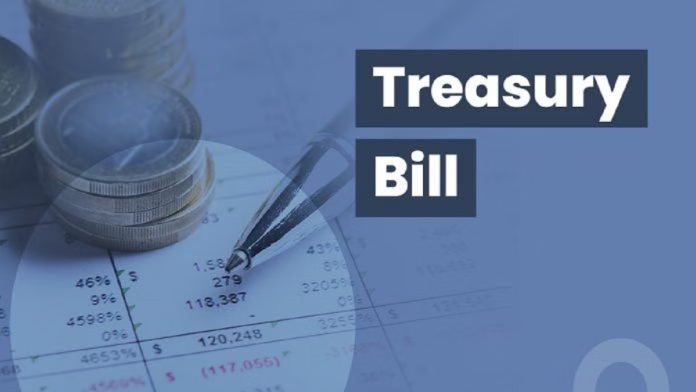
The upbeat momentum spilled into the broader fixed income market. As investors continued to hedge against inflation and seek returns, treasury bills trading closed on a bullish note. Market activity was largely driven by demand for short-term instruments, with particular buying interest observed in July, August, and May bills.
Data from Cordros Capital Limited confirmed that the average yield in the market narrowed by 6 basis points to 20.6%. A yield curve assessment showed contractions across all tenors: short-term yields dropped by 4bps, mid-tenors fell by 3bps, and long-term instruments saw a sharper 8bps decline.
Analysts attributed the decline in yields to robust demand for 87-day, 178-day, and 346-day maturity bills, which recorded yield compressions of 13bps, 4bps, and 24bps, respectively. Meanwhile, the OMO segment followed a similar pattern, with average yields dropping 24bps to settle at 26.2%.
Market participants remain on alert for further CBN interventions and bond auction outcomes as Nigeria’s monetary authorities navigate a delicate balancing act between curbing inflation and managing liquidity in the system.