






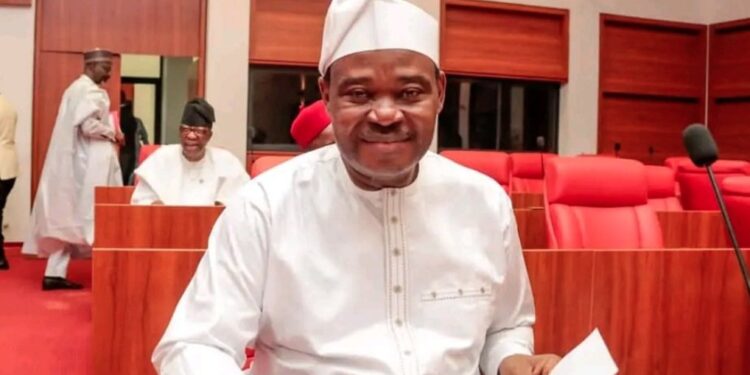
Senator Jimoh Ibrahim reassures that President Bola Tinubu’s participation in BRICS does not pose any risk of tension with a potential Donald Trump administration in the US. He states that Tinubu’s leadership style is in line with liberal democratic values, similar to those upheld in the United States, despite differing governance approaches.
Speaking on Channels Television’s Sunday Politics, Ibrahim, who represents Ondo South in the National Assembly, explains that while their leadership methods may differ, there is no ideological conflict between Tinubu and Trump. He clarifies that Tinubu is a liberalist, which aligns him with America’s democratic principles, ensuring that relations between Nigeria and the US remain stable.
Ibrahim also acknowledges the contrast in leadership philosophies, noting that Tinubu focuses on cooperation and collaboration, while Trump tends to adopt a more transactional, unilateral approach to foreign policy.
In January 2025, Nigeria joins BRICS as a partner country, marking a significant shift in its global economic stance. Ibrahim points out that this move highlights the growing importance of Africa in global geopolitics, with countries like China enhancing their influence across the continent. He mentions that BRICS+ members have already engaged President Tinubu regarding economic partnerships, including trade in China’s Yuan.
Despite potential differences, Ibrahim suggests that Donald Trump has an opportunity to engage with Tinubu and understand Nigeria’s role in these political and economic engagements, especially as China’s footprint in Africa expands.
Ibrahim discusses China’s increasing economic footprint across Africa, with infrastructure projects like airports and seaports being funded by loans. He highlights that China’s primary objective is to secure legitimacy across the continent. He reveals that China has approached President Tinubu with the proposition of conducting trade in Yuan. However, Tinubu’s condition remains clear: trade volume and benefits for Nigeria must increase before any agreement is made.
Ibrahim underscores that Africa is becoming a pivotal player in the geopolitical rivalry between the United States and China. Both superpowers view the continent as crucial in determining the future of global leadership, making Africa an essential focus in shaping global power dynamics.