





The Nigerian National Assembly gave us premium drama this week. Not the scripted kind. The kind that makes you pause your live stream, rewind, and ask: “Wait, what just happened?”
First, it was Senator Natasha Akpoti-Uduaghan walking out of a budget defence session after a tense exchange over Ajaokuta Steel. Then it was the Minister of Works, David Umahi, in a near shouting match over road contracts and a N3.4 trillion budget proposal. Add lawmakers shouting at each other over praise speeches, and suddenly oversight sessions started to look like a reality TV reunion episode.
But beneath the raised voices, the struck gavel, the “you can’t shout at me!” and the walkouts, there is something serious at stake. Oversight is not performance, it is responsibility.
Take the Ajaokuta issue. For decades, Ajaokuta Steel has been Nigeria’s industrial mirage: always almost revived but no result. When a senator questions why an existing MoU with Russia is not being leveraged while the Minister says $1.5–$2 billion is needed for resuscitation, that is not grandstanding. That is accountability. That is exactly what oversight should look like.
But oversight also demands structure and respect. When deliberations stretch nearly four hours and a senator insists she still has something to say before the gavel falls, we are reminded that parliamentary procedure must never become a tool for silencing dissenting voices. Striking the gavel ends a session; it should not end legitimate scrutiny.
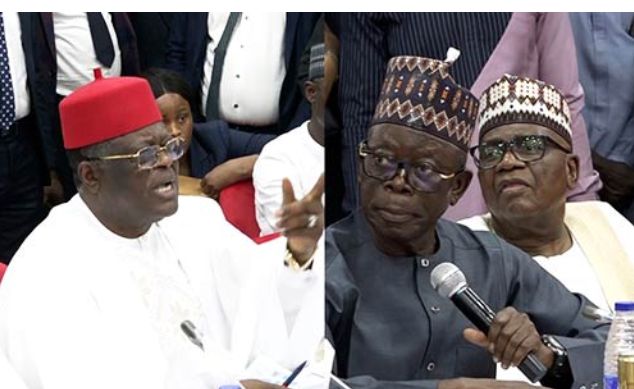
Then came the Works Ministry session. A proposed N3.4 trillion budget. Over N2.2 trillion allegedly owed to contractors. Only 9% of the previous capital allocation released. That alone should have commanded a sober, forensic interrogation.
Instead, the focus drifted to whether a major road contract can be reassigned from Julius Berger to Mikano (known for generators). Whether the work was substandard. Whether the Minister would resign if it was. And then lawmakers turned on themselves!
Here’s the problem: Nigerians are not interested in theatrics. They are interested in roads that don’t swallow cars. They are interested in steel plants that actually produce steel. They are interested in budgets that translate into bridges, power, and jobs.
The Senate Committee on Finance has reportedly suspended consideration of the 2026–2028 fiscal framework pending detailed performance reports for 2024 and 2025. That move, quiet as it may seem, is more powerful than any shouting match. That is institutional pushback. That is the legislature saying: “Before we approve new numbers, show us what you did with the old ones.”
Oversight is not about humiliation. It is not about ego or age. It is not about who can shout louder. It is about stewardship of public funds. Ministers must understand that scrutiny is not an attack. When you accept a ministerial portfolio, you accept interrogation. You accept uncomfortable questions. You accept suspicion. It comes with the office. Oversight is not disrespect; it is democracy breathing.
At the same time, lawmakers must remember that power exercised without decorum weakens the institution they are sworn to protect. Silly interruptions, personal jabs, procedural ambushes are not needed.
If the National Assembly takes this task seriously and sincerely, history will record these sessions not as viral clips but as moments of institutional strengthening. And if ministers submit themselves calmly to scrutiny, armed with data rather than defensiveness, public trust will grow.
Ward Rounds
Rivers State Cabinet Dissolution
Governor Siminalayi Fubara has dissolved the Rivers State Executive Council, directing commissioners to hand over to permanent secretaries. On paper, it looks administrative. In context, it feels political. This comes after a so-called peace brokered by President Tinubu, yet tensions remain thick between Fubara and loyalists of his predecessor, now FCT Minister, Nyesom Wike.
Must incumbent and former governors in Rivers State always be at each other’s throats? Governance is not a sequel to a political rivalry. Rivers people deserve stability, not endless power chess. Na wa o.
El-Rufai Airport Confrontation
Former Kaduna Governor Nasir El-Rufai says security agents attempted to arrest him and seize his passport upon arrival from Egypt, describing it as executive overreach. Power jam power, as they say. When former powerholders experience state pressure, the conversation suddenly shifts to civil liberties – the ones they didn’t uphold in power.
If the state has grounds, it must act lawfully and transparently. If it doesn’t, intimidation only deepens distrust. Nigeria must indeed outgrow executive overreach, whoever is in office.
2027 Election Budget
INEC is proposing N873.8 billion for the 2027 general elections. Elections are expensive: logistics, technology, security, personnel. Democracy costs money. But trust? That costs even more.
After 2023, what Nigerians need in 2027 is not just funding, but credibility. INEC must spend wisely, communicate clearly, and deliver transparently. Let’s just hope that beyond the figures lies reform, transparency, and technical competence. Nigerians are not just funding an election; they are investing in trust and confidence can be rebuilt.
Electoral Act Amendment
After public pressure and protests, the Senate has adopted a dual-mode transmission of results: electronic and manual, for 2027. Did we need all these dramas before arriving here?
Electoral reforms should not require public outrage to move forward. If technology can strengthen integrity, it should be embraced deliberately, not reluctantly.
Lagos Demolitions
Residents of Makoko continue to protest demolitions tied to urban renewal. I do not claim full knowledge of the facts here. But displacement, anywhere, demands compassion.
Urban planning must prioritize safety and legality, yes. But it must also prioritize humanity. If people are uprooted, support structures must follow. Safety first, but dignity too.