







Nigeria on Tuesday laid to rest one of its most influential leaders, former President Muhammadu Buhari, in a solemn state funeral that drew together the country’s political elite, military top brass, global dignitaries, and citizens mourning a man many saw as a pillar of discipline, simplicity, and nationalism.
President Bola Ahmed Tinubu and Vice President Kashim Shettima led a high-powered federal delegation to Daura, Buhari’s hometown, where the former military ruler and two-term civilian president was buried following Islamic rites.
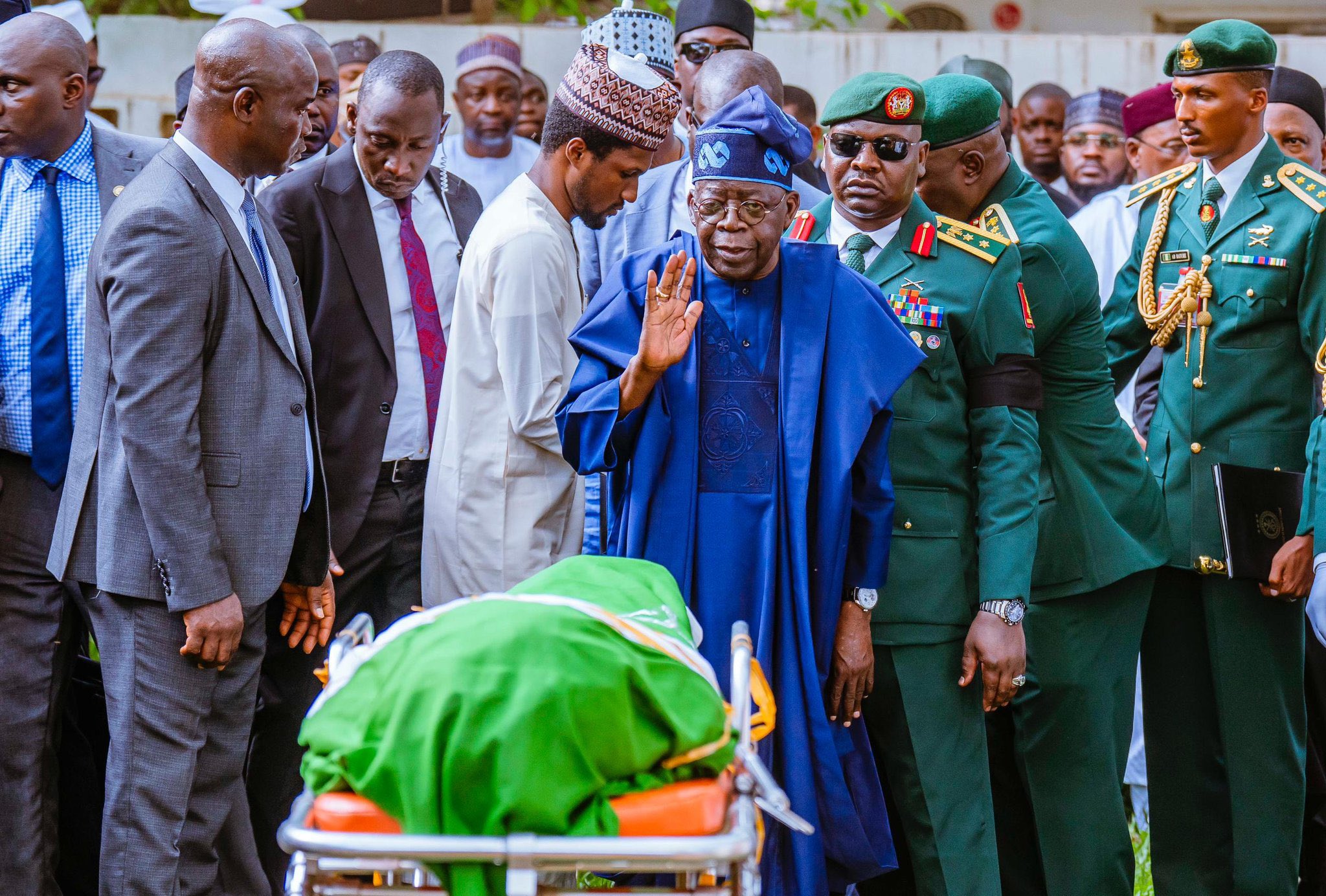
Buhari died on Sunday, July 13, at the age of 82 in a London hospital. His body was flown into the Umaru Musa Yar’Adua International Airport, Katsina, aboard the Presidential Aircraft, symbolically the same jet he used during his presidency. President Tinubu was present at the airport to personally receive the flag-draped coffin at 1:51 p.m., following his own arrival from Abuja minutes earlier.
The state burial, conducted by Chief Imam of Daura, Sheikh Salisu Rabiu, took place at the PMB Helicopter Ground, drawing mourners from all walks of life. The casket, carried by a nine-man team of senior military officers, was wheeled in a slow, dignified procession as a military band played the hymn “God Be With You Till We Meet Again.”
Among the international dignitaries in attendance were Guinea-Bissau President Umaro Sissoco Embaló, Niger Republic Prime Minister Ali Zeine, and former Nigerien President Issoufou Mahamadou. From Nigeria, the lineup of attendees included former Vice Presidents Yemi Osinbajo and Atiku Abubakar, Senate President Godswill Akpabio, Speaker of the House Tajudeen Abbas, and over a dozen state governors.
Traditional rulers, including the Emirs of Katsina, Daura, and Kano, also paid their respects, as did private sector leaders such as Aliko Dangote, Sayyu Dantata, and Dahiru Mangal.
The Katsina airport saw an unprecedented 130 aircraft movements in 48 hours, according to the Nigerian Airspace Management Agency, reflecting the national scale of the loss.
President Tinubu, joined by Buhari’s widow Aisha and family members, accompanied the coffin on a one-hour road trip to Daura. There, prayers were held and the former president was interred at his residence at 5:50 p.m., concluding a full military funeral that included a 21-gun salute.
As condolences continued to stream in, Buhari’s former appointees and close associates remembered him as a leader defined by integrity, humility, and service to country over self.
Dr. Rabi’atu Aliyu, former Minister of State for the Federal Capital Territory, called Buhari “honest, resilient, and tolerant,” saying, “I feel this loss deeply, as if I just lost my own father… He was detribalised and appointed people based on merit.”
Sadiya Farouq, former Minister of Humanitarian Affairs, described the late president as “a father, a patriot, and a nationalist” who upheld discipline and believed in opportunity for all. “We have lost a pillar, especially for the poor and vulnerable,” she said.
Pauline Tallen, ex-Minister of Women Affairs, said Buhari “embodied humility and simplicity,” adding, “Look at his life ,he held some of the highest offices, yet lived modestly.”
Former Minister of Transportation Rotimi Amaechi called Buhari’s death “a personal loss,” describing him as “principled, disciplined, and selfless.”
Dr. Aliyu Audu, ex-Senior Special Assistant on Public Affairs, summed up the sentiment: “Buhari was a bright star of Nigeria who served with deep commitment. We are gathered in his humble home because he lived a truly humble life.”
The Presidential Committee will continue with a weeklong schedule of condolence visits and memorial activities to honor the legacy of a leader whose impact, both revered and debated, remains deeply etched in Nigeria’s political history.
President Buhari served as Nigeria’s Head of State from 1983 to 1985 and returned as a democratically elected leader in 2015, completing two terms before handing over to President Tinubu in 2023. His funeral marked the end of an era one that is marked by austere leadership, anti-corruption crusades, and a steadfast belief in the unity of Nigeria.