








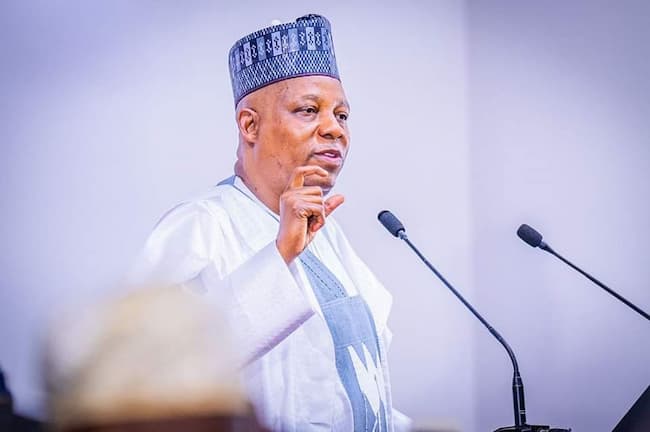
Vice President Kashim Shettima has declared that Nigeria is ready to lead a continental shift toward sustainable growth through a framework of impact, inclusion, and investment. Speaking on Wednesday, January 28, 2026, at the Africa Social Impact Summit (ASIS) in Abuja, Shettima argued that development should no longer be framed as “expenditure” but as a strategic investment in human capital.
He criticized the long-standing reliance on foreign aid and loans, advocating instead for “strategic capitalism” driven by patient capital and private enterprise. The Vice President emphasized that while the Tinubu administration has initiated significant reforms, no government can finance Africa’s development agenda alone, necessitating a “co-investment” model with the private sector.
As part of this vision, the Federal Government officially launched two flagship initiatives: the Business Coalition for Education (BCE) and the Women and Youth Financial and Economic Inclusion (WYFEI) platform. These programs are designed to address foundational literacy and numeracy while providing a performance-based accountability framework for economic empowerment.
Shettima noted that these initiatives are not merely social obligations but industrial value chains that strengthen national resilience. By positioning Nigeria as the primary implementation platform for the African Union’s WYFEI program, the administration aims to create a scalable model for inclusive growth across the continent.
The Vice President’s remarks in Abuja follow a high-profile week at the World Economic Forum (WEF) in Davos, where he inaugurated the first-ever “Nigeria House.” During the global summit, Shettima highlighted that Nigeria’s economy expanded by 3.9 percent in 2025, its fastest pace in a decade, fueled by a non-oil sector that now accounts for 96 percent of the GDP.
He invited the global business community to shift their perception of Africa from a place of “handouts” to a hub of innovation and domestic productive capacity. With the Dangote Refinery positioning Nigeria as a net exporter of fuel, Shettima insisted that Africa’s rise must be “homegrown and earned” rather than “parachuted in” from the outside.


 in Abuja, Shettima argued that development should no longer be framed as "expenditure" but as a strategic investment in human capital.)