






By Emmanuella Opara | November 10th 2026
KEY POINTS
- Türkiye plans to establish defence production facilities and military training centres in Nigeria as part of efforts to deepen bilateral security cooperation.
- The two countries are targeting $5bn in annual bilateral trade, up from the current $2bn.
- About 200 Nigerian special forces personnel are undergoing a two-month training programme in Türkiye.
- Turkish investments in Nigeria remain below $1bn, despite exceeding $10bn across Africa.
MAIN STORY
Türkiye is planning to establish defence production facilities and military training centres in Nigeria as both countries seek to strengthen security cooperation and raise bilateral trade to $5bn from its current level of approximately $2bn.
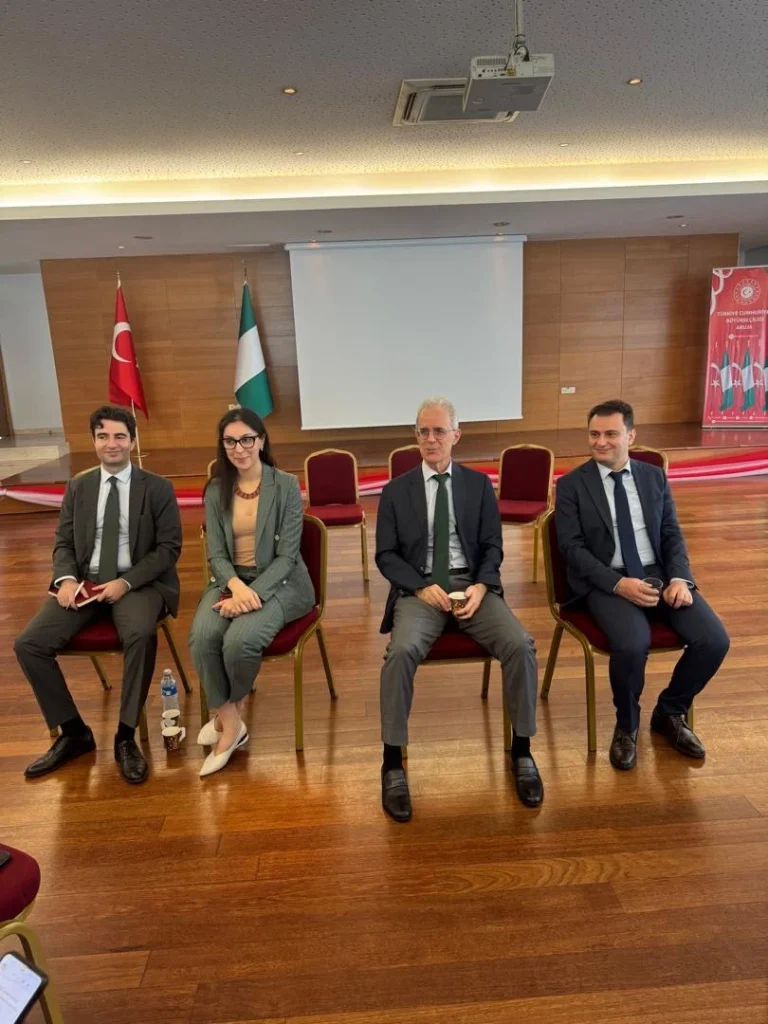
The Turkish Ambassador to Nigeria, Mehmet Poroy, disclosed the plans in Abuja on Monday during a briefing to mark 66 years of diplomatic relations between the two countries.
Poroy said the proposed facilities would enable Türkiye to support Nigeria’s local defence manufacturing capacity rather than limit its involvement to supplying military equipment.
The initiative forms part of efforts to implement agreements reached during President Bola Tinubu’s visit to Türkiye earlier in 2026. The visit, attended by nine Nigerian ministers, resulted in the signing of nine agreements and memoranda of understanding.
The ambassador said discussions were ongoing on establishing local production units to manufacture some of the equipment required by Nigeria.
On military training, Poroy disclosed that 200 Nigerian special forces personnel were completing a two-month training programme in Türkiye, while plans were being developed to establish a training centre in Nigeria.
He said the proposed arrangement would allow Turkish military officers to provide continuous training to Nigerian troops locally, reducing the need to send all personnel abroad.
Poroy also expressed his country’s willingness to share its experience in combating terrorism, citing the more than 40,000 lives lost in Türkiye’s 40-year fight against the menace and the billions of dollars spent tackling it.
He said counterterrorism required a broader approach that addressed economic and religious factors alongside military operations.
The ambassador noted that Nigeria’s military was already deploying Turkish attack helicopters and drones in operations against insecurity, particularly in the northern part of the country.
Beyond defence, the two countries are seeking to expand commercial relations, with a target of increasing bilateral trade to $5bn from approximately $2bn, including oil and gas transactions.
Poroy said the existing trade volume did not adequately reflect Nigeria’s economic potential, particularly when compared with Türkiye’s total trade with African countries, estimated at about $37bn.
He also disclosed that Turkish investments across Africa had exceeded $10bn, while investments in Nigeria remained below $1bn.
To improve the figures, the ambassador said he had engaged the Abuja Chamber of Commerce and Industry alongside the Turkish Commercial Counsellor to explore opportunities for increased trade and investment. Similar discussions had also taken place with chambers of commerce in Kano, Kaduna and Lagos.
The Turkish Embassy is also facilitating visa procedures for Nigerian businesspeople to encourage direct engagement between companies in both countries.
Poroy said stronger business-to-business relationships were necessary to expand commercial activities and achieve the bilateral trade target.
On humanitarian cooperation, he disclosed that the Turkish Government had provided food assistance to 3,000 internally displaced families in Adamawa State.
He added that Turkish non-governmental organisations, including the Turkish Religious Affairs Foundation, spent approximately $5m on humanitarian interventions in Nigeria over the previous year, particularly food distribution during Ramadan and Eid-el-Adha.
The ambassador said Türkiye intended to sustain its humanitarian activities and was considering a more structured arrangement with Nigerian authorities to improve coordination.
He also highlighted the historical relationship between the two countries, tracing diplomatic contacts to the 16th century, when the Ottoman Empire maintained correspondence with the Kanem-Borno Sultanate.
Poroy said November 9, 1960, marked the establishment of diplomatic relations at ambassadorial level, following Nigeria’s independence. Türkiye had opened a Consulate-General in Lagos in April 1959, while its first ambassador to Nigeria arrived in 1962.
He described Nigeria as a strategic partner in efforts to promote security, stability and economic development in West Africa and across the continent.
THE ISSUES
The proposed defence factories could create opportunities for local manufacturing and technology transfer, although the ambassador’s announcement did not specify the investment value, production capacity or implementation timeline.
The trade target also highlights the gap between the economic potential of both countries and their current commercial relationship. With bilateral trade at approximately $2bn, reaching $5bn would require stronger investment flows, increased private-sector participation and expanded business partnerships.
The disparity between Türkiye’s investments across Africa and its relatively limited presence in Nigeria also points to an opportunity to attract more Turkish businesses into the Nigerian market.
WHAT’S BEING SAID
“We are planning to have some local production unit also in that context, not only selling to Nigeria, the tools, equipment, that arms that it needs, but also the possibility of having local production here in Nigeria,” Mehmet Poroy, Turkish Ambassador to Nigeria, said.
WHAT’S NEXT
The immediate steps include ongoing consultations on local defence production and the proposed military training centre. Both countries are also expected to pursue stronger private-sector engagement and investment partnerships as they work towards the $5bn trade target.
BOTTOM LINE
Türkiye’s plans to establish defence production and training facilities in Nigeria signal an expansion of its relationship with the country beyond military equipment supplies. However, achieving the broader $5bn trade ambition will depend on translating diplomatic agreements into concrete investments and commercial activities.