










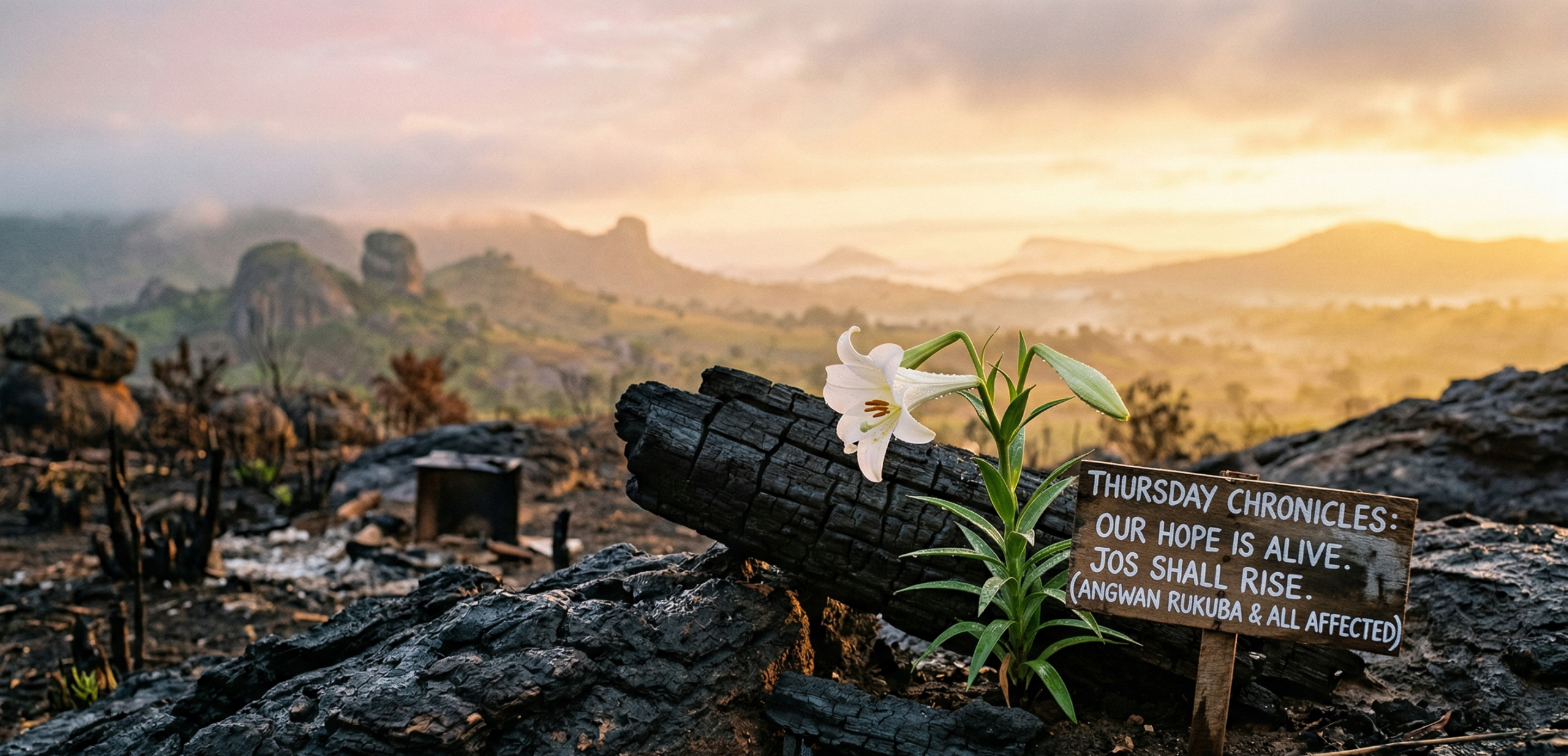
Hello, my Resilient People. Welcome back to the Chronicles. Today, the “ginger” we usually share is tempered by a deep, familiar ache. As we prepare for the Easter long weekend, Good Friday (April 3) and Easter Monday (April 6, 2026), our hearts are heavy. We aren’t talking about the danfo drama or the latest viral dance today. Instead, we are turning our eyes toward the North—specifically toward Jos, Plateau State.
The “Home of Peace and Tourism” is once again a house of mourning. For our brothers and sisters on the Plateau, this “Holy Week” began not with the quiet reflection of Palm Sunday, but with the scent of smoke and the sound of footsteps at midnight. Pull up a chair; we need to have a heart-to-heart about the cost of peace, the failure of security, and the weight of our shared humanity.
Jos is arguably one of the most beautiful places in Nigeria. Its rolling hills and cool breeze should be a sanctuary. But for decades, it has been haunted by a recurring nightmare. The recent violence that erupted on Palm Sunday, March 29, 2026, in the Angwan Rukuba community of Jos North, isn’t just a “news headline” to the people living there; it’s a neighbor turned stranger and a community shattered.
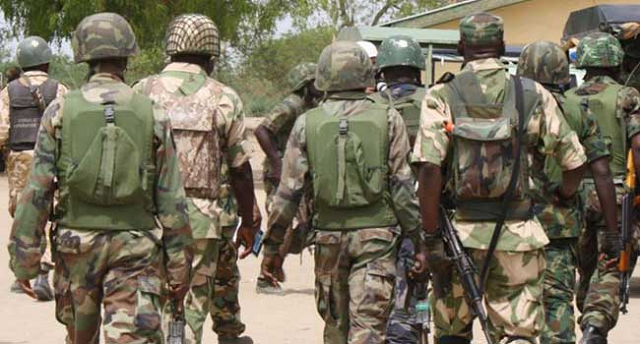
The tragedy of Jos is often reduced to a simple “Religious War” or an “Ethnic Clash” by outsiders looking for a quick soundbite. But for those on the ground, it is a complex, heartbreaking failure of Security. When an attack happens and the response is slow, a 48-hour curfew is imposed after the damage is already done. That vacuum is quickly filled by fear, and fear is the greatest recruiter for tribalism and religious extremism. Whether it is the recurring raids in Mangu or the bloodshed seen in Bokkos in the weeks leading up to this, the story remains the same: a cry for protection that seems to go unanswered.
We have to be honest with ourselves: Religion and Tribe in Nigeria have become weapons of mass distraction.
- The Tribalism Trap: We retreat into “My People” vs “Your People.” We forget that a mother’s grief over a lost child is exactly the same whether she speaks Berom, Fulani, or Hausa. Tribalism tells you your neighbor is your enemy, but your true common enemy is the poverty and insecurity that affects you both.
- The Religion Trap: We pray in the morning for peace and then use that same faith to justify hating someone who prays differently in the evening. God is not the author of these killings; men with agendas are.
While we are busy arguing about who “started it” or which tribe “owns” the land, the real culprits—the failure of intelligence and the absence of justice—go unpunished. The politician’s pen is often most active when it is drawing lines between us, making us forget that we all breathe the same air and bleed the same red.
Nigeria is currently in a unique spiritual window. We’ve just transitioned from the “Double Fasting” of Ramadan and Lent into the Easter Celebration. For Christians, Easter is the ultimate symbol of hope, the belief that life wins over death. But how do you preach “Life” to a family in Jos North whose world was turned upside down on Sunday? How do you celebrate a “Risen Savior” when your neighbor is being buried?
This is where our “National Character Audit” comes in. If we only mourn “our own,” we have already lost the war. Security shouldn’t be a luxury reserved for the “Big Men” in Abuja; it is a fundamental human right for every farmer in Mangu, every resident in Angwan Rukuba, and every student in Unijos. We cannot have a true holiday while a part of our country is in a state of mourning.
Key Take-Home Points for the Heart-Broken
- Grief has No Religion: When blood is spilled on the Plateau, it stains the entire Nigerian map. Let’s stop “ranking” tragedies based on the victim’s faith. A life is a life, and every soul lost is a hole in our national fabric.
- Demand Intelligence, Not Just Infantry: A curfew after an attack is a reactive measure. We need proactive, intelligence-led security that stops the violence before it starts. Security is about prevention, not just management.
- Justice is the Only Foundation: Peace is not just the absence of war; it is the presence of justice. Until perpetrators—regardless of their tribe or status—are caught and prosecuted openly, the cycle of “revenge” and retaliation will never end.
- Accountability Over Alibis: Stop accepting “unknown gunmen” as an explanation. We must demand that our leaders provide real protection and real answers.
Lessons to Carry into the Easter Feast
- Be a Bridge-Builder: In your small corner, speak against hate speech. Don’t share that “broadcast” or tweet that generalizes a whole tribe or religion as “evil.” Use the holiday to reach across the fence.
- Support the Displaced: There are thousands of families in Internally Displaced Persons (IDP) camps and displaced within Jos right now. If you have extra this Easter, find a way to support NGOs providing food and blankets. Hope is more believable when it comes with a meal.
- The Power of Presence: If you have friends or colleagues from the affected areas, call them. Don’t just send a generic “Happy Easter” graphic. Ask them: “How are you really doing? Is your family safe?”
- Celebrate with Purpose: Let your joy be a defiance against the darkness. We celebrate not because the world is perfect, but because we believe it must be better.
As we wrap up this somber edition, I want to speak to our brothers and sisters in Jos: You are not forgotten. We feel the weight of your silence and the heat of your tears. To the rest of Nigeria: Let’s stop letting “Religion” and “Tribe” be the fence that keeps us from being human. We are a people of the same soil.
See you next Thursday—hopefully with a report of a quiet, peaceful, and truly restorative holiday for every Nigerian.









 and Easter Monday (April 6, 2026), our hearts are heavy. We aren’t talking about the danfo drama or the latest viral dance today. Instead, we are turning our eyes toward the North—specifically toward Jos, Plateau State.)