






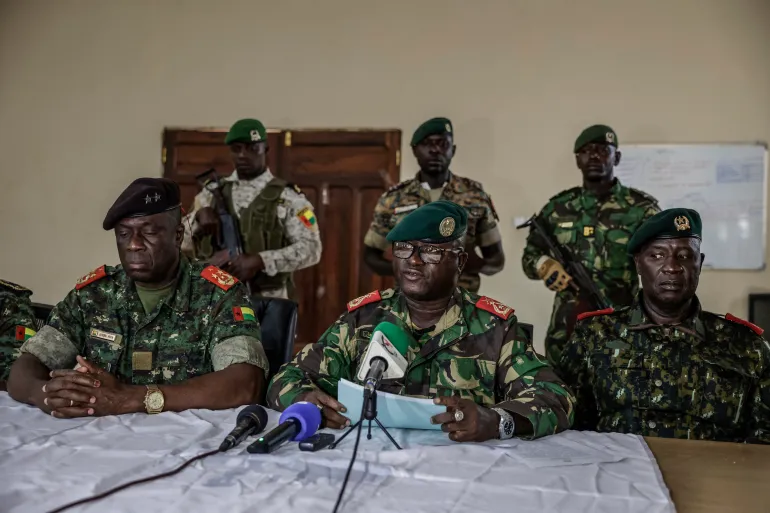
Soldiers in Guinea-Bissau say they have taken control of the country and detained President Umaro Sissoco Embaló following gunfire in the capital, Bissau.
Government sources told the BBC that the president was arrested shortly after shots were heard near the presidential palace on Wednesday afternoon.
The military officers appeared on state television to announce that they had suspended the electoral process, closed national borders, and imposed a night-time curfew.
They alleged that unnamed politicians, backed by “a well-known drug baron,” were plotting to destabilise the country.
Background
Guinea-Bissau, located between Senegal and Guinea, has a long history of coups. Since independence from Portugal in 1974, the military has played an influential role, and the country has gained a reputation as a transit hub for cocaine trafficked from Latin America to Europe. The United Nations has previously described it as a “narco-state.”
Election Context
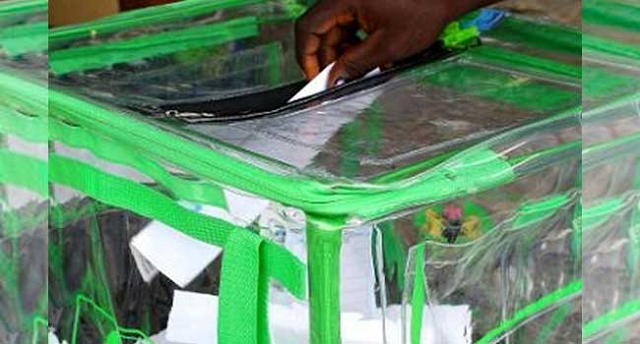
The country was awaiting the final results of Sunday’s presidential election, which were expected on Thursday. Both Embaló and his main rival, Fernando Dias, had claimed victory.
Dias is politically aligned with former Prime Minister Domingos Pereira, who was barred from contesting the election.
Developments After the Arrest
Before the military announcement, Embaló told France 24 by phone: “I have been deposed.”
Government sources later said Dias, Pereira, and Interior Minister Botché Candé had also been arrested. The coup leaders reportedly detained the army chief, Gen Biague Na Ntan, and his deputy, Gen Mamadou Touré.
General Denis N’Canha delivered the televised statement establishing a “High Military Command for the Restoration of Order” and urged residents to remain calm. Soldiers then set up checkpoints across Bissau.
Regional and International Reactions
Election observers from the African Union and Ecowas said they were “deeply concerned” by the coup announcement, noting that the voting process had been peaceful.
They said both leading candidates had earlier assured them they would accept the election results.
Portugal called for a swift return to constitutional order and urged all actors to avoid violence.
About President Embaló
Embaló, 53, was elected in 2019 and has previously claimed to have survived several coup attempts. Opposition parties argued that his mandate legally ended in February 2025, after he initially said he would not seek re-election.
Guinea-Bissau remains one of the poorest countries in the world, with a population of about two million and large uninhabited islands along its coast, often exploited by drug traffickers.