



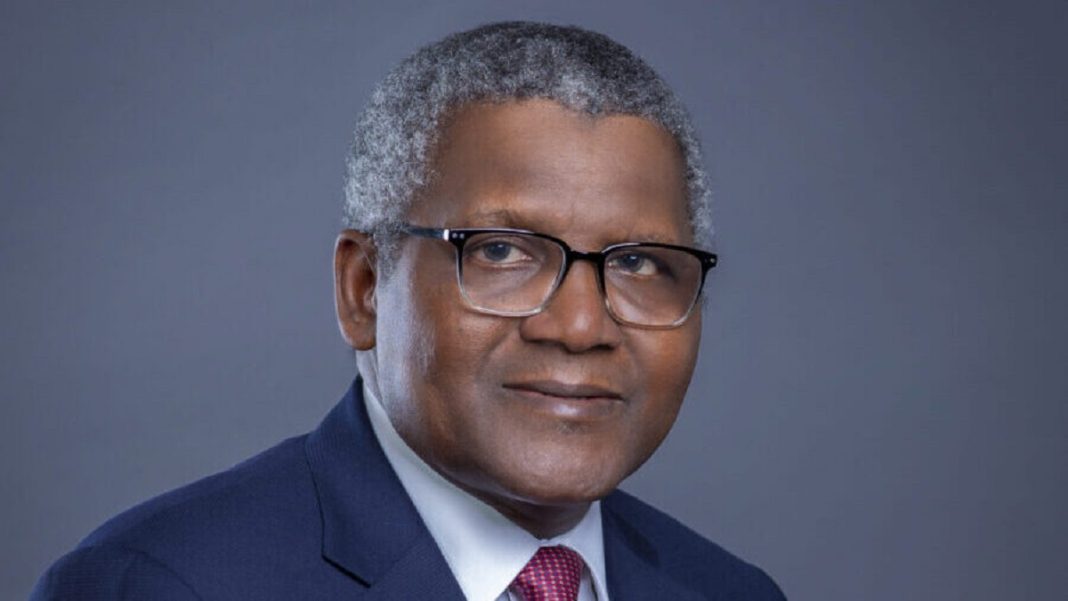
President of the Dangote Group, Aliko Dangote, has disclosed that Nigerians currently pay 55 per cent less for Premium Motor Spirit (PMS) compared to their West African neighbours, thanks to local refining by the Dangote Petroleum Refinery.
Speaking during a high-profile visit by the President of the Economic Community of West African States (ECOWAS) Commission, Dr Omar Touray, Dangote said the 650,000 barrels-per-day refinery is already playing a transformative role in stabilising fuel prices, boosting industrial productivity, and supporting Nigeria’s energy security.
“Neighbouring countries pay an average of $1 per litre, which is about ₦1,600, but here in Nigeria, we are selling at between ₦815 and ₦820 per litre, Many Nigerians are unaware that they are currently paying just over half of what is obtainable in the region.” Dangote stated.
The business magnate noted that since the refinery began diesel production last year, prices dropped significantly from ₦1,700 to ₦1,100 per litre, bringing broad economic relief to sectors such as mining, manufacturing, and agriculture.
“This price reduction has had a cascading effect. It has helped industries, sustained agricultural activity, and supported job creation. This is what local refining can achieve,” he said.
Dangote reiterated that the refinery, the world’s largest single-train facility, is equipped to meet not only Nigeria’s fuel needs but also those of the entire West African sub-region. He debunked claims that the refinery could not meet local demand, stressing that the ECOWAS delegation’s visit was an eye-opener.
“Some said we couldn’t even meet Nigeria’s domestic requirements. But today, ECOWAS officials have seen the scale, capacity, and global standard of this refinery. Their presence here will hopefully inspire other countries to initiate similar large-scale industrial projects,” he noted.
He added that the success of the refinery represents a broader vision for economic self-reliance across the continent. “As long as we keep importing what we can produce, Africa will remain underdeveloped. This project proves we can produce for ourselves at scale and to international standards,” he said.
Dangote also revealed that a major development initiative is in the pipeline, promising further benefits for Nigerians. “This refinery was built for the people of Nigeria, and we want them to enjoy the maximum benefit,” he said.
In his remarks, ECOWAS Commission President Dr Omar Touray lauded the refinery as a symbol of hope and possibility for the continent, describing it as “a clear demonstration of what Africa’s private sector can achieve.”
“What I have seen today gives me renewed hope for Africa. If anyone doubts the potential of this continent, they should come here. This refinery is what we need—African solutions to African challenges,” Touray said.
He applauded the refinery’s adherence to Euro V standards, noting that many imported fuels in West Africa fall below this benchmark, contributing to environmental and public health risks.
“We’re still importing sub-standard fuels while a regional facility like Dangote’s exceeds our sulphur limits. This is why the private sector must take the lead in our industrialisation efforts,” he stated.
Touray called for stronger engagement between governments and private sector players to ensure that regional policies reflect on-the-ground realities. “We must stop making decisions on behalf of the private sector from a distance. This visit gives us the insight we need to create an enabling environment for industrial growth,” he said.
He pledged ECOWAS’s full support for the Dangote Group’s regional expansion and urged other African countries to emulate Nigeria’s infrastructure investments.
“Let us build for the continent, not just for individual nations. I congratulate the Dangote Group and commit that ECOWAS will help open access to the wider regional market and hopefully, the entire African continent,” Touray said.
The ECOWAS delegation included Commissioner for Infrastructure, Energy and Digitalisation, Sediko Douka; Commissioner for Internal Services, Prof. Nazifi Darma; Director of Private Sector/SME, Dr Tony Elumelu; and Chief of Staff to the ECOWAS President, Abdou Kolley.