The Nigerian Defence Academy (NDA) says it is investigating a video that has gone viral on the internet showing some military cadets beating a young man for allegedly complimenting a female cadet.
A statement issued on Thursday by the academy’s spokesman, Musa Yahaya, said that preliminary investigation into the matter has confirmed that the incident occurred somewhere in Lagos in 2014 while the cadets were on break.
The statement noted that the NDA, being a responsible institution that is saddled with the task of producing the nation’s future military leaders would not in anyway, tolerate such unruly and flagrant mistreatment of Nigerians.
It further explained that the current leadership of the academy would ensure that the matter is thoroughly investigated and disciplinary loopholes addressed.
The Federal Inland Revenue Service (FIRS) has begun a tax audit of the Nigerian National Petroleum Corporation (NNPC) in its bid to ascertain and remit all tax revenues due to the government into the Federation Account.
This was disclosed by the Executive Chairman, FIRS, Mr. Babatunde Fowler, who said the audit was being carried out as part of measures aimed at boosting tax revenue in the 2016 fiscal period.
Fowler revealed that the FIRS had received approval from the Minister of Finance, Mrs. Kemi Adeosun, to begin a joint audit of all Ministries, Departments and Agencies of the government.
He said the need for the joint audit arose owing to the fact that the arrangement where government agencies were to deduct Withholding Tax and Value Added Tax from contractors and remit same to the Federation Account had not yielded the desired results, adding that all banks operating in the country must ensure that all tax revenues of government were remitted to the Federation Account.
The FIRS boss expressed optimism that with the new measures put in place by the agency, the country would from March begin to see an increase in the level of compliance by the MDAs on Withholding Tax and VAT. He commended the FIRS for rising up to the challenge of funding the budget through tax revenue as a result of the decline in oil revenue.
He, however, drew the attention of the FIRS to queries raised by the Office of the Accountant-General of the Federation about the non-disclosure of the four per cent cost of collection in the agency’s statement of accounts.
Ogun Unveils OLARMS Portal For Land Sales, Registration
The Ogun State Government has begun a new ‘Welfare Insurance Policy’ aimed at creating opportunities for its workers to save for the rainy day, and has encouraged transport unions operating in the state to embrace the new development.
The General Manager of the Ogun State Parks and Garages Development Board, Alhaji Ayo Ogunsolu, advised in Abeokuta, during a one-day workshop organised in collaboration with Capital Express Assurance Limited.
Ogunsolu, who was represented by the Director of Administration and Supplies, Mr. Lola Sotola, said the insurance policy was essential as it created an avenue for them to receive instant response in times of need, adding that it was an opportunity to save for the future.
According to the National Head of Marketing, Capital Express Assurance Limited, Mr. Mathew Ogwezhi, interested clients would pay N60 on a daily basis. He said the money would enable the company to insure their clients against circumstances beyond their control.
The Ogun State Police Public Relations Officer, DSP Olumuyiwa Adejobi, said the Welfare Insurance Policy was a step in the right direction.
He advised transport unions in the state to eject unscrupulous elements in their midst, adding that commercial motorcyclists who were fond of wearing earrings and dreadlocks, posed threats to the security of the state.
Coscharis Group Limited – We are a reputable conglomerate with strong presence in automobile (having franchise of premium cars/vehicles) and with business interests in other major sectors of the economy and recently, we have ventured into commercial agriculture
We seek creative, talented and result-oriented individuals who are focused and career minded. At Coscharis group, you will have endless possibilities of receiving technical, products and sales training(Locally and Abroad), career development and rewards for your contributions to the company’s growth.
Due to continuous growth in our businesses, we are looking for qualified, result oriented, dynamic and energetic professionals to fill the following positions listed below:
St. Nicholas Hospital is a multi-specialist private hospital located in the heart of Lagos, Nigeria. It was founded in 1968 by the chairman Chief Dr M.A Majekodunmi. Over the years it has grown to become one of Nigeria’s leading hospitals, providing reliable, effective and high quality healthcare for all patients. St. Nicholas hospital has achieved this by attracting highly trained doctors, nurses and support staff and investing in state-of-the art equipment and laboratory services.
Applications are invited from suitably qualified candidates for the following vacant positions:
British American Tobacco (www.bat.com) is a market leading, global organisation with a long, established history and a bright and dynamic future. Thanks to our people we have continued to deliver growth and exceed expectations in an increasingly complex and challenging marketplace.
Our aim is to become the leading tobacco company in each of our markets by providing excellent products with confidence and responsibility expected of global consumer brands.
If you have the talent and motivation to help us succeed you’ll find we are equally committed to helping you reach your full potential too.
We are recruiting to fill the following vacant positions below:
Federal Ministry of Industry, Trade and Investment – The Government of Nigeria has emphasized the importance of diversifying the economy, supporting sectors that have potential for growth and creating massive employment. In line with this commitment, the Government has sought and received Credit from the World Bank to help Nigeria support Micro, Small and Medium Enterprises (MSME) operating in different high potential sectors throughout the country. This support is being implemented under the Federal Ministry of Industry, Trade and Investment (FMIT&I) and operationalized in the Growth and Employment (GEM) Project.
The GEM Project Development Objective is to increase firm growth and employment in participating firms in Nigeria. The project became effective in July 2013, and will close in September 2018. The project focuses on manufacturing and service sectors, specifically supporting ICT, entertainment, tourism and hospitality, light in manufacturing and construction. Project support addresses crosscutting sector issues, assistance to specific clusters, and more direct support to firms channeled through a platform – called the Business Innovation and Growth (BIG) Platform providing various trainings, technical assistance and grant schemes. The GEM Project intends to apply part of the proceeds of this credit to payments for consulting services.
The consulting services (‘the Services’) include implementation support to the project as regards to the daily management and coordination of all activities on the BIG Platform.
The GEM Project of FMIT&I now invites eligible individual consultants to indicate their interest for the following positions below:
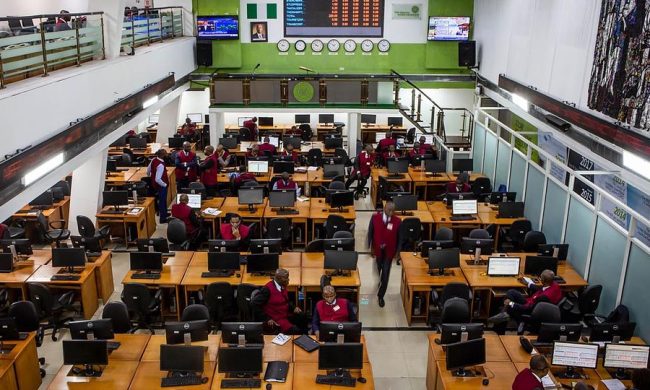
Statistics from the Nigerian Stock Exchange, NSE, showed on Thursday, February 4, that the stock market lost more than N1.63 trillion in January due to profit-taking and currency volatility
The News Agency of Nigeria (NAN) reported that the drop represented a 16.50 per cent to close at N8.225 trillion from the N9.850 trillion in December.
Also, the All-Share Index dropped by 4726.10 points or 16.50 per cent to close for the month at 23,916.15 against 28,642.25 posted in December.
The volume of shares traded also declined by 5.67 billion shares worth N42.05 billion traded in 67,479 deals from the 7.23 billion shares valued N55.28 billion transacted in 53,414 deals in December.
The decline represented 21.58 per cent.
The financial services sector remained the toast of investors during the period, accounting for 3.87 billion shares worth N16.93 billion traded in 27,065 deals.
The Asset Management Corporation of Nigeria, AMCON, has listed Capital Oil and Gas Industries Limited, Seawolf, the defunct Bellview Airlines, Resort International Limited, Timbuktu Media (owner of the defunct Next Newspaper), former Chairman of the National Population Commission (NPC), Chief Festus Odimegwu, and 214 other firms, their respective directors, and individuals with outstanding debts of N1.146 trillion that have failed to visit the corporation for the resolution of their debts.
The corporation revealed this in a list of outstanding obligors made public on Thursday, February 4.
While AMCON put the outstanding debt of Seawolf at N160.09 billion, it listed Uwamu Adolor, Okunlola Remi, Rasheed Mahey Rafindadi, Wessels Alwyn, Odulami Remi, Waziri Ibrahim Dahiru and Oduntan Adetunji, as directors of the company.
Also, the list showed that Capital Oil, which is indebted to the corporation to the tune of N104.8 billion, has Mr. Ubah Ifeanyi Patrick, Ubah Uchenna, Ubah Chidera Graciuos, Orji Joseph Anayo, Chigbogu Fidelia Ezinwanne, Awodein Ayodeji Tolulope, Usoro Nsikan Anthony, and Akerele Oyinlade Mercy, as its directors.
Directors of Resort International include Mr. Wale Babalakin (SAN), who has a N132 billion judgment debt against the federal government, and a court ruling ordering AMCON to offset his indebtedness to it against the judgment debt.
Other directors of Resort International are Akinsanya Olayinka, Layonu Abiodun, Akibambi Temitayo Kola, Spectra Limited and Adewunmi Abiola. AMCON listed Resort as being indebted to the tune of N36.30 billion.
Other firms on the debtor list include Tanzila Petroluem Limited – N49.2 billion; Home Trust Savings – N25.749 billion; Suru Worldwide Ventures – N24.41 billion; Roygate Properties – N23.261 billion; Ziklagsis Network Limited – N20.334 billion; Lexcap Partners – N18 billion.
Similarly, AMCON also listed Anyiam Osigwe Limited – N17.247 billion; Iorna Global Resources Limited – N15.873 billion; Hosanna Properties Limited – N14.983 billion; Unudike Enterprises Limited – N14.16 billion; Bulk Pack Services Limited – N13.493 billion; Global Haulage Resources Limited – N11.472 billion; Taka Continental Limited -N11.378 billion; JAG Global Resources Limited – N11.108 billion; Felshade International Nigeria – N10.979 billion; AFRIJET Airlines Limited – N10.886 billion; Hotel De Island (belonging to Sentor Buruji Kashamu and family) – N10.797 billion; and Petroleum Brokers Limited – N10.681 billion, on the long list of debtors.
According to the corporation, companies that have been listed are those that failed to respond to AMCON’s repeated calls for discussions on their repayment plans.
The Federal Government has discovered 23,306 ghost workers in the civil servants on its payroll.
It was learnt on Thursday, February 4, that a special team constituted by the Federal Government uncovered cases of multiple salary payments with the active connivance of civil servants and some banks.
They have reportedly been identified and marked down for thorough investigation, it was gathered.
Consequently, the government is said to have embarked on a process of investigating and removing civil servants already identified in the scam from its payroll, although unconfirmed reports also indicated that some of those affected have begun to resign their appointments as a pre-emptive measure against humiliation at the end of the investigation.
Another source said out of the 312,306 civil servants whose bank accounts have so far been checked through the Bank Verification Number (BVN) platform, “23,306 individuals have issues with their accounts.
“With the adoption of the BVN for salary payment, the Federal Ministry of Finance has so far checked the details of about 312,000 civil servants,” a development said to have led to the discovery of a high level of irregularities in salary payment.
He explained further: “Out of the accounts of about 312,000 civil servants processed so far, the ministry has uncovered irregularities in the account of about 23,306 civil servants. They are suspected to have been collecting double salaries.
“These individuals are in two categories. In the first group, we found out that the names of some civil servants, whose salaries are being processed, are different from the names on the accounts where their salaries are paid. What this means is either those in this category are drawing salary from two sources (which could be different parastatals), or they are ghost workers.”
Minister of Agriculture, Audu Ogbeh, on Thursday, February 4, stated that Nigerians were at the risk of starving to death by 2050 if nothing is done to ensure all-year-round farming.
Ogbeh, who made this disclosure, when he defended the 2016 budget proposal of his ministry before the joint Committee on Agriculture, said the present mode of farming in Nigeris is incapable of sustaining increasing population in the country.
He said there is an urgent need for all stakeholders in the agricultural sector to work towards improving mechanised farming and irrigation in order to ensure all-year-round farming that will avert the problem.
“We have written to state governments to encourage them to develop dams and canals so that agriculture becomes an all-year-round activity and it is not confined to the rainy season alone.
“Four or five months of farm activity cannot sustain the country for 12 months.Besides, by 2050 Nigeria’s population will be very close to 500 million, going by the current rate of growth.
“This is just 34 years from now. If we carry on at the current rate of one crop per year and very low mechanisation, Nigeria runs a risk of starving to death,’’ he said.
Ogbeh also said the current crisis between herdsmen and rural farmers is a major setback for the agricultural sector in the country. He maintained that as part of its effort to tackle the problem, the ministry would develop paddocks to grow grasses and also develop boreholes and dams for cattle rearing across the hinterlands.
In this digital age, there’s never been a better time to be an entrepreneur in Nigeria. Google’s co-founder Sergey Brin said “Scarcity breeds clarity”. What he meant was that if and when times are tough businesses of all sizes need to maintain a start-up mentality – forcing people to think creatively and rise to the challenge when resources are scarce. Inventive and entrepreneurial people use challenging times to take risks, launch businesses and grow existing enterprises.
Our generation’s industrial revolution is digital and the Internet has broken down trade barriers so effectively that small businesses can now compete for new customers, from home. Even the smallest company can have national and even regional success, providing it has a good product or service that consumers, somewhere, will pay for. Entrepreneurs born during hard times will not be limited to selling products in their locality, but can expand quickly and with smaller risk. The Web has given entrepreneurs access to a live focus group which they can tap into to discover trends, build business plans and test their products cheaply. Whether you sell at a trade fair, or own a shop in Ikeja or sell goods online, it’s invaluable to know where and when there is demand for your product.
As recently as five years ago, SMEs and entrepreneurs would have had to invest in expensive market research to discover gaps in the market, but now the same research can be undertaken with a few clicks of a mouse. If you wanted to know which products to display in your shop window next Christmas, why not compare the volume of search interest in each product, using Insights for Search and discover the winning product? Or why not find out whether there is a bigger demand for your product in Abuja or Port Harcourt instead of risking money by launching it on a whim? Or set up a Facebook page or a Twitter account and canvass opinions for free.
Entrepreneurial mindsets are exploiting new business niches and are driving Nigeria’s economy. As such, we need to prepare the next generation of entrepreneurs to meet the challenges brought by the global nature of enterprise. We need to help them understand that their future competition in business may not come from their neighbouring store on the high street, or even a competitor in the same city or country, but from an equally talented entrepreneur in Nigeria, or India, or elsewhere.
So why not take a few minutes this week to think about how you can sharpen your entrepreneurial skills online and grow your business?
Here are a few steps that businesses can take to begin building their smartphone Internet strategies today:
Keep layout simple
Keep mobile Internet layout simple so mobile users can navigate easily on the small screen.
Use clear and concise headlines, keep scrolling simple (top to bottom) and make search easy for the user by ensuring that search boxes are visible and search results are clean and easily filtered.
Prioritise content
Make it easy for customers on-the-go to find content that is most relevant to their needs.
Select valuable content for users on-the-go and understand the limitations of the mobile attention span by providing an experience that is more transactional and action-oriented, rather than browsing based. Ensure that site navigation and load time is as fast as possible.
Use uniquely mobile features
Users can interact through touch, sound, sight, and location on their mobile device. Take advantage of this functionality to maximise user experience.
Offer users the most relevant information based on their location and leverage other functions on mobiles such as GPS, cameras and notepad. Building for feature phones is important, but smartphones allow for a rich user experience.
Design for thumbs, not mice
Remember that most smartphone users will be interacting with your website through a touch screen.
Design your site to prevent accidental clicks and avoid hover over menus. Distinctively coloured buttons and stand out conversion buttons should be larger and more prominent.
Make it easy to convert
Make it easy for users to convert on-the-go.
Shorten the conversion process by keeping forms concise and reducing unnecessary fields. Keep call to actions clear and make account access and log-in processes quick and easy. If you have sales people: remember a phone is a communication device. Utilising a click-to-call option is the best way to connect sales representatives to consumers looking for specific products and services.
We’re in the earliest chapters of mobile’s history. As the mobile web expands, the opportunities available for marketers to reach consumers and grow their businesses will increase as well. Businesses are boosting sales, brand-awareness, and purchase-intent through effective mobile campaigns. It’s not too late to be early to mobilise your business.
Guaranty Trust Bank Plc, GTBank, has invited holders of its $500 million 7.50 per cent Eurobond initially due by May 2016, to tender their securities for redemption by the bank from Thursday, February 4.
This is a part of efforts to assuage the fears expressed by international investors over its ability to redeem its Eurobond
A statement from the bank yesterday requested that investors in the debt instrument should tender any and all of their securities for purchase by the offer or for cash, on the terms of, and subject to the conditions contained in a tender offer memorandum dated February 4, 2016 .
The offer commenced yesterday and will end at the expiration deadline, according to the bank, stating that results of the offer are expected to be announced on or before February 11, 2016.
However, it pointed out that if the expiration deadline would be extended, an announcement to that effect would be made no later than 9a.m. (New York City time), on the next business day after the previously scheduled expiration deadline.
The bank however explained that through the offer, “it seeks to deploy its available United States dollar liquidity to the repurchase of the Securities ahead of the scheduled maturity in May 2016. This liability management exercise allows the bank to efficiently manage its liquidity by addressing in full debt maturing in 2016.
GTBank also stated that any securities purchased by the offeror would be surrendered for cancellation to the principal paying agent in respect of the securities.
Cummins Cogeneration Ltd, has signed a 300 MW Power Purchase Agreement, PPA, with Sapele Power Plc as part of its plans to build one of Africa’s largest gas-fired power plants.
This partnership is coming just weeks after the company announced the signing of a 300 MW investment in neighboring Beyin, Ghana.
The Chairman of the company, Deepak Khilnani, who spoke at the event, said: “We are excited about our partnership with Sapele Power Plc because we believe this synergy will birth strengths and capabilities that will deliver a clean and sustainable long-term energy solution for Nigerians.”
This project will be operated using Cummins Combined Heat and Power (CHP) lean burn gas generator sets which emit up to five times less nitrogen oxide than comparable diesel generator sets and near-zero particulate matter.
Currently, Sapele Power Plc operates Nigeria’s second largest power plant by an installed capacity of about 1020MW, capable of meeting the energy needs of around 750,000 homes at full capacity.
Upon this partnership, the plant will distribute electricity generated from the plant directly to Nigerian Bulk Electricity Trading Plc (NBET), supplying millions of homes and businesses with clean power.
Anthony Onoh, Chairman of Sapele Power Plc, who expressed delight on the signing of the agreement, said: “We know that Nigerians have high expectations from the privatized power sector and that is why the company, has a strong focus on sustainable power generation focused on capacity recovery from its existing asset, as well as expansion from a mix of projects which would double the plant installed capacity within the next three years.”
“The project will be split into two phases; the first phase is expected to be completed and exporting power by July 2016 and the second phase is forecast for commissioned by December 2017,” he added.
Upon completion, the project will supply approximately three billion kilo-watt-hours of electricity to the Nigerian grid per annum, which is approximately 10 per cent of total production today.
“We are innovatively rising to the challenge of improving performance at our generating station; as well as integrating more renewable energy into the grid.” Anthony further explained that talks with the U.S. EXIM Bank, the African Development Bank, and the African EXIM Bank about funding for the power generating plant expansion projects were on-going.
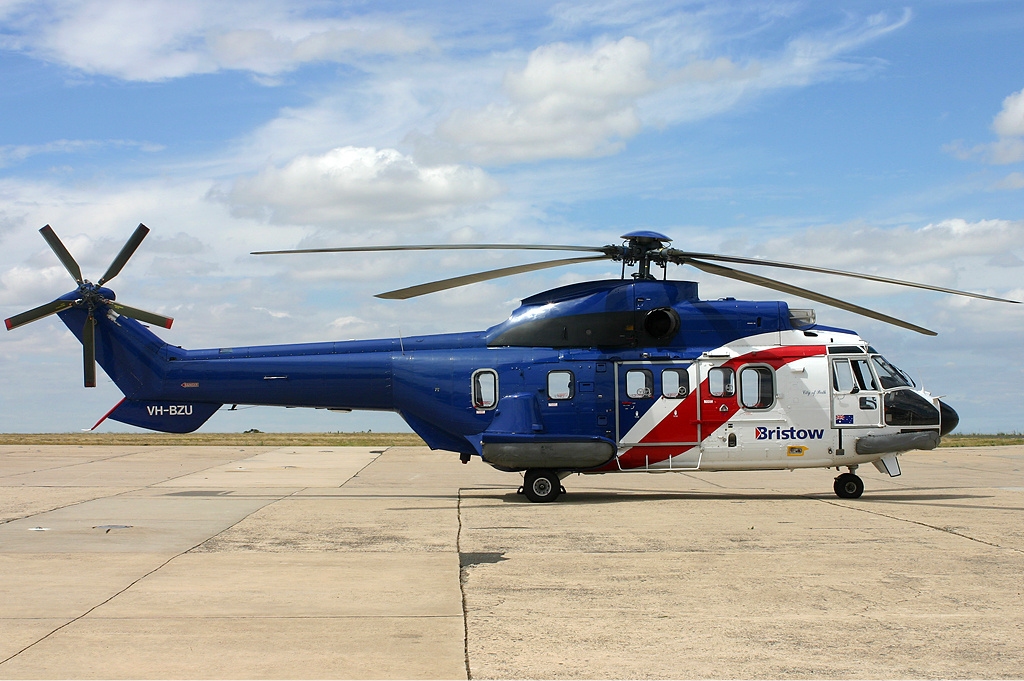
The Nigerian Civil Aviation Authority, NCAA, has suspended the operation of the Sikorsky S-76C++helicopter operated by Bristow Helicopters Limited in Nigeria, following the two crash incidents in just six months
At a press briefing in Lagos on Thursday, February 4, the director general of NCAA, Captain Muhktar Usman said the authority views with utmost seriousness the successive mishaps of Bristow Helicopters’ operating aircraft Sikorsky S-76C++ on the coastal waters of Lagos.
“These decisions are without prejudice to the investigations being conducted by the Accident Investigation Bureau (AIB). As a matter of fact, it will serve to assist in the entire process. The authority will fully support AIB in the investigation and the suspension will enable the NCAA carry out a full scale audit on its operations with particular emphasis on its Sikorsky S-76C++ type,” Usman said.
The Sikorsky S-76C++ is an American medium-size commercial utility helicopter manufactured by the Sikorsky Aircraft Corporation. The aircraft features twin turbo shaft engines, four bladed main and tail rotors and it has a retractable landing gear.
The helicopter was first built in the mid 1970’s with the design goal of providing a medium helicopter for corporate transportation and the oil drilling industry.
Parent company of Shell Petroleum Development Company of Nigeria, SPDC, Royal Dutch Shell, has confirmed it will cut 10,000 staff and direct contract jobs across its global companies in 2016.
Shell which employs around 90, 000 in more than 80 countries stated that it will slash the jobs to curb costs amid the lingering slide in oil prices.
Shell’s Chief Executive, Ben van Beurden, said in a webcast on its 2015 fourth quarter and full year results yesterday that the plan was part of holistic changes the company was undertaking to restructure and refocus its operations this year.
The Shell chief executive said the company was making substantial changes by reorganising its upstream, reducing costs and capital investment to enable Shell respond to lower oil prices.
Beurden who said the planned merger between Shell group and BG Group was expected to be completed in a few weeks, revealed that the company has exited the Bab sour gas project in Abu Dhabi, (UAE) and is postponing final investment decisions on LNG Canada and Bonga South West in deep water Nigeria in 2016.
The equity segment of the Nigerian Stock Exchange, NSE , continued its downward trajectory on Thursday, February 4, as the All Share Index (NSE ASI) dipped further by 0.38% to close at 23,517.19 points, compared with the depreciation of 0.96% recorded on Wednesday, February 3.
Year-to-date (YTD), the NSE ASI depreciated by 17.89%. Similarly, the Market Capitalization slid by 0.38% to close at N8.09trn, compared with the marginal appreciation of 0.96% recorded yesterday to close at N8.12mrn.
The depreciation recorded in the share prices of Dangote Cement, Nestle, Dangote Sugar, Oando, and UBA were mainly responsible for the loss recorded in the value of the Index.
The total value of stocks traded on the floors of The NSE today was N3.74bn, up by 28.54% from N2.91bn traded yesterday. The total volume of stocks traded was 2,641mn in 3,057 deals.
The three most actively traded stocks were: Wema Bank (2,453mn), FBN Holdings (40.70mn) and FCMB (38.02mn). The trading in Wema Bank shares accounted for 92.88% of the total volume traded today. The most actively traded sectors were: Financial Services (2,603mn), Conglomerates (22.69mn) and Consumer Goods (6.78mn).
The Debt Management Office,DMO, on Thursday, February 4, unveiled federal government’s plans to raise a N90 billion ($452.26 million) worth of local currency denominated bonds at an auction on February 10, the second of such in 2016.
The debt office said it will sell N40 billion in paper maturing in 2020 and N50 billion in the debt maturing in 2026, using the Dutch Auction System in which the price is lowered until the bond is bought.
Both debt notes are reopenings of the previously issued bond and Nigeria is planning to borrow as much as $5 billion to help fund its budget deficit due to the plunge in oil which has also sent the naira into a tailspin.
It expects a deficit of N3 trillion ($15 billion) in 2016, up from an initial N2.2 trillion ($11 billion) estimate. Nigeria’s total debt rose to N12.60 trillion ($65.42 billion) as at December 2015, up from N11.2 trillion in 2014.
Meanwhile, the Central Bank of Nigeria sold N242.38 billion ($1.22 billion) worth of three-month-to-one-year treasury bills on Wednesday at higher yields than in its previous auction yesterday.
The bank raised N50 billion more than initially planned as it increased the amount of six-month paper auctioned from the N30 billion it had previously announced to N80 billion and sold N45.17 billion of its three-month paper at 4.95 per cent, up from 4.29 per cent at a sale on January 20. It also sold N80 billion of six-month debt at 7.97 per cent against 7.59 per cent and N117.21 billion of one-year paper at 9.49 per cent compared with the 9.32 per cent on the same date.
Total subscription stood at N400.82 billion, compared with N288.98 billion. The 3-month bills closed at 4.59 per cent on the secondary market on Wednesday, the 6-month traded at 7.87 per cent while the one year paper closed at 8.45 per cent.
The Eko Distribution Company, EKDC, has sealed a bilateral agreement with Egbin Power Station for supply of 100 mega watts of electricity to boost power supply within its network
The agreement is to ensure ensuring effective power supply that would enhance the current cost reflective tariff.
Managing Director of Eko Disco, Oladele Amoda, who disclosed this during the company’s stakeholder’s town hall consultative customer’s forum said that the company will invest in additional 100 megawatts from Egbin power station to boost power supply within its operations.
He said: “We have concluded bilateral arrangement with Egbin for supply of 100 megawatts. Customers within Lekki, Ajah, Ibeju and environs will benefit greatly from this special plan.”
“This is energy that would come directly to us without passing through the national grid.”
Oil Major, Chevron has posted a loss of $588 million in the fourth quarter of 2015, compared with earnings of $3.5 billion in the 2014 fourth quarter (Q4).
Foreign currency effects boosted earnings in the 2015 quarter by $46 million, compared with an increase of $432 million a year earlier, the company said .
Full-year 2015 earnings were $4.6 billion compared with $19.2 billion in 2014 and sales and other operating revenues in Q4 2015 were $28 billion, compared to $42 billion in the year-ago period, the statement also said.
“Our 2015 earnings were down significantly from the previous year, reflecting a nearly 50 per cent year-on-year decline in crude oil prices. We’re taking significant action to improve earnings and cash flow in this low price environment. Operating expenses and capital spending were reduced to $9 billion in 2015 from 2014, and I expect similarly large reductions again in 2016. In addition, asset sales proceeds were $6 billion in 2015, with additional sales planned for 2016 and 2017,” the chairman and chief executive officer (CEO), Chevron, John Watson, said.
He added, “Improved refinery reliability allowed us to capture the benefits of a favorable margin environment and post excellent downstream results for the year. We continued to reshape the downstream portfolio with well-timed asset sales and good progress on petrochemical investments. We advanced our upstream major capital projects.
“We had first production from two deepwater projects in Africa, and ramped up production from Jack/St. Malo in the deepwater Gulf of Mexico and our shale and tight resources in the Permian Basin.”
By Boluwatife Oshadiya | April 1, 2026
Key Points
Federal Government plans Cybersecurity Coordination Council to strengthen national cyber resilience
Initiative follows rising cyber incidents disrupting banks,...