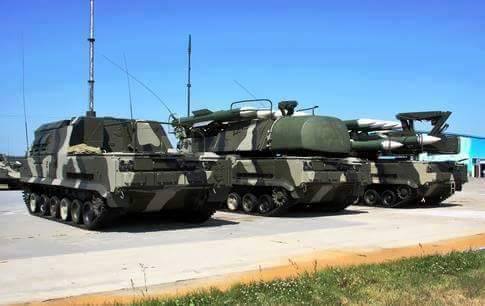
Details in the 2016 budget have shown that the Federal Government has allocated N311.38 billion to the Nigerian Army, Navy and Air Force for the 2016 fiscal year.
An analysis of the allocated amount indicates that N65.03 billion will be used for the purchase of various military aircraft, combat equipment, trucks and maintenance of boats among others.
Out of the N311.38bn, the sum of N139.8bn, made up of capital expenditure of N120.01bn and recurrent expenditure of N19.78bn is allocated to the Nigerian Army.
For the Nigerian Navy, the sum of N85.97bn is allocated for its operations. This amount is made up of N60.33bn for recurrent expenditure and N25.64bn for capital spending.
The Nigerian Air Force has a total budget of N85.61bn, made up of N62.15bn for recurrent expenditure and N23.46bn for capital expenditure.
For the Nigerian Army, the budget document states that the sum of N5.64bn has been budgeted for the purchase of defence equipment; N2bn for kitting of armed forces personnel; and N1.96bn for the purchase of trucks.
Similarly, the sum of N2.07bn is being proposed for security votes including operations while N7.24bn has been budgeted for the construction of military barracks.
For the Navy, the budget document states that the purchase of defence equipment will gulp N18.29bn while the sum of N372.95m and N734.06m are budgeted for the maintenance of aircraft and sea boats respectively.
In the same vein, the document indicates that the government is planning to spend N1.7bn to purchase surveying equipment, N296.88m to fuel aircraft; N645.35m for sea boats and N706.07m for security votes, including operations.
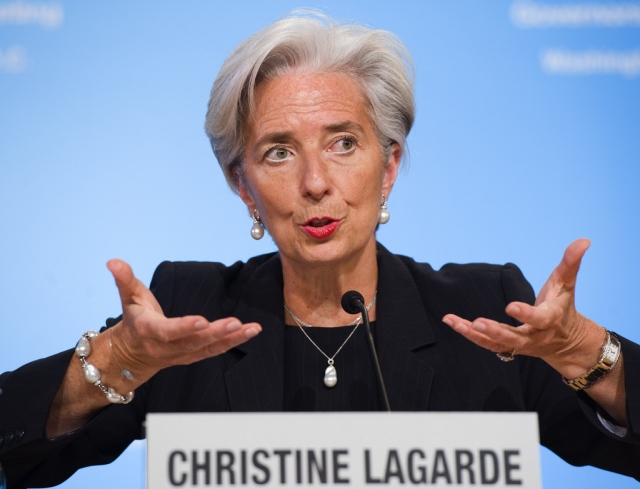
The Managing Director of the International Monetary Fund, Christine Lagarde, has said that the organisation was keen to assist the Federal Government of Nigeria in tracing stolen funds, plugging revenue leakages and restructuring the tax system.
Lagarde, who is in the country on a four-day working visit, also said that Nigeria had all the potential to overcome the current economic challenge of falling commodity prices without resorting to the IMF for financial support.
The IMF boss reportedly said this during a closed-door meeting with President Muhammadu Buhari at the Presidential Villa, according to a statement by the President’s Special Adviser to the President on Media and Publicity, Mr. Femi Adesina.
Buhari, on his part, said he had told all heads of Ministries, Departments and Agencies of government that under his leadership, they must give full account of all funds allocated to them.
He said his administration would look inwards, enforce regulations to stop financial leakages and adopt global best practices in generating more revenue to mitigate the effects of dwindling oil prices on the Nigerian economy.
The President said that the Federal Government was reviewing its operational costs and had directed all the MDAs to cut down on their overheads.
According to him, the Federal Government will welcome the technical support and expertise of the IMF for its plans to diversify the Nigerian economy and further unleash its growth potential.
After her meeting with Buhari, the IMF boss said with the determination and resilience so far displayed by Buhari and his team, Nigeria did not need any loan from her organisation and that she was not in the country to negotiate loans with the Federal Government.
The household oral care brand from Procter & Gamble, Oral-B has restated its commitment in helping Nigerians have stronger teeth and improved overall oral health in 2016 and beyond. The brand which has a strong bond with dental associations in the recent years made this known during the post-Health Week Executive debrief session in Lagos and the National Oral Health Week 2015 held in Abuja.
At the National Oral Health Week organized by the Federal Ministry of Health, held in Abuja, The Honourable Minister of State for Health, Dr. Osagie Enahire had also made a similar appeal to Nigerians to see their “oral health as closely integrated with their general health system as the mouth is the gate way to the body and several oral diseases are related to non-communicable diseases such as diabetes mellitus and hypertension.”
Speaking at the Executive editorial debrief session following the 2015 National Oral Health Week, the Brand Manager of Oral B for Sub-Saharan Africa, Aliza Leferink, pointed out that “healthy teeth and gums are fundamental to overall health and well-being. And we want Nigerians going into 2016 and beyond with stronger teeth, which comes from forming a great daily care habit, consistency and the right toothpaste use.”
“Maintaining healthy teeth can be achieved by following a number of simple principles, and Oral-B wants to help Nigerian consumers on their way to better oral-care-routines.” Aliza advised that firstly, one should brush twice a day and floss daily. Most people find it difficult to brush at night. But this is one of the most effective ways of preventing germs, gum disease and tooth decay in the long term. Brushing at least twice a day will help to prevent acid build up from the breakdown of food by bacteria.
To brush the teeth correctly, one should spend at least two minutes using a recommended technique, which includes 30 seconds brushing each section of your mouth (upper right, upper left, lower right and lower left), both morning and night. Start with outer and inner surfaces, and brush at a 45-degree angle in short, half-tooth-wide strokes against the gum line. Make sure you reach your back teeth. Move on to chewing surfaces. Hold the brush flat and brush back and forth along these surfaces. Once you get to the inside surfaces of your front teeth, tilt the brush vertically and use gentle up-and-down strokes with the tip of brush. Finally, brush your tongue in a back-to-front sweeping motion to remove food particles and help remove odor-causing bacteria to freshen your breath”.
Oral-B also demonstrated that the hygiene and condition of the tooth-brush itself is very important for a healthy mouth. Tooth brushes should be changed 3 to 4 times a year. If the toothbrush bristles become frayed and worn, they may lose their effectiveness, and when ineffective, it is not able to get into all of the nooks and crannies of your mouth and clean your teeth and gums as a new toothbrush does. Some studies have shown the typical toothbrush can harbor up to 10 million bacteria, so a good and frequently exchanged toothbrush will help keep your teeth clean and healthy.
Good diet and low sugar intake is another habit that needs to be cultivated. It is advisable to visit the dentist for regular check-ups, preferably every six months to ensure gum and teeth do stay healthy. Most people go to the dentist only when they are in pain. They should go for both prevention and cure!
The Oral-B toothpaste combines three powerful ingredients, stannous chloride, sodium fluoride and a specific Polychelation Technology which address the seven areas dentist check most to help people achieve healthy, beautiful teeth. Through its new advanced toothpaste formulation Oral-B tooth paste creates a protective shield around the teeth and gums. During brushing the paste distributes key ingredients throughout the mouth.
Oral-B brand is a worldwide leader in Oral Care. Oral-B continuously strives to work closely with the dental professionals to deliver high quality products. Oral-B Toothpaste was developed by dentists and helps to protect the 8 most common oral health problems at the same time: Tooth holes, bad breath, gum problems, tooth sensitivity, stains, bacteria deposits, tartar, and enamel erosion.
Indications have emerged that oil exploration has plunged in the United States and Canada due to decline in investments, hence raising hope for the dominance of Organisation of Petroleum Exporting Countries, OPEC.
Baker Hughes latest weekly rig count indicated that oil rigs deployed for exploration “dropped to 698 rigs, two less than the previous week and confirming one of the worst years in a generation for the US rig market.”
According to Energy Voice, “Rigs targeting crude in the US fell by 2 to 536. Natural gas rigs were unchanged at 162, bringing the total of working rigs to 698. Drillers searching for oil this year idled the largest proportion of their rig fleet since at least 1988.”
It indicated that “Drillers in the Permian Basin of west Texas and New Mexico added five rigs in the last week to boost the total to 217, according to the report. In the Haynesville shale, a source of gas in east Texas and Louisiana, one additional rig was put to work.”
“About 70per cent of the vertical rigs in the US have been dismantled this year, compared with 59per cent of horizontal drilling units, according to the report,” it added.
It maintained that two-thirds of oil rigs in the U.S. have been parked since drilling peaked in October 2014.
The report indicated that in Canada, rig count is down by 43 to 83 rigs, with oil rigs down 32 to 12, and gas rigs down 11 to 71.
It maintained that Canadian rig count is down 125 rigs from last year at 208, with oil rigs down 40, and gas rigs down 85.
The Securities and Exchange Commission, SEC, on Tuesday, January 5, disqualified 24 Capital Market Operators, CMOs, for noncompliance and/or the inability of the audit firms to substantiate their claims of compliance.
A list uploaded to the SEC website after capital verification has been conducted showed that 429 CMOs adhered to the minimum requirements while 24 others were disqualified.
A source at SEC, who pleaded anonymity, said that the regulator will not be able to release the list due to the present sensitive nature of the market, as such might further erode investors’ confidence and trigger more sell-off of shares.
“In exercise of the powers conferred on it by the Investment and Securities Act (ISA) 2007, the Securities and Exchange Commission hereby releases the list of Capital Market Operators that complied with new minimum capital requirement after capital verification exercise,” the apex regulator said in the circular.
This list, it further said, “was based on the consideration of the reports on capital verification and the responses received from the affected Capital Market Operators (CMOs).
“In all, 24 CMOs were disqualified for non-compliance and/or inability to substantiate claim of compliance based on queries raised by the audit firms. In addition, 16 new CMOs were added on the list, 10 of which were newly registered companies and six filed evidence of compliance after the release of provisional list which were verified and accepted.”
To facilitate the smooth implementation of the new minimum capital requirements for CMOs, the Capital Market Committee (CMC) set up a market- wide Implementation Committee on New Minimum Capital Requirement for CMOs comprising SEC, the Nigerian Stock Exchange (NSE), the Central Securities Clearing System (CSCS), the Association of Stockbroking Houses of Nigeria (ASHON) and all other capital market trade groups.
The Federal Government has abolished tendering process for the engagement of pre-shipment inspection and monitoring agents for the oil and gas sector.
Minister of Finance, Kemi Adeosun, who disclosed this on Tuesday, January 5, said the cancellation of the exercise was necessitated by a series of complaints as well as petitions alleging that the process had been marred by irregularities.
The decision was premised on the President Muhammadu Buhari’s order in June 2015, that the Federal Ministry of Finance should commence the process of engaging pre-shipment inspection and monitoring agents.
Following the approval of the Bureau of Public Procurement (BPP), a selective tendering process was initiated under which 65 companies were selected and invited to bid.
However, the statement explained that since the inception of the process, numerous complaints have been received by the Ministry suggesting that the method by which the 65 companies were selected was faulty and lacked transparency.
The statement read in part: “The Minister of Finance, Mrs. Kemi Adeosun, has ordered the immediate cancellation of the tendering process for the engagement of pre-shipment inspection and monitoring agents for oil and gas. The receipt of numerous complaints and a petition regarding alleged irregularities in the process necessitated the decision.”
It added that, “a formal petition was received by the BPP, making specific allegations about the process. Under public procurement rules, the receipt of a formal petition requires a suspension of the tendering process to allow for an investigation.
The Ministry of Works, Power and Housing is to expend N20, 692,987,864 on the provision of electricity to its corporate headquarters in Abuja.
The expenditure, which is contained in the 2016 Appropriation Bill, also includes the sum of N45, 463,197 for fueling of its generating plants.
Following the amalgamation of the three key ministries, there seems to have been an attempt to also grant the ministry and its parastatals a huge chunk of the national budget, particularly in the power sector.
For instance, the National Rural Electrification Agency (NERA) has been allocated the sum of N9.7 billion; Electricity Management Services was allocated the sum of N2.2 billion; National Power Training Institute has N1.3 billion; Nigeria Electricity Liability Management Limited has N3.3 billion; Nigeria Bulk Electricity Trading Plc. has N60.7 billion, while the Transmission Company of Nigeria got an allocation of N48.2 billion.
Similarly, the Federal Road Maintenance Agency (FERMA) has been allocated the sum of N46.2 billion, just as the sum of N569,566, 969 has also been allocated to the same ministry for local and foreign travels; maintenance of motor vehicles and transport equipment as well as for fuel and lubricants of its vehicles.
The same ministry has proposed a total of 19 new electricity projects valued at N20.287 billion and 78 road projects estimated to cost N260.838 billion. These projects are located in different parts of the country.
According to an online flight-monitoring platform, the Aviation Passenger Service, APS, nine Nigerian domestic airlines cancelled 29,775 flights in 2015, as the shortage of aviation fuel, bad weather and other operational deficiencies weighed in on operations in 2015.
The grounded flights were out of a total 93,158 flights recorded between January 1 and December 31, 2015 across airports in the country.
Data compiled from the APS, one of the surviving projects initiated by former Aviation minister, Osita Chidoka, showed that while 43,999 flights were “delayed”, only 19,384 flights departed to their destinations “on time”.
The airlines’ flight performance monitor portal showed that Dana Air topped the overall flight performance chart for the year with 40.1 per cent ‘On Time’ performance with the least cancellations.
The airline was followed by First Nation with 39.1 per cent and Arik Air with 25.5 per cent. Discovery Air was rated the lowest performer with 0.1 per cent.
In 2015, the incidence of cancellations and delays were worsened by the strike by air traffic controllers which grounded all domestic flights at that time, leaving passengers stranded at terminals across the country.
Inclement weather had also at the beginning and end of 2015 ravished some parts of the country, causing massive flight delays, rescheduling and cancellations.
This development is an effort to meet the growing demand for non-scheduled flights services in the country.
The plan is contained in the proposed 2016 budget presented by President Muhammadu Buhari to the National Assembly recently.
A breakdown of figures contained in the budget proposal for the ministry indicates that the ministry has allocated N173m for the construction of a general aviation terminal (GAT) at Wing D of the Abuja airport.
Construction of the GAT for private jets operation will gulp N71.5m, while N13.6m has been appropriated for the provision of a GAT protocol lounge and rehabilitation of the fire station at the airport.
The GAT is where non-scheduled flights like private jets, chartered and special airlines’ operations take place at the airport.
Also, the ministry has proposed to construct a new airline office at the airport for N66.5m, while a new accident rescue centre will be built for N45m.
Output is not far below July’s 31.88 million bpd, the highest since Reuters records began in 1997.
Carsten Fritsch, analyst at Commerzbank said:“There is certainly no chance of Saudi Arabia scaling back its oil supply to make space for Iranian oil,” adding the tensions still justify a risk premium on prices because they could escalate, Reuters reports.
“In other words, the existing oversupply may actually grow further in the short term.”
The biggest monthly decline in output came from Iraq, the world’s fastest growing source of supply growth in 2015.
Exports from Iraq’s main outlet, its southern terminals, have slipped from November’s record level which had been boosted by delayed October cargoes, but are likely to reach new highs in the coming months, industry sources said.
Shipments from Iraq’s north by the Kurdistan Regional Government via Ceyhan in Turkey have edged lower, while those by Iraq’s State Oil Marketing Organisation have remained at zero for a third month, the survey found.
Top exporter Saudi Arabia has kept output steady to slightly lower, sources in the survey said, due to less demand from outside the country and largely steady domestic use.
“Directionally, supply is down a little bit,” said a source who tracks Saudi output. Saudi production reached a record high of 10.56 million bpd in June.
Nigerian output declined by 50,000 bpd due to disruptions to exports from the Brass River and Bonny production streams, sources in the survey said.
Output in Iran, eager to reclaim its spot as OPEC’s second-largest producer when sanctions over its nuclear programme are lifted, is edging up, the survey found. Kuwait and Qatar also posted small supply rises.
Indonesia, which rejoined OPEC on December 4 bringing the membership to 13, will be included in the January survey.
The Minister of Environment Amina Mohammed has projected that the nation can generate $7, 5 billion from of grid solar energy.
Mohammed who spoke at the just held Conference of Parties on Climate Change, otherwise known as COP 21, in Paris, France, said: “In particular, we plan to develop around 13,000 gigawatt of off-grid solar power, delivering energy access to the poorest communities in a cheaper and healthier manner with less emission.
“We also plan to create a more efficient, lower carbon oil and gas sector. By ending gas flaring and using the gas for commercial purposes, including power generation, we could generate as much as $7.5bn worth of benefits.”
The Minister said given the climate risks that Nigeria faces, this is the only way in which the government’s ambitious Agriculture Transformation Agenda can be delivered
“Nigeria’s ambitious INDCs aim at reducing emissions by 20 per cent by the year 2030 with support from the international community. This will support the restructuring of the economy in a way that will facilitate inclusive growth with vast opportunities to diversify the energy mix, with emphasis on renewable energy and efficient gas power,” she added.
Transactions on the Nigerian Stock Exchange, NSE, closed south on Tuesday, January 5 as the All Share Index slumped by 0.95 per cent to close at 28,102.14 points from 28,370.32 on Monday, January 4.
Similarly, the market capitalization also fell from N9.757 trillion to N9.665 trillion.
Ecobank recorded the highest gain of the day with N0.84 gain or 5 per cent to N17.64 followed by Fidelity Bank with a gain of N0.07 or 4.83 per cent to close at N1.52 followed by Livestock that gained N0.06 or 4.51 per cent to close at N1.39 per share.
On the other hand, Stanbic IBTC topped the losers’ chart with N1.53 loss or 9.26 per cent to close at N15.00 followed by Unity Bank that lost 0.10 or 8.93 per cent to close at N1.02 per share, and Nigerian Breweries that lost N6.46 or 5 per cent to close at N122.74 per share.
All together, a total of 195,969,167 shares worth N1,892 billion exchange hands in 2,975 deals.
The value of the naira strengthened to N262 against the dollar on Tuesday, January 5.
The greenback which sold at N265 yesterday gained value selling at N262 as demand for forex dropped.
The volatility in the money market all through 2015 had left the economy in shambles with uncertainty trailing exchange rates and the CBN struggling to save the local currency from the lingering plunge.
The Central Bank of Nigeria, CBN, has said it will be selling $10,000 each to the 2699 licensed Bureau de Change operators, BDCs at the first dollar sales of the year on Wednesday, January 6, 2016.
This decision is coming as the naira gained grounds to hit N262 against the dollar on Tuesday, January 5.
The Acting President of the Association of Bureau de Change Operators of Nigeria (ABCON) said its members have begun to pay up the N250,000 renewal fee.
CBN Director, Corporate Communications, Ibrahim Mu’azu yesterday confirmed that there would be dollar sales to BDCs, contrary to reports that the apex bank will stop sales of foreign exchange to BDCs.
The apex bank last week had published the list of 2,699 BDCs whose licenses have been confirmed having introduced the new requirements in a bid to correct observed deficiencies in the operation of BDCs in the country.
CBN had reviewed the mandatory cautionary deposit for BDCs to N35 million, while the application fee was raised to N100,000, the licensing fee to N1 million, the annual renewal fee for the forex dealers was also increased to N250,000.
Last month, CBN published revised guidelines for the operations of BDCs which ordered BDCs to close all branches within 90 days, saying branch operations is no longer allowed in the subsector.
The Nigerian stock market has shed N92 billion on the second trading day of the year, Tuesday, January 5, due to profit taking.
The market capitalization which opened at N9.757 trillion, slumped by N92 billion, to close at N9.665 trillion, yesterday.
Similarly, the All-Share Index depreciated by 268.18 points or 0.95 per cent to close at 28,102.14 on Tuesday.
Analysts at the United Capital said bargain hunting is expected to greet the market this week as investors take position on low-priced stocks with significant upside potential coupled.
“However, pockets of selling on the back of recent gains will likely offset gains in the week with the benchmark likely to close marginally negative,” they said.
Market breadth closed negative with 15 gainers and 28 laggards recorded. ETI recorded the highest price gain by 5 per cent or 84 kobo, to close at N17.64 per share. Fidelity Bank gained by 4.83 per cent or 7 kobo to close at N1.52, while Livestock appreciated by 4.51 per cent or 6 kobo to close at N1.39 per share.
Africa Prudential leaped by 3.17 per cent to close at N2.60, while CCNN appreciated by 3.11 per cent to close at N9.96 per share.
The Nigerian National Petroleum Corporation, NNPC, on Tuesday, January 5, announced that the country’s three refineries located in Kaduna, Port Harcourt and Warri have attained a combined daily production of 6.76 million litres of petrol per day.
The state-run oil firm, in a statement by its spokesman, Ohi Alegbe, disclosed that the figure is projected to surge to over 10 million litres per day by the end of January 2016.
The statement which gave a breakdown of petrol production from the plants indicates that while Port Harcourt refinery which was re-streamed a week earlier is producing about 4.09 million litres daily, the Kaduna refinery is contributing about 1.29 million litres and Warri which was re-streamed on Sunday is adding a yield of 1.38 million litres of petrol daily.
This an improvement compared with the 1.5 million litres Kaduna refinery was producing as at Christmas day, 2015, while the Warri refinery which was then undergoing restreaming, was producing noting.
NNPC confirmed that the PMS volumes from the refineries which are currently operating at an appreciable percentage of their nameplate capacities will help stabilise the fuel supply and distribution situation in the country.
Following the restrictions placed on some items in the Nigerian foreign exchange market as well as the ban on the usage of naira denominated cards outside the country, some Nigerians have resorted to buying dollars from neighboring countries.
Some Nigerians go to Togo, Benin Republic and Ghana, among other neighboring countries to source dollars to send via courier or other means abroad, Leadership investigations reveal.
Also, findings show that speculators taking advantage of the high demand for dollars in Nigeria buy the greenback from outside the country to sell it in Nigeria.
The value of the naira had dropped to an all time low of N283 to the dollar last year but has remained stable since last week at N265.
The apex bank had placed various restrictions on the foreign exchange market, having removed 41 items from the eligible for forex list and reduced the annual and daily spending limits.
It had also backed the move by banks to stop accepting foreign currency deposits as well as the recent ban on the usage of naira denominated cards abroad, a move that has been condemned by many Nigerians especially students living abroad.
Confirming this, the acting president of the Association of Bureau de Change Operators of Nigerian (ABCON), Aminu Gwadabe said “there are people that now buy euro in Nigeria and convert it to dollar and bring it back to sell. The people doing this are traders that make it their business and not BDCs”
He noted that the speculators who follow international exchange rates take advantage of the high demand of dollar in Nigeria. This he said may spike activities at the parallel market affecting the value of the dollar.
It is a new year! We have finally crossed over to 2016, and while everything seems to be taking a new turn, it seems as though very little has changed in the tech world. No doubt 2015 witnessed the rise of major startups, local apps, impressive tech trends as well as innovations including wearable to large-screen smartphones. However, with the new year already rolling, we must ask ourselves: what are the possible things in store for Nigeria, with regards to technology?
Looking into 2016, Jovago.com, Africa’s No.1 online hotel booking site predicts trends, innovations or technologies that may be witnessed in the Nigerian tech scene this year.
Strengthened security
With Boko Haram issues stretching into the new year and a rise in crime and other insecurities now prevalent in the country, Nigeria’s IT and physical security will become more connected and that convergence could lead to a safer environment as well as the use of better tech tools to ensure security.
From the use of analytics to track driver behavior, implementation of e-procurement systems, biometrics, security and threat management will certainly evolve and hopefully businesses as well organizations will adopt these improved measures.
Increased power of Social Media
This last year, social media played a key role in influencing several national issues, especially during the election period. Nigerians harnessed the potential of modern communication tools to air their opinions and mobilize protests, successfully preventing a rigged election. Twitter hashtags and social media memes became important tools for mobilization and are likely to become even more prominent as 2016 progresses.
There will be more subscribers on key social media platforms including Instagram, Snapchat and Twitter, as well as sensational blogs such as Linda Ikeji and BellaNaija, where they can give feedback on various posts and topics. The government is already responding to this perceived threat (especially as it affects access to information, media attacks, and cyber crime) and may adopt a social media bill in 2016.
A dearth of start-ups
Last year witnessed the rise of new startups such as Tuteria.com, Printivo.com and Gamsole.com. Although startups in general have now become part of the Nigerian society, spreading from metropolitan hubs to suburban areas, the current state of Nigeria’s economy suggests a dearth in the rise of startups in 2016. Despite the large customer base and talents available, investors are not keen on investing due to the fall in value of the Naira and as such, startup inventors have little or no opportunities to raise venture capital. 2016 may have this sector experience challenges in the area of accessing funds; and even existing startups will find it difficult to thrive.
Dangote Cement P.L.C. is the biggest quoted company in West Africa and the only Nigerian company listed among Forbes Global 2000 Companies. The Company currently has several cement production plants in Nigeria in addition to presence in 14 other African countries. To consolidate its current strategic expansion drive and as part of our growing vision.
GE Oil & Gas is a world leader in advanced technologies and services with 43,000 employees in more than 100 countries supporting customers across the industry – from extraction to transportation to end use. Our unrelenting commitment to the environment, health and safety, quality and integrity defines us: it’s The Way We Work. We develop smart solutions for our customers across the oil and gas value chain delivering the innovation, customized service solutions, training programs and technology that helps them to maximize their efficiency, productivity and equipment reliability.
Job Number: 2279057 Location: Lagos, Nigeria
Business: GE Oil & Gas
Business Segment: OG-HQ Headquarters
Role Summary/Purpose
This role will be responsible for identifying, positioning and leading efforts to develop the customer portfolio, forecasting and planning opportunities, managing orders, closing sales and securing contribution margin targets for the Downhole Technology (DT) portfolio of GE Oil & Gas, within the Sub-Sahara region.
Essential Responsibilities
Establish a plan for SSA to support existing customers and grow the customer portfolio by developing leads and new opportunities
Develop and maintain a strong network with key individuals within the customer’s organization and leverage to anticipate customer’s needs as well as accurately forecast sales on a monthly, quarterly and annual basis.
As a coach, accelerate the onboarding and development of a Downhole Technology (DT) services business in the region.
Provide technical support and guidance to clients to help them select the appropriate technology that can provide the desired services within the operating specifications
Monitor the market and evaluate competition and customer specific strategic and operational factors to support business decisions
Drive appropriate processes and rigour to ensure that the opportunity pipeline is up to date and accurate in the sales funnel
Ensure a review rhythm around closure of the assigned geographical region key deals.
Coach the local services team to ensure quality and availability of services.
Build and deliver a plan to improve our customer service experience
Comply with Company Safety policies and procedures and continuously promote and satisfy all Environmental Health and Safety (EHS) requirements
Ensure that all business matters are conducted with the highest integrity and in full compliance with GE Oil & Gas policy
Qualifications/Requirements
Technical Bachelor’s Degree from an accredited university. Minimum of 10 years relevant experience in Sales in the Oil & Gas industry
Demonstrated track record of sales / business development growth in Sub-Saharan Africa
Proven Wireline industry experience, with a Cased Hole and/or Open Hole Logging focus.
Willingness and ability to travel 40% time across Sub Saharan Africa
Experience in running Sondex Cased Hole Logging tools with knowledge of Formation Evaluation and/or Production Logging Interpretation.
Must be a self-starter who is driven to completion of sales orders and project execution