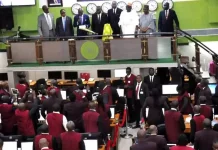
The Central Bank of Nigeria, CBN, said it had granted N14.7 trillion total credit to the economy as of June 30th, 2015.
Of the aforementioned amount, N760.8 billion representing five per cent, was contributed by collective Development Financial Institutions (DFIs), in the country.
The apex bank boss, Godwin Emefiele, made this disclosure on Tuesday, February 23, in Abuja while presenting key note address at the maiden edition of the bi- annual forum for stakeholders of DFIs.
Represented at the occasion by Deputy Governor, Financial System Stability, Joseph Nnanna, Emefiele revealed that given the limitation in the resources available at the disposal of DFIs, “government was considering a plan that would make it possible for DFIs to access the capital market for fund to finance critical sectors of the economy.
According to Emefiele, “the Nigerian experience has shown that government resources have been the main source of long term fund for these institutions, which is not sustainable.”
“It is therefore, envisaged that with time, the DFIs would be capable of accessing the capital market for funds to finance the critical sectors of the economy.”
Findings have revealed that Nigerians in the diaspora are avoiding sending cash to Nigeria through the regular money transfer agencies in the country as they seek to take advantage of the wide gap between the official naira exchange rate and that of the parallel market.
While the official naira exchange rate to a dollar is N197 to a dollar, it is sold at about N370 to a dollar on the parallel market.
Nigerians that live abroad now prefer to send dollar cash and other foreign currencies to the country, so that the beneficiary would be able to convert it at the black market rate at higher value, THISDAY findings show.
With about $21 billion sent home by Nigerians in diaspora in 2015, the country was the sixth largest receiver of remittances in the world in 2015.
This was revealed by the Migration and Remittances Factbook 2016. The country was also by far the largest receiver of remittances in the continent, which was said to have received a total of $34.8 billion last year.
The report, which relied on data gathered from January to December 1, 2015, was compiled by the Global Knowledge Partnership on Migration and Development with support from the World Bank, German, Swedish and Swiss governments
Tony Ehiguese Digital Marketing Specialist tony.e@digicraft.ng | @tehiguese
I’ve often wondered what brands do to keep consumers coming back for only their products. I listen to brand owners talk about the high level of consumer insights and behavioral patterns at their fingertips. However, I was taken quite aback when the series of competitive value propositions flooded the beverage market.
You see, I’ve held on to this notion that a customer is capable of staying glued to your brand if you deploy the right marketing campaigns. Well, that changed quickly with FMCG brands and I think the brand managers think the same way.
It all started with the introduction of the Big Cola drinks by AJEAST. This was a smart move as AJEAST had a plan to enter the Nigerian market as quickly as possible. Hence they offered 65CL pet size of their drink for N90. Up till now, I haven’t seen an ad on the Big Cola but I see it in every shop I go.
In terms of awareness, Pepsi and Coca cola probably have the highest top of mind for any beverage company not just in Nigeria, but worldwide. It was surprising to see that Pepsi also introduced more value by increasing the size of their pet bottles to 60CL for the same price. This was cleverly done via their somewhat successful online ‘Long Throat’ campaign. It insinuated that revenue was under threat from the AJEAST brands and they had to act fast.
Coca Cola recently followed suit by also introducing 60CL pet bottles at the same price. For a company that owns the second most common word in the world to feel threatened by competition is something to think about. Could it be that we as Nigerians, don’t care about brands and we just want more value for less or are brands not doing enough to bond with their consumers? Both questions have the capability of painting the right picture. I recently was exposed to campaigns executed by brands (Especially Coca Cola) abroad and I was impressed. There is this conscious effort in their campaigns to generate emotions from consumers and this is key. Little wonder why we have coke and pepsi addicts over there. I recently had a chat with a friend on this issue and these were his exact words:
‘Nigeria is still a poor country. We think of the price and the value first. The quality can come after’.
While this represents his opinion, he may not be far from the truth. There was the case of Cowbell milk to Peak milk and Tecno mobile phones to the likes of Iphone and Samsung to buttress his point. Value proposition is beginning to move to the telecoms industry as GLO is constantly gaining the highest amount of internet subscribers – due to their ridiculously cheap data plans. Spectranet is also dominating the ISP market due to their low data offerings. Whether or not their product or service is top notch is a different case.
So if this is the case, do we need to step up our marketing campaigns to retain customers or simply throw quality out the window and offer consumers more value for lesser price? That’s left for the brand custodians to decide.
World Health Organization (WHO) has promised to support Nigeria and other countries that have recently suffered outbreaks of meningitis C.
WHO Regional Director for Africa, Dr. Matshidiso Moeti, stressed the need to introduce the vaccine MenAfriVac into the routine immunization schedule for Nigeria and 25 other meningitis belt countries.
Moeti said Meningococcal meningitis A epidemics had been nearly eliminated from Africa. “We now need to urgently make progress in our fight against other strains of meningococcal meningitis, learning from the spectacular success of MenAfriVac. The price of MenAfriVac, at less than $0.50 per dose, ensured that this vaccine is a sustainable public health solution.
“In the past year, both Niger and Nigeria have suffered outbreaks of meningitis C, and meningitis W135 is responsible for the current outbreak in Togo. Meningitis X also remains a threat.
After a successful two-week of exciting polo, music, fashion, champagnes and cocktails, the 2016 NPA Lagos International Polo Tournament finally came to a grand close on Sunday 21st February 2016 at the Lagos Polo Club, Ikoyi, Lagos.
From thrilling performances by players and music stars, to the dazzling GTBank Lounge where guests were treated to epicurean cuisine and vintage wine, the 2016 NPA Lagos International Polo Tournament lived up to its billing as the best tournament ever. Elite, stylish and extravagant are few words that describe this year’s event, as the social scene at the annual Lagos polo tournament was as much of a show as the game on the pitch.
Following a 2-year hiatus, the organizers set out to host an event second to none and unparallel on every front. The game attracted everyone from big name politicians, aristocrats, traditional leaders, sport lovers and the full panoply of professional players from Argentina, Syria and South Africa.
An exciting first stage of the high-class tournament came to a close on Valentine’s Day with Lagos Shoreline emerging the biggest winner by clinching the Open Cup at the expense of Lagos Caverton while Lagos dominance of the first stage was highlighted once again by Sao Polo’s win of the Dansa Cup against STL in an all-Lagos final. Lagos Shoreline defeated Lagos Caverton 9-8 to emerge champions of the Open Cup while Lagos Sao Polo beat STL 5-4 1/2 to win the Dansa Cup. The Kola Karim-led Shoreline also added the Oba of Lagos Cup, which they won by beating Lagos Ashbert.
The second stage of the tournament kicked-off on February 16th with three matches in the Low Cup. However, the highlight of this stage was the prestigious Majekodunmi Cup, which is the most-lucrative trophy in Nigerian sports, as it worth N25m for the winners. Fifth Chukker Polo emerged winners of the prestigious Majekodunmi cup having defeated Ironclad/Trojan in the final. In the Low Cup final, Aerovote defeated Lagos Zippy while the last match of the day saw Kano Titans beat Kano Keffi Ponys in the Majekodunmi Subsidiary final to clinch the Governor’s Cup.
Commenting on the GTBank sponsored NPA 2016 Lagos Polo tournament, Mr Segun Agbaje, Managing Director of Guaranty Trust Bank plc stated that “We are proud to partner one of Nigeria’s oldest and most reputable Polo Clubs in delivering an event that is second to none on the Country’s social and sporting calendar, and one that provides a platform for us to connect with our customer segment that play and enjoy the “Sport of Kings”. Segun Agbaje further stated that, from its profound origins rooted in noble values to the naturally evolving symbiosis between player and horse; Polo reflects pure passion, quality, competitiveness and fair play.
Guaranty Trust Bank plc is one of the few Nigerian financial institutions that have maintained a defined Corporate Social Responsibility (CSR) strategy, most especially in sports education. The GTBank Masters Cup as well as the Principals Cup tournaments in Lagos and Ogun states are some of the projects the bank has taken up in this regard.
The Economic and Financial Crimes Commission (EFCC) has arrested a former Minister of Interior, Abba moro, who is being quizzed for his alleged role in the immigration recruitment which led to the death of about 20 young graduates.
A source from the anti-graft agency magde this known on Monday evening that Mr Moro will soon be arraigned in court of competent jurisdiction as soon as it finalises its investigation.
In 2014, the immigration service under his watch organised a recruitment exercise nationwide on the same day and due to the massive crowd, officials of the immigration were unable to effectively control the crowd.
This error led to the death of the young graduates and the former President, Goodluck Jonathan, ordered an investigation into the situation, a report which is yet to be made public.
President Muhammadu Buhari has appointed a visually impaired man, Dr. Samuel Ankeli, as his Senior Special Assistant with responsibility for his dealings with persons living with disability.
Dr. Ankeli headed the Directorate of Persons with Disability at the Buhari/Osinbajo APC presidential campaign headquarters, the first of any such department in a political party in Nigeria.
He led a team that successfully mobilised a large number from the more than 24 million disabled persons in the country to support the All Progressives Congress candidate and his running mate during the 2015 presidential election campaign.
Dr. Ankeli, who hails from Benue State, went to school in Giwa, near Zaria and Kaduna, afterwards headed to the Ahmadu Bello University to study veterinary medicine.
He worked with the Benue State government before quitting to give time to his activist role in the promotion of the well-being of the blind and people with all kinds of disability.
Dr. Samuel Inalegwu Ode Ankeli is married with children as well as leads a very active religious and sporting life.
The Federal Government has said that many of the heads of agencies in the nation’s maritime sector will be sacked if the sector does not meet a target of N500 billion revenue set for it by the end of 2016.
Speaking on Monday at a two days Maritime Summit sponsored by the Nigerian Shippers Council (NSC) and Tell Magazine, the Honourable Minster of Transportation, Rotimi Amaechi stated that he has already informed all Heads of agencies in the maritime sector to generate N500billion by end of the year or get sacked.
He said that the only way the N500 billion target can be acheived is to put in place the proper reform. He also added that if they don’t achieve that target other hands who are capable will be employed.
According to him, “If you think that the corruption in the maritime sector has stopped by the emergence of the new government, the answer is no. If you think corruption in the transportation sector has stopped with the emergence of the new government, the answer is again no.
“We all need to sit together to agree on the right things to do. The right people must come into the industry to make the industry much more productive. The days where because somebody knows Rotimi Amaechi, the Managing Director of the Nigerian Shippers Council (NSC) will give him contract is gone.
“I have told the Managing Directors under my Ministry that I don’t want to know them, I don’t want to award contracts.
The Retail Council of Nigeria (RCN) has appealed to the CBN to relax its foreign exchange policy on imported items to sustain the growth of the retail sector.
The Secretary of the council, Alhaji Kunle Hamzat, said that sustainability of the retail sector was being threatened by stringent policies of the apex bank.
“We understand that forex is not available and you cannot give what you do not have but in apportioning what is available, the retail sector is neglected. The suppliers of goods that we sell are not given the desired attention by the CBN.
“The low supply and fluctuation in the exchange rate have made it impossible for our suppliers to give us sufficient goods and whatever is supplied is always at very high prices,” Hamzat said.
According to the Governor of the CBN, Mr Godwin Emefiele, the action became necessary to stimulate domestic production. He, however, explained that the apex bank would be vigilant and do a periodic review of the restricted items until it was satisfied that the excluded items were produced locally. It is estimated that Nigerians spend $1.3 trillion every year importing items like rice, fish, sugar, wheat and toothpick.
Hamzat urged government to strengthen and sustain the growth of the retail sector through the formulation of positive economic policies.
According to the Federal Ministry of Industry, Trade and Investment, N205.4 billion ($1.26bn) worth of investment was attracted into the retail sector of the country between 2012 and 2013.
Members of the Enugu State House of Assembly have called on the Federal Government to reimburse the State Government 25.9 billion Naira used to rehabilitate federal roads across the state.
The legislatures moved the motion in a plenary session at the Legislative Complex in Enugu on Monday.
A member representing Nsukka East Constituency, Honourable Chinedu Nwamba, moved the motion explaining that the immediate past administration of Governor Sullivan Chime, two years ago, carried out reconstruction and rehabilitation of over 10 federal roads.
He said the decision to reconstruct the road was taken due to the daily loss of lives, decreasing economic activities and untold hardship citizens faced plying the route.
Mr Nwamba said that the reimbursement would go a long way in assisting the present administration to enhance development in several other sectors of development including agriculture, commerce, education and tourism.
Other members of the House also contributed in the appeal, explaining that the state needed the money to remain afloat in developmental activities.
The lawmakers believe urgent reimbursement of the money owed the State Government would help keep hope alive in the various communities of the state.
Embattled ex-militant leader, Chief Government Ekpemupolo, (alias Tompolo), has told the Court of Appeal sitting in Lagos to set aside the order of a Federal High Court, Lagos, which issued a bench warrant for his arrest.
It will be recalled that on January 14, 2016, trial judge, Justice Ibrahim Buba of a Federal High Court, Lagos, issued a warrant for Tompolo’s arrest following an application by the Economic and Financial Crimes Commission, EFCC.
EFCC had filed a charge against Tompolo and nine others, over allegation of money laundering and stealing of about N34 billion belonging to the Nigerian Maritime Administration and Safety Agency, NIMASA.
But on January 27, 2016, Tompolo filed an application before the court, to set aside the said warrant of arrest. On February 8, 2016, the said application was argued and dismissed by the court.
Tompolo, thereafter, filed an appeal against the ruling of the lower court, on February 18, 2016.
Tompolo, in the appeal by the law firms of Tayo Oyetibo, SAN and Ebun-Olu Adegboruwa, is complaining that the learned trial court erred in law, in refusing to set aside the warrant of arrest issued against him, when there was no evidence to show that he had been notified of the summons and the criminal charge pending against him, before the court.
Tompolo also complained that the trail court should have ascertained that the EFCC duly complied with the order of the court for substituted service, by posting the charge at the correct address as contained in the order of the court.
According to him, the application leading to the issuance of the warrant of arrest was not competently placed before the court, as the counsel that signed and filed it on behalf of the EFCC failed to affix his seal thereto, as required by law.
Tompolo is thus asking the Court of Appeal to set aside the warrant for his arrest and vacate all subsequent proceedings emanating from the flawed process of the criminal charge.
He is further seeking that the charge against him should be transferred from the current judge, to another judge of the Federal High Court.
He added that he is a law abiding citizen who is only demanding that the Federal Government should show compliance with the rule of law and due process, in the filing and prosecution of any crime that may be alleged against him.
He also wants the relevant law enforcement agencies to be notified with the details of the appeal, so that they may be well cautioned from taking undue advantage of the criminal charge to wreck havoc upon Gbaramatu Kingdom, Delta State or to harass the family, relatives, friends and well his wishers.
The Chairman, House of Representatives Committee on Media and Public Affairs, Abdulrazak Namdas on Sunday insisted that the N6.07tn proposed 2016 budget would not be altered.
Speaking in Abuja, Namdas said, “No, we will pass the budget size of N6.07tn.”
Namdas explained that all National Assembly committees needed to do was to move funds around within the various sub-heads while still retaining the total figure. He stated that there were funds located in certain sub-heads where they were not needed.
According to Namdas, there were sub-heads where such funds would be useful but they were starved of money.
“Thus, in cleaning up the budget, these are the considerations that will come up.
“The committees are busy working; we want to allocate resources to where they will be needed.
“The provisions in the budget will no longer be the same by the time the document leaves the National Assembly; money will go to where it is needed, though we will retain N6.07tn,” Namdas said.
The federal government in its effort to check the activities of illicit miners across the country, has said it would revoke all unsubstantiated mineral titles in the next one week.
The Minister of Solid Mineral Development, Dr Kayode Fayemi, lamented that the activities of illegal miners had become a most worrisome development in all parts of the federation.
”this is a worrisome development but not something we are not aware of,while the illegal miners are only concerned about the minerals that will earn them some little money,it has great health and safety hazards in the long run”.
“it was unfortunate that despite the gold being mined from various parts of the federation,there was no record of gold in the nations federal inland revenue service(FIRS),leading to the fact that all gold taken out was sold for peanuts and yielding no tax or revenue to the federal government”.
“Under our watch we will bring this to a stop and restructure and formalise illegal mining to meet health and safety standards,” he said.
The Minister stressed that “it was the desire of government to provide employment for its teeming youths and urged the illegal miners under the Artisanal and Small Scale Mining (ASM) department of the ministry to get formalised.”
AOS Orwell, an integrated indigenous oilfield services company in Nigeria and Ghana offering well construction and engineering services to the oil and gas sector, has the following vacancies below for a suitably qualified persons to join its Process Management Division.
British American Tobacco (www.bat.com) is a market leading, global organisation with a long, established history and a bright and dynamic future. Thanks to our people we have continued to deliver growth and exceed expectations in an increasingly complex and challenging marketplace.
Our aim is to become the leading tobacco company in each of our markets by providing excellent products with confidence and responsibility expected of global consumer brands.
If you have the talent and motivation to help us succeed you’ll find we are equally committed to helping you reach your full potential too.
We are recruiting to fill the position below:
Job Title: Project Monitoring and Evaluation Intern
Job number: 10191BR Location: Lagos
Appointment type: Fixed term
Job Purpose and Key Deliverables
The Monitoring and Evaluation Officer will be responsible for overseeing activities under the Project Management component of the Project which pertain to tracking and evaluating implementation performance.
Under the overall guidance of the General Manager and direct supervision of the Project Team, the M&E Officer will be responsible for the monitoring and ensuring high quality and timely inputs, and for ensuring that the project maintains its strategic vision and that its activities result in the achievement of its intended outputs in a cost effective and timely manner.
The M&E officer will be responsible for designing and implementing the M&E activities of the Project; assisting the Project Manager in preparing Quarterly/Annual reports on project progress and will monitor the project activities on a regular basis and will be responsible for the collection & analysis of different data in relation to the project activities.
The Monitoring and Evaluation Officer works in close collaboration with work closely with project team and collaborators and partners, operations clusters, Government officials, private sector, non-government and civil society organizations.
Duties and Responsibilities
The Monitoring and Evaluation Officer will have the following duties and responsibilities:
Develop and strengthen monitoring, inspection and evaluation procedures
Monitor all project activities, expenditures and progress towards achieving the project output;
Recommend further improvement of the logical frame work;
Develop monitoring and impact indicator for the project success;
Monitor and evaluate overall progress on achievement of results;
Monitor the sustainability of the project’s results;
Provide feedback to the Project Team on project strategies and activities;
Suggest strategies to the Project Management for improving the efficiency and effectiveness of the project by identifying bottlenecks in completing project activities and developing plans to minimize or eliminate such bottlenecks;
Report monthly, quarterly, half-yearly and annual progress on all project activities to the General Manager/Project Team;
Conduct capacity assessment on existing monitoring and evaluation indicators and the monitoring strategy for the project;
Provide inputs, information and statistics for quarterly, annual and other reports to Project Management Team;
Participate in annual project reviews and planning workshops and assist the Project Team in preparing relevant reports;
Support monitoring and evaluation of the effects and impact of the project;
Assist in coordinating across the available components of the Project to ensure effective implementation of M&E;
Assist the project personnel with M&E tools and in supporting them in their use.
Perform other duties as required;
Measurable Outputs and Performance Indicators:
Preparation of monthly M&E reports;
Assist the Project Team in preparing other relevant reports;
Organize and conduct training on M&E for Project IPs and government staff
Assist Project Team in the preparation of reports on the findings and lessons learned from project innovations;
Provide input and update information related to project outcomes;
Assist Project Team in preparing monthly and quarterly reports on project progress based on M&S reports on project activities;
Prepare Issues Log and Risk Log for the project;
Develop M&E system for the Project and for the government counterpart/stakeholders;
Prepare and maintain data base.
Essential requirements
Competencies:
Demonstrates integrity by modelling the BATNF values and ethical standards
Promotes the vision, mission, and strategic goals of BATNF
Displays cultural, gender, religion, race, nationality and age sensitivity and adaptability
Functional Competencies:
Organises and accurately completes multiple tasks by establishing priorities while taking into consideration special assignments, frequent interruptions, deadlines, available resources and multiple reporting relationships
Plans, coordinates and organises workload while remaining aware of changing Priorities and competing deadlines
Establishes, builds and maintains effective working relationships with staff and clients to facilitate the provision of support
Knowledge Management and Learning:
In-depth knowledge on M&E and development issues
Excellent knowledge of monitoring and the application of methodology: Good understanding of capacity assessment methodologies; excellent ability to identify significant capacity building opportunities;
Excellent communication skills (written and oral)
Ability to lead implementation of new systems (business side), and affect staff behavioural/ attitudinal change.
Self-Management:
Focuses on result for the team
Consistently approaches work with energy and a positive, constructive attitude
Demonstrates strong oral and written communication skills
Remains calm, in control and good humoured even under pressure
Demonstrates openness to change and ability to manage complexities
Responds positively to critical feedback and differing points of view
Solicits feedback from staff about the impact of his/her own behaviour
Desirable Requirements
Agricultural student or Student in an Agriculatural related course in the 3rd or practical year of a recognised Nigerian University or Polytechnic 2:1 equivalent
Candidates should be at least 18 years of age
Excellent numerical and writing skills
Application Closing Date
3rd March, 2016.
How to Apply
Interested and qualified candidate should APPLY
Nestle Nigeria Plc with a presence in more than 130 countries and factories in more than 80 research centres
brings many global benefits. We believe in long term career development and appreciate how challenges and motivation will help you reach your potential. Nestle Nigeria Plc upholds the principle of Non- Discrimination and Equal Employment Opportunities in its recruitment processes.
Application are hereby required from suitably qualified candidates to fill the vacant position below at Flowergate Factory, Sagamu:
Job Title: Production Technician
Location: Sagamu, Ogun
Job Description
To operate and carry out autonomous maintenance on the production line under his responsibility to meet up with Safety, Quality and Output requirements.
Responsibilities
Carry outline operations in accordance to operating instructions and parameters.
Achieve required quantity of products and of right quality as per specifications.
Carry out autonomous maintenance, CIL of assets under his/her control.
Update necessary records of operations as at when due.
Comply with safety, health, environment and food safety and quality procedures
Other tasks as assigned by superior officers.
Requirements
OND/City & Guilds/NABTEB (Technical) in Electrical / Mechanical Engineering.
Minimum of five (5) credits including English language and Mathematics in SSCE/NECO or its equivalent.
Must have at least 1 year experience in a reputable manufacturing organisation.
Computer literacy.
Good communication skills (oral and written).
Good interpersonal skills.
Application Closing Date
3rd March, 2016.
How to Apply
Qualified and interested candidates should send their details in the “MS Excel format” below only to: flowergate.recruitment@ng.nestle.com (also attach your CV) on or before
Excel Format
Title | Surname | Other Names | Age (as at 1st Feb. 2016 | Basic Qualification (e.g SSCE/NECO) | No. of Credits |Other Qualification(s) e.g OND | Years of Experience | Phone No l
Note: Only short-listed candidates will be contacted.
Bourbon Interoil – As international leader in marine services, “Bourbon” offers to the most demanding oil & gas clients worldwide a full line of innovative, safe, high performance and new generation vessels and an expanded offer of offshore oil & gas services delivered by 11 000 experienced and competent employees across 45 countries. By joining “Bourbon” you will be “Under the flag of excellence”.
We are recruiting to fill the following positions below:
The Nigeria Interbank Settlement System, NIBSS, and banks in the country have spent over N400 million to provide incentives to promote adoption of electronic payment in the country.
Managing Director of NIBSS, Ade Shonubi disclosed this on Monday, February 22, while addressing a press conference on the forthcoming Efficiency Award organized by the company to reward and recognize outstanding stakeholders in the promotion of electronic payment.
He said: “The banks have spent over N400 million as incentives under electronic payment incentives scheme. “The electronic payment incentives scheme (EPIS) is an initiative of the Central Bank of Nigeria (CBN), Bankers Committee, and the banks in Nigeria to promote electronic payment in Nigeria.”
“There were series of activities around it that started over a year ago. One of the first thing is when we were refunding cash back to people, and at the end of the month, you receive some amount of money for using your PoS, and then we had adverts.”
Commenting on the impact of the electronic payment incentives scheme on the level of epayment transactions in the country, Shonubi said, “In the month of December we had 18 million transactions on our platform.”
“That is just for one month. On the average we do about 15 million transactions in a month. Before now it was much lower than that. So clearly the numbers are moving up.”
Manufacturers Association of Nigeria, MAN, has expressed worry that many of its member companies will close down production at the end of the first quarter of 2016 as a result of raw materials scarcity.
President of MAN, Frank Udemba Jacobs, said that since the introduction of foreign exchange restrictions policy by the apex bank almost eight months ago, their members find it difficult to import their raw materials.
“The recent policy statement of the Central Bank of Nigeria (CBN) has not really augured well for manufacturers. To an extent, we seem to agree with the reasons behind the decision of the CBN, mainly the dwindling crude oil price in the international market but sometimes, the policy seems to be like throwing the child out along with the bath water, in the sense that our members raw materials could not be purchased or sourced.
The policy denied them foreign exchange to import their raw materials and we are concerned that before the end of this quarter, it is possible that many of these companies will be out of business, because by then, they would have run out of their raw materials, most of them have come to make presentation to us that they are going to close down unless there is a change in the policy from the CBN,” he said.
According to him “the recent statement by the CBN that money deposit banks can now receive foreign exchange into domiciliary account of customers; it’s cheering news in the sense that some of the smaller industries might be able to transfer money in order to buy their raw materials.
“The decision also to stop the funding of the exchange is again a good decision, it’s a step in the right direction, we are hoping that that same funds that are saved should be channeled into the productive sector by allowing the real sector to get their foreign exchange to import their raw materials, that is one of their major challenges.”
“We are also faced with the challenge of change in government, because normally when government is changed like it happened in Nigeria last year, it takes a long time for new policy thrust of the new government to come out especially with the long delay in the appointment of the cabinet, all those things throw the economy into a state of uncertainty for a very long time and it becomes difficult for my members to predict the economy to be able to plan their businesses.
The Equity market activities closed on a negative note on Monday, February 22, as the Nigerian Stock Exchange, NSE All Share Index (NSE ASI) slid marginally by 0.04% to close at 24,423.37 points. Year-to-date (YTD), it depreciated by 14.73%.
Consequently, the Market Capitalization depreciated marginally by 0.04% to close at N8.399trn, compared with the appreciation of 0.70% recorded last Friday to close at N8.402trn.
The depreciation recorded in the share prices of UBA, Zenith Bank, Nigerian Breweries, GT Bank, and Oando were mainly responsible for the loss recorded in the Index.
The total value of stocks traded on the floors of The NSE today was N5.99bn, up by 547.31% from N925.39mn traded last Friday. The total volume of stocks traded was 3.45bn in 2,432 deals. Tiger Branded Consumer Goods Plc accounted for 67.95% of the total valued traded today.
The three most actively traded stocks were: Tiger Branded (3.28bn), Unity Kapital (37.70mn) and FCMB (31.25mn). The most actively traded sectors were: Consumer Goods (3.28bn), Financial Services (132.68mn) and Industrial Goods (15.19mn).