Strong indications have emerged that the efforts of the Central Bank of Nigeria (CBN) to stabilize the Naira may have started yielding fruits.
Feelers from two unnamed officials of the apex bank, indicated that the deployment of a number measures by the bank may have turned the tide in the forex market and led to the suffering of currency hoarders and speculators.
It will be recalled that the apex bank had said that speculators were behind the market burble since upper week which made foolery of the Naira sending it crashing to an all-time low of N400 to the US dollar.
The CBN Governor, Godwin Emefiele, had accused speculators who connived with bureau de change operators to undermine the efforts of the bank at propping up the Naira and warned that such speculators would eventually be punished by the market.
On Wednesday, the Naira at the parallel market exchanged for about N295, a further improvement on the N305 to the dollar on Tuesday, garnering over N100 gain on the panic by speculators struggling to cut their losses. Some parallel market operators revealed that they bought from sellers at the rate of N272 and sold at N295.
A large number of the sellers who had suffered huge losses admitted that they had bought at the rate of N380 hoping to sell at N400 before the sudden turn in fortunes.
The nation’s power industry is about to receive a boost as one of Nigeria’s leading independent power providers, Cummins Power Generation Nigeria Limited, has rolled out an action plan leading to the building of the 300 megawatts Africa’s largest gas-fired power plant with Sapele Power Plc (SPP).
According to the Power Purchase Agreement (PPA) signed with SPP, Cummins will invest in the construction, operation and maintenance of the plant to ensure continuous power supply and Sapele will then evacuate the power through the national grid.
The plant will operate on natural gas and utilise the cogeneration waste heat recovery technology of Cummins gas engines, one of the most efficient on the global market, designed and manufactured in the United Kingdom, making the project both economically viable and environmentally friendly.
SPP operates Nigeria’s second largest power plant with installed capacity of 1020MW, capable of meeting the energy needs of around 750,000 homes at full capacity.
The chairman, SPP, Anthony Onoh, who outlined some of the strategies to be deployed by the company to achieve the set target, explained:“We have put together a detailed business plan for the phased and sustainable actualization of this goal.
The first phase of this plan focusing on capacity recovery is billed to bring plant output to 250MW by Q2 2016, with the return to service of a third steam turbine unit.
“The second phase of the plan will triple plant output in the short-mid term through a mix of projects such as the present project with Cummins.
Sapele Power Plc, leveraging its parent company’s pedigree in the energy and oil and gas industries, is poised to facilitate the timely implementation of this project. Our growth plan is driven by strong transaction economics, a robust and expanding sector supported by favourable government, fiscal terms, and strong potential financial results.”
Starting a new business is easy. Keeping it afloat is a different story. Statistics report that less than half of the startups in OECD countries pass the five-year mark. To sail in the sea of fierce competition, economic depression, enigmatic consumer behavior and fleeting trends, one of the key factors of success is having the right marketing strategy.
First you need a cost-efficient strategy that’s viable with a limited budget — so online is the place you should go if you’re looking for high ROI and the ability to target and measure every dollar carefully. Second, you cannot expect your customers to find you – you need to go where you customers are.
Finding your way on the web
The web has leveled the playing field for businesses of all sizes — to reach millions of customers you no longer need a shop with expensive rent in the right part of the mall/shopping street. You can go online to reach these same customers for as little as a few dollars a day.
Many people are already familiar with search advertising. For example, if you’re selling weight-loss products, you can have your ad appear on the search results page when people search for terms related to diets, weight-loss, exercise, etc. But online advertising isn’t just about search.
Many of the people spending time online are simply surfing the web, skimming through news articles or browsing through their favorite football fan community sites. Think of how you spend time on the web. Do you consistently search query after query or do you mostly browse the web for content that grabs your attention? Unless you’re doing heavy duty research for your thesis, time spent browsing will outweigh that spent searching.
So what should you do to reach these people?
Step #1: Target those customers who are browsing rather than searching.
This sounds like a big challenge. It is — sort of. There are many websites out there, but how could you possible reach your thousands or millions of potential customers across thousands or millions of websites where they’re spending their time?
The answer is content advertising. The general idea behind content advertising is to show an ad next to the content people are reading on various websites. For example, your ad for muscle pumping products could appear when a young athlete is browsing a page on an amateur bodybuilding site. Think of it as a chameleon blending into the surrounding colors. The content of the ads will naturally blend in with the content of the page, creating an unobtrusive ad that many web surfers welcome because it is relevant to what they’re interested in at that moment.
Online ad networks can help you distribute your ads to these many sites cost effectively. Services like Google AdSense can automatically serve ads that are relevant to the content on the page. These systems work by analyzing the content on the page real-time, determining what the pages are about, and then finding the relevant ad in its inventory to display to the user. You as an advertiser don’t have to do any of the work to find the sites and serve the ads.
Step #2: Research who exactly you want to reach and where they tend to spend time.
Ad networks are a great help, but you can’t just randomly throw out your bait and hope that it’ll grab the attention of the right kind of fishes. You have to know a little bit more about your fishes and where your fishes like to swim. It’s a good idea to do some first-hand research.
If your target customers are white-collar working men in their mid-30s with an above-average income, find out what sort of Internet usage behaviors are particular to this group.
Do you want to initiate a buzz among users on popular online communities? You might want to first take a look at some of the sites to see whether the majority of community goers actually have the financial capacity to purchase your products.
You can easily get your hands on the latest site traffic ranking and visitor demographic information through your local research agency.
There are also free tools like Google Ad Planner (www.google.com/adplanner) available to help. You can enter demographics and sites associated with your target audience into Ad Planner and the tool will return information about sites that your audience is likely to visit. Then you can drill down into those sites to get even more detail about their particular demographics (age, income, education, gender) and what other sites those people tend to visit.
Step #3: Show up in front of your customers exactly where and when you want to.
Now that you know who you want to speak to and have an idea where you can find and talk to them, you’re ready to set up a content advertising campaign. You’ll want to choose to work with a network of sites that reaches your target customer. It’s not uncommon for businesses work with multiple networks depending on how small or big of a niche they want to reach.
Google AdSense, for example, has the world’s largest network of publishers ranging from large online news sites to small niche community sites where hundreds of millions of users of all demographics visit every month.
In closing, let’s summarize:
– Consider online advertising if you want a measurable, targeted, cost-effective way to find new customers.
– Content advertising enables you to reach potential customers with a targeted, relevant message no matter where they are on the web.
– Drill down into specific categories and characteristics of potential customers so you plan your advertising campaign wisely
– Choose an ad network(s) that will help you reach the customer segments that are right for you
The Chairman of Jaiz Bank Plc, Umaru Mutallab has stated that the on-going crisis rocking the foreign exchange market was as a result of the billions of Dollars expended to import refined fuel products to sustain the economy.
He told participants at the Daily Trust Board of Economists Breakfast Meeting held on Thursday, February 25, that in addition to that Nigeria,uses huge forex to import food items and most of the consumer goods which led to enormous pressure on the naira.
Mutallab called for the development of agriculture to help in the production of foods that can substitute for imports.
On security, he advised that all offices and residential areas should be properly marked and identified to help keep track of criminals and insurgents that may constitute a threat to the peace of the society.
Indications have emerged that Nigeria may witness another round of fuel scarcity as importers have complained about their inability to access dollars needed to import the commodity.
Also, it was learnt that the Nigerian National Petroleum Corporation (NNPC) has not been able to sign agreements quickly enough to exchange crude oil for refined petrol after it canceled previous swap agreements through which refined fuel is imported into the country.
The corporation had recently announced it will begin in March a new swap process called direct-sale direct-purchase to make refined petrol available to Nigerians.
Traders and local sources told Reuters that new fuel bookings have shrunk as importers cannot get the dollars needed to import fuel.
“It has ground to a halt. Nothing is finalized … so there is literally zero discussion going on,”One trader said of new petrol fixtures.
Sources told Reuters that NNPC is trying to sign additional long-term contracts to cover well beyond the 210,000 bpd of oil that was exchanged in the past.
Trading houses and refineries are eager for these; a string of them travelled to Abuja over the past month to make their case, and several also met with NNPC in London.
The companies say they could quickly move vessels with gasoline to Nigeria. But negotiations are taking longer than expected, leaving a gap in imports.
The Senate has summoned the Minister of Industries, Trade and Investment, Mr. Emeka Enelamah; heads of the Nigerian Broadcasting Commission and the Consumer Protection Council over alleged unwholesome practices by Multichoice Nigeria, operators of Digital Satellite Television.
The red chamber also mandated the Committee on Information to organise a public hearing for all stakeholders including the civil society on how to protect Nigerian subscribers.
The recommendations followed a motion moved by Senator lsah Misau, titled, “Concern about unwholesome practices by Multichoice Nigeria (DSTV).”
He noted that Multichoice Nigeria, a subsidiary of South Africa- based Multichoice Africa, owners of the DSTV had been known to dominate the Nigerian satellite television market, thereby enabling it to engage in negative and unhealthy trade practices.
Misau further noted that in the past few years, the DSTV had constantly been in the news over one legal battle or the other with aggrieved subscribers who were dissatisfied with the programming service and alleged unreasonable subscription hikes across their various bouquets which had led to growing public complaints and petitions.
The lawmaker noted that the motion was of public interest, as a lot of football-loving Nigerians following the English Premier League were now at the mercy of DSTV, which is enjoying the monopoly of broadcast in the country
He noted that the complaints included arbitrary increase in the subscription charges and refusal to adopt the pay as you use model applicable in other climes where Multichoice operates.
The firm was also accused of moving major subscribers from low subscription bouquets to high subscription bouquets, poor service delivery and absence of toll-free lines for customers’ complaints amongst others .
The Senate President, Bukola Saraki, said that the motion was beyond the issue of DSTV but about protecting the Nigerians’ rights in the area of services.
Allianz Global Corporate & Specialty (AGCS) CEO in Africa, Delphine Maïdou, highlighted opportunities for the corporate and industrial insurance sector in Sub-Saharan Africa at a Risk Management Conference in London on 25 February 2016. Delphine, who is also president of the Insurance Institute of South Africa (IISA), spoke about what the region needs to do to close the insurance gap as well as the role of risk management and insurance in infrastructure and economic development.
Dubbed ‘Sub-Saharan Africa: The Next Generation of Emerging Markets’, the seminar was attended by CEOs, CFOs, brokers, risk managers, regulators, policy makers and other influential role players within the risk management and insurance industry across Europe and other parts of the world.
“With growing economies, Sub-Saharan Africa presents a huge potential for business insurance. Insurers and brokers need to work very closely with risk managers, regulators and stakeholders within the region to create awareness about the purpose and value of insurance so more companies, projects and stakeholders can be adequately protected,” said Maïdou.
Below average insurance penetration
Currently, the world’s insurance industry is dominated by developed countries. The Group of Seven (G7) countries alone account for almost 65% of the world’s insurance premiums even though they cover just over 10% of the world’s population. However, the total premiums in Africa for both life and non-life insurance amounted to US$71.9 billion in 2012, which translates into a penetration rate of 3.65% well below the global average, which is 6.5%, though it is above the average for emerging markets of 2.65%_.
Despite lower commodity prices and the slowdown of the Chinese economy, as well as strains in some large emerging economies, the economy in Sub-Saharan Africa is expected to grow by 4% in 2016. Even though higher borrowing costs are weighing heavily on some of the region’s largest economies such as Angola, Nigeria, and South Africa, the zone presents significant potential for infrastructure and economic development through foreign direct investment and public-private partnerships.
“2015 was a very tough year for emerging markets and some countries will remain highly vulnerable to economic shocks and market volatility in 2016,” said Ludovic Subran, chief economist at Euler Hermes. “Sub-Saharan African countries will continue to face a trio of challenges: low commodity prices, the Chinese slowdown and the tightening of US monetary policy. These countries also suffer from their own internal pressures such as inflation, weak domestic demand and socio-political tensions.”
In spite of the challenges, the region remains the fastest growing insurance market after emerging Asia, with insurance premium growth of 4.5% to 5% predicted for 2016-17_. However, Maïdou warned that insurance needs to keep pace with investment and economic development: “Sub-Saharan Africa’s continued growth depends on closing its vast infrastructure and skills gap, which needs innovative credit and investment solutions facilitated by public private partnerships through a clear policy and legal framework. But for these solutions to work, they will require equally appropriate risk management and risk transfer solutions – which essentially means increasing insurance penetration.”
Maïdou points out that local and global brokers and insurers operating in countries that have high insurance penetration such as South Africa, Namibia and Mauritius need to work with their counterparts in other African countries to foster the use of modern insurance and risk management for businesses within those areas.
Nigeria is a case in point. Africa’s largest country by Gross Domestic Product (GDP) has a mere 0.6% insurance penetration. However the country has all the ingredients for a thriving insurance industry because of its vast population of 170 million and an active economy.
“Innovative and agile insurance solutions can help businesses in Nigeria and the rest of Sub-Saharan Africa,” she asserted. “There are numerous ways to close the protection gap to mitigate business risks such as business interruption, fire and explosion, and political risks to name a few. Both traditional insurance and the new generation of alternative risk transfer solutions can be used to find the right responses to an increasingly complex risk environment. In essence, this involves educating businesses about these risks and advising them on relevant risk management and insurance solutions, while also ensuring such solutions are accessible in local markets. It is also critical for all players within the industry to do their homework about the regulatory and legal aspects of insurance within each country so they devise relevant and fully compliant solutions.”
Based in Johannesburg, AGCS works with brokers, risk managers and other stakeholders on the continent to offer them insurance and risk consultancy across the whole spectrum of specialty, alternative risk transfer and corporate business including Marine, Energy, Engineering, Financial Lines (including D&O), Liability, Mid-Corporate and Property insurance (including International Insurance Programs).
The former Commonwealth secretary-general, Chief Emeka Anyaoku, stated that the official devaluation of the naira will inevitably produce a further rise in inflation to the detriment of all Nigerians. He also called for an immediate restructuring of the country’s present governance architecture by adopting true federalism.
“An incontrovertible fact is that with the current level of the country’s dependence on imported goods resulting in a monthly import bill that is about four times the value of its main export (crude oil) that is traded in dollars, official devaluation of the naira via-a-vis the dollar will inevitably produce a further rise in inflation to the detriment of all of us, especially the masses.
“Besides, in such circumstances, devaluation will lead to an unacceptable drain in the country’s external reserves that is already worryingly depleted,” he said.
“The crux of the challenge we face with the current world price for crude oil, is to devise policies for reducing the level of the county’s dependence on imported goods while in the meantime, allowing the Naira to float in the non-official currency markets with adequate safeguards being effectively enforced by the government against round-tripping in the management of our foreign exchange.
He said that restructuring the country will go a long way in enabling the country to achieve the speedier development and political stability that would more effectively eliminate the causes of the centrifugal forces existing in Nigeria.
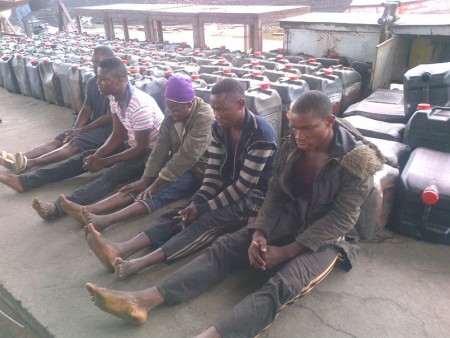
The Pipelines and Products Marketing Company, a subsidiary of the Nigerian National Petroleum Corporation, has recovered over 1,500 jerrycans of petrol siphoned by vandals at Ogere Waterworks in Ogun State.
Topline Leighton, a private security which monitors and patrols PPMC’s pipelines along the System 2B, said the discovery of the oil theft was made on Monday.
The Security Coordinator, Topline Leighton Limited, Mr. Adetona Adigun, said the private pipelines surveillance firm was engaged by the PPMC to monitor the NNPC/PPMC System 2B products pipelines from Atlas Cove Depot in Lagos to Mosimi in Ogun State and other areas in South-west region.
Adigun, who addressed journalists at Ogere Waterworks, said the firm had made a series of discoveries of fuel theft from the System 2B network, which accounts for 60 per cent of petrol supply in the country.
“We have achieved a landmark, which nobody has made, here at Ogere Waterworks in Ogun State. Over 1,500 of jerrycans full of petrol were seized from vandals, together with their equipment.
“This is our commonwealth, and with the collaboration of other security agencies – police, Navy, Civil Defence Corps, we are ready to match them in ensuring that our national assets are secured. It is not going to be business as usual.’ he said.
He said that three suspected vandals were arrested, adding that they would be handed over to the appropriate security agency for prosecution.
“All the arrests that we have been able to make have kept the vandals at bay. We have been having products pumped from Lagos to Mosimi, to Ibadan and to Ilorin. So, now our next line of action is to expand our operations.
“On December 25, 2015, we made a discovery in Ajebo, Ogun State that made the Managing Director of PPMC to come around. We also made another discovery at Ilase and at Robert Island Village, close to the Atlas Cove.
The House of Representatives has resolved to authorise the Federal Capital Territory Administration (FCTA) to continue spending from its 2015 budget until May 31, 2016. President Muhammadu Buhari had requested the National Assembly to grant an extension of time up to March 31, for the implementation of the Federal Capital Territory (FCT) 2015 budget.
Buhari said he was desirous of securing an extension to enhance the continuation of projects in the nation’s capital before the 2016 budget is signed into law.
Thus, in a bid to grant the presidential request expeditious passage yesterday, the House commenced debate on the general principle of the Bill, and set aside all its relevant rules to pass the Bill.
Chairman of House Committee on FCT, Hon. Herman Hembe, Benue APC, had proposed the amendment, which did not go down well with the opposition Peoples Democratic Party, PDP members.
Ruling, Speaker Yakubu Dogara, said laws were not retrospective but futuristic, saying that it was better to give up to May 31 than for the Administration to get stuck if the 2016 budget delays. He clarified that the moment the 2016 appropriation law is in place, it would automatically invalidate this approval.
The Nigerian Economic Summit Group has expressed its support for the implementation of the electricity tariff, which took effect on February 1, 2016, saying the new tariff regime would encourage private sector investment in the power sector.
The NESG, a private sector think-tank and policy advocacy group, said in a report that the country’s persistent electricity supply shortage presented serious obstacles to the growth and development of the economy.
It said this shortage of reliable power in sufficient quantity to meet the increasing requirements of a rapidly growing economy was predicted to be affecting the Gross Domestic Product growth by between two per cent and four per cent per annum.
The group noted that as of February 14, 2016, peak generation in the country was 4,741 megawatts for a population of 160 million people, compared to Algeria, another African country, which has 11,000MW for a population of 39 million people.
“Egypt has 24,000MW for a population of 88 million people. South Africa has 40,000 MW for a population of 53 million people, and Brazil has 100,000 MW for a population of 204 million people,” said NESG.
It said, “Under the former pricing regime, the combined sum of electricity prices and tariffs is far below industry’s costs. Unless these prices were raised significantly, the industry will never be viable (or seen to be heading in the direction of financial viability), and the private sector will not invest.
“Without private investment, the country will remain in the dark and extinguish any prospects for economic growth and development.”
According to the NESG, the rule of thumb for any developed industrial nation is that at least 1,000MW of electricity generation and consumption is required for every one million head of population. This rule provides a useful indicator as to the scale of the investments that need to be made in the Nigerian electricity supply industry over the coming years.
Nigeria will therefore need significant amounts of power generation, if it is to attain constant power supply (calculated to be 155,000MW using above rule of thumb), the group said.
Human rights lawyer, Mr. Femi Falana (SAN), has filed a suit at the Federal High Court in Abuja asking for an order restraining the Central Bank of Nigeria from allowing market forces to determine the exchange rate of the naira.
The renowned lawyer also asked the court to direct the CBN to stop the use of the United States of America’s dollar as a legal tender in Nigeria.
The suit, FHC/ABJ/CS/146/16, which was filed on behalf of Falana by a lawyer in his firm, Mr. Wisdom Elum, names the CBN as the sole defendant and is yet to be assigned to a judge.
Falana alleged in the suit that the CBN’s monetary policy had led to a situation where too much naira was made to chase a few dollars with an attendant weaker naira and adverse multiplier effects such as rising inflation, closure of factories and high level of unemployment.
He also alleged that the CBN had so “dollarised the economy” that the foreign currency had become a legal tender, with school fees as well as rents now being charged and paid in dollars “to the detriment of the economy.”
He contended that while the CBN had fixed the exchange rate at N198 to a dollar, and President Muhammadu Buhari had continued to restate his promise not to devalue the naira, the apex bank “had allowed market forces to increase the exchange rate to over N400 to a dollar.”
A supporting affidavit deposed to by another lawyer in Falana’s law firm, Mr. Femi Adedeji, stated, “The devaluation of the currency and dollarisation of the economy have made mockery of the yet-to-be-passed 2016 budget of the Federal Government.
“The monetary policy of the defendant (the CBN) has led to a situation whereby too much naira chase few dollars, thereby making the naira weaker in relation to the dollar and instigating an adverse multiplier effect.
“The monetary policy of the defendant has also led to increasing costs, rapidly rising inflation and interest rates, closure of factories and the attendant high level of unemployment.”
The lawyer, therefore asked the court to determine, “whether the monetary policy of the defendant, which allows market forces to fix and determine the exchange rate of the naira is not a violation of Section 16 of the CBN (Establishment) Act 2007 and Section 16 of the Constitution of the Federal Republic of Nigeria, 1999 as amended.”
The Minister of Agriculture and Rural Development, Chief Audu Ogbeh, revealed that its blueprint for the development of the agricultural sector will be ready in two weeks’ time.
“In another two weeks at the very farthest, we shall be presenting to you our road map, we shall be presenting it to you before we present it to the country.
“We will give you an idea of how we want to go about what we want to do, the areas of preference and the emphasis we want to lay on improving on production, creating wealth, cutting down on import because today the import bill is extremely high.’’
The minister revealed that the country’s volume of imports in rice and wheat was already reducing, adding that his ministry’s target was working on milk importation. He expressed optimism in the gradual improvement in tuber production and processing as well as cotton production for the textile industry.
Chairman, Senate Committee on Agriculture, Sen. Abdullahi Adamu, lauded the approach adopted by the present administration towards developing agriculture.
Gusau Institute founded by former Minister of Defence, General Aliyu Mohammed Gusau (rtd), has donated 15,000 volumes of books to tertiary institutions and secondary and primary schools in the country, saying that Nigeria’s economic growth and global competitiveness relies on development in the education sector.
According to an educational expert, Dr. Haroun Adamu, who represented the former minister at the presentation ceremony of the books to the institutions and schools, “It is our hope that these 15,000 volumes we are distributing today will indeed strengthen your hands as educators to transform and change the students in your care so that they can advance Nigeria’s growth and global competitiveness.”
“we have a large number of out-of-school children and young adults with limited literacy and numeracy skills who have little hope of ever joining the formal workforce. The educational system suffers from deteriorating quality and insufficient investment to keep pace with the country’s growing school-age population.”
Institutions that benefited from the donations are, Nigerian Defence Academy (NDA), Ahmadu Bello University (ABU), Zaria, Kaduna State University (KASU), University of Jos, Federal University, Gusau, Kaduna Polytechnic, Nuhu Bamali Polytechnic, Zaria, Federal College of Education, Zaria and Federal College of Technical Education, Zamfara, Musa Shehu Yar’Adua Centre, Abuja, Barau Dikko Specialist Hospital, Kaduna, Kaduna Public Library, College of Islamic Studies, Gusau, Zaria Academy; Secondary and Primary Schools.
Adamu spoke about the research library saying: “with approximately 22,000 volumes of books, journals and magazines and it is the biggest library in Nigeria.”
The Minister of State for Petroleum Resources, Dr. Ibe Kachikwu and other industry stakeholders will convene in Abuja next month to provide insights into the way forward for the Nigerian oil and gas industry amid the low oil price environment. The minister had confirmed his participation as the guest of honour and host minister at the 25th edition of its Annual Oloibiri Lecture Series and Energy Forum taking place on March 3, 2016.
According to the Chairman, SPE Nigeria Council, Mr. George Kalu, this year’s edition would bring together experienced exploration and production industry experts, who would provide insights into how to advance Nigeria’s oil and gas activities to mitigate the effect of low oil prices and chart the right course towards sustainable future for the industry.
The E&P executives that will speak at the event are the Managing Director/Chief Executive Officer, First E&P Development Company, Mr. Ademola Adeyemi-Bero; the Director, Department of Petroleum Resources, Mr. Modecai Baba-Ladan; the Managing Director, Shell Nigeria Exploration and Production Company, Mr. Bayo Ojulari; the Managing Director, ExxonMobil Nigeria, Mr. Nolan O’Neal; the Group Executive Director, E&P NNPC, Dr. Maikanti Baru, and the Chairman, PETAN and Managing Director, Oildata Inc., Mr. Emeka Ene.
President Muhammadu Buhari has said that Nigeria’s hope of economic revitalisation depends on the rapid development of its agricultural and solid mineral resources.
The President said his administration was fully committed to facilitating the productivity of Nigeria’s agriculture and solid minerals sectors to save the nation from the harsh effects of dwindling crude oil prices.
According to his Special Adviser on Media and Publicity, Mr. Femi Adesina, the President spoke in Riyadh on Tuesday at a meeting he had with leading members of the Council of Saudi Arabia’s Chambers of Commerce and Industry.
He had invited Saudi Arabian businessmen to invest in both agriculture and solid minerals, he said that his administration would welcome greater foreign investment in support of its efforts to rapidly diversify the Nigerian economy.
President Buhari regretted that the country had depended too much on crude oil exports to the neglect of other resources.
Fan Milk Plc is a leading manufacturer and marketer of healthy, nutritious and safe frozen dairy and non-frozen dairy food products with distribution channels across the length and breadth of Nigeria. Fan Milk Nigeria is a well established and fast growing food processing industry offering wide range of products
We are recruiting to fill the following vacant positions below:
Pfizer – Good health is vital to all of us, and finding sustainable solutions to the most pressing health care challenges of our world cannot wait. That’s why we at Pfizer are committed to applying science and our global resources to improve health and well-being at every stage of life. We strive to provide access to safe, effective and affordable medicines and related health care services to the people who need them.
We are recruiting to fill the position of:
Job Title: Trade Marketing Lead
Job ID: 1028229 Location: Lagos
Full-Time: Regular
Division: Marketing
Business Unit/Line: GEP
Reports to Position Title: Marketing Director NEAR
Position Summary
The Trade marketing Lead acts as “Change Agent” and will be responsible for the following:
Identify local strategic opportunities and challenges for retail/trade marketing
Collaborate closely with Country Portfolio Leads (CPL) to include retail chapter for brand plans and develop brand/Therapeutic Area (TA) strategies
Develop trade marketing tactics and programs
Collaborate with Retail & Distribution Manager to ensure brilliant execution of trade marketing tactics and programs
Act as change agent for retail in NEAR markets, master the “retail/trade marketing communication” to ensure full transparency
Position Responsibilities
Be the “Change Agent” for NEAR countries: ensure capability build-up and targeted service to achieve strategic retail objectives in the region
Convince countries of the opportunities of trade marketing at point of Sale and drive NEAR trade marketing strategies and tactics
Focus on Top 5 markets but support markets according to their individual need, provide trade marketing material/training etc.
Support NEAR in developing retail chapters for country and brand Operating plans
Collaborate with regional and country stakeholders to embed “success in retail”
Align with regional team on regional/local retail opportunities/challenges, set priorities
Collaborate with CPL to influence inclusion of trade marketing as a growth driver for main T.A (Cardiovascular, Pain , Anti-infective and Men & Women/ Specialty).
Collaborate with sales managers and commercial team to execute trade marketing programs at the point of sales and generate insights/analysis from implementation
Collect market level insight and share knowledge with Retail center
Consolidate market insights, develop market-specific solutions (share best practices)
Track results of trade marketing programs and capability build-up
Track individual program & tactic/market performance and its evolution
Monitor capability development in markets, support via coaching and track progression
Develop quality relationships and insights with new and existing customers – be “customer obsessed”
Organizational Relationships:
Report to Marketing Director
Provide insights on NEAR trade marketing reality
Be accountable for execution of agreed programs & tactics and responsible for budget allocated
Alignment on business priorities, trends and challenges
Trade marketing Lead to provide strategic advice and coaching with regards to “trade marketing” issues
Ensure effective alignment with Customer Service Colleagues – “one retail team”
Align on roles and responsibilities, i.e. focus on sell-out and sell-in
Fine-tune retail chapter in brand plans: Collaborate with CPL
Align on strategic priorities in NEAR : focus on defined top markets and key retail personality brands
Provide promotional materials to be expedited in NEAR markets
Ensure execution of retail programs, foster local retail creativity: collaborate with CPLs and Retail & Distribution Manager.
Facilitate tracking of performance
Instill a retail KPI mindset in the relevant teams/for relevant brands, i.e. add these KPIs to their performance judgment
Based on defined retail KPIs (switch, Numeric Distribution and Weighted Distribution) – monitor and interpret results and take action
Advance local capabilities are being built-up
In collaboration with Global Commercial Operation and Customer Service Colleagues, develop, offer and implement necessary training to enhance “retail capabilities”
Education and Experience
Education: First degree required; MBA an advantage
Pharmaceutical or FMCG industry experience within the area of Marketing or Trade Development
5-10 years relevant trade/customer marketing experience that can be applied in the Pharmaceutical Industry
Trade marketing expertise in independent channels beneficial
Experience in large organizations and highly regulated industries
Experience in influencing without direct/formal authority
Experience in cross-cultural environments, flexibly adapts
Lafarge Group – Created in 1833, Lafarge group, headquartered in France, is the world leader in building materials, with top-ranking positions in three of its activities: No 1 worldwide in Cement, No 2 worldwide in Aggregates & Concrete, and No 3 worldwide in Gypsum.
Located in 62 countries with 64,000 employees, Lafarge is a world leader in building materials, with top-ranking positions in its Cement, Aggregates & Concrete businesses. In 2013, Lafarge posted sales of 15.1 billion euros.
Lafarge ranked amongst the top 10 of 500 companies evaluated by the “Carbon Disclosure Project” in recognition of their strategy and actions against global warming. With the world’s leading building materials research facility, Lafarge places innovation at the heart of its priorities, working for sustainable construction and architectural creativity.
We are recruiting to fill the position below:
Job Title: Field Sales Executive
Location: Lagos
Business Unit: Aggregates and Concrete (A&C)
Job Type: Permanent
Job Description
Promote good H&S practices on customer forums, sites and at public forums
Execute the sales strategy on Micro-Financing & Micro-mass housing
Manage and organize the field work of the Easy Home team
Build partnerships with relevant prospect groups in the micro-housing sector
Execute the multiplier effect strategy at the field level
Represent Easy Home in various forums to create awareness on the programme
Implement Easy Home service to National scale
Identify opportunities for new products and/or service innovations
Duties & Responsibilities
Promote H&S best practices to staff and our customers
Manage Easy Home field activities to ensure they achieve their own KPIs and the Business Units ambitions & budget
Organize and track weekly activities of team leads, sales reps, and technical assistants
Planned and random site visits
Daily communication with the whole team
Ensure supply of cement is well supported by partnering retailers
Organize and drive the multiplier effect with partnering retailers
Network with other relevant stakeholders in the micro-housing segment in Nigeria (cooperatives, CDAs, religious associations, workers/market associations, company unions, etc.) to drive sales
Report & control Budget for Easy Home team
Aggregate and analyse Weekly reports on cement sales, clients numbers, and multiplier effect
Aggregate and analyse Monthly reports on cement sales, clients numbers, and multiplier effect
Ensure the alignment with the Cement function sales strategy
Execute the improvement of construction quality strategy
Train the team on selling the partnering workers supply organization and ensure implementation
Train the team on selling the standardized designs
Ensure roll-out of the Easy Home programme to the national level
Alignment with partnering microfinance team in all locations
Support in recruitment of the team
Training of Easy home team (LafargeHolcim and partnering microfinance bank) on sales
Identify relevant cement retailers, blockmakers and other building materials sellers – possibly one-stop-shops – according to pre-defined criteria to partner with the programme,
Drive the multiplier effect with the new partnering retailers.
Essential & Desirable Skills
Good knowledge of construction materials sales best practices, and housing market in general in Nigeria
Knowledge of LafargeHolcim products
Presentation, communication and networking skills
Vision, business sense, basic financial knowledge and negotiation skills
Strong customer focus
Results orientated, proactive, capable of delivering under pressure
Independent thinker and manager of own timings
Ability to discuss and influence others
Good team player with effective interpersonal skills covering group facilitation and customer interface aspects
Application Close Date
1st March, 2016.
How to Apply
Interested and qualified candidates should APPLY