Diamond Bank Plc joined a host of other companies last week to sending a profit plunge warning to capital market operators.
FCMB Group Plc and FBH Holdings Plc had sent similar profit warnings to the market due the challenging operating environment.
Also, Computer Warehouse Group (CWG) Plc last Tuesday said it would record loss for 2015 financial year.
Diamond Bank said on Friday that the lingering deterioration in Nigeria’s macro-economic conditions has resulted in the bank recognizing higher than expected impairment charges on loans made to the energy and commercial business sectors.
The bank said: “In light of these deteriorating conditions, and subsequent review of Diamond Bank Plc’s management accounts for the financial year ended December 31, 2015, preliminary indications are that earnings will be lower than in 2014.”
According to the bank, in recent years, it has deployed considerable resources in building a dependable risk management framework, and the quality of its loan portfolio in general, remains high.
Oil and gas industry players have been urged to adopt cost-saving processes to stay afloat as oil price plunge leads to cancellations of significant projects and delays put at $600 billion.
The Managing Director/Chief Executive Officer, First Exploration and Petroleum Development Company Limited, Ademola Adeyemi-Bero, who gave the advice, said the over-supply and oil in storage are still at record levels, which is about three billion barrels.
Adeyemi-Bero said global demand growth for oil would continue steady at 1.2 million barrels per day (bpd) per year.
He noted that the global over supply has been driven by the United States shale play and Canadian oil sands mines, despite the fact that United States oil and gas drilling experiencing a historic drop, well below 1990’s levels.
Adeyemi-Bero said US oil shale reservoir declined by 6.8 per cent monthly, but that these factors don’t have visible impact because of market over-supply.
He said most private players were driven by major budget cuts and shortages and that Brent oil price has reached bottom level while Henry hub gas price touched below $2 per million standard cubic feet (mscf) with the US exporting its first liquefied natural gas (LNG) cargo in over four decades.
He said to counter oil price volatility and instability, said smart solutions must be deployed to derive maximum value during project development and execution and throughout asset lifecycle operations.
He moved for the use of low unit technical cost (UTC), such as maximizing hydrocarbon recovery and reservoir development and reservoir and facility management.
Despite the volatility in the global oil market, China is seeking more crude oil exports from Nigeria, the Chinese Embassy’s Economic and Commercial Counsellor, Mr Zao Ling Xiang, said at the weekend
“The total amount of export to China is only about one million barrels in 2015 that was just 1.3 per cent of Nigerian annual oil export.
“In my opinion, it really doesn’t matter whether Iran comes back or not; Chinese companies want to import more crude oil from Nigeria,” Lin Xiang said.
The trade volume between both countries stands at $14.94 billion (2014), making Nigeria China’s third largest trade partner in Africa.
The economic counsellor added that Nigeria’s trade figure was 8.3 per cent of China’s total trade volume with Africa and 42 per cent of the total trade volume between China and Africa.
Besides, both countries have made “remarkable achievements” in infrastructure cooperation.
Lin Xiang said President Muhammadu Buhari’s planned visit to China next month will facilitate the implementation of agreements reached at the 2015 China-African Summit in Johannesburg.
He said China also sought to explore other areas of cooperation with Nigeria, adding: “China is the largest developing country in the world and Nigeria is the largest developing country in Africa and both countries have complementary advantages in natural and human resources, funds and markets.
“Right now, the Nigerian Government is trying to diversify its economy, which is fully in line with the 10 China-Africa cooperation plans announced at the summit on China-Africa trade in Johannesburg in 2015.
A four-man team from the International Civil Aviation Organization, ICAO, has arrived Nigeria to kick off the Universal Safety Oversight Audit Programme, USOAP, which begins today, Monday, March 14.
The General Manager, Public Relations of the Nigerian Civil Aviation Authority, NCAA, Sam Adurogboye, confirmed the arrival of the team in a statement yesterday.
Relevant authorities including NCAA and FAAN have expressed readiness for the audit, which is expected to end on March 25. Areas to be inspected by the auditors according to the NCAA spokesman include legislation, organization, accident and incident investigation, air navigational services (ANS) and aerodrome & ground aids (AGA).
There would be a closing meeting where the draft audit result would be presented, the statement said.
Findings have revealed that Nigerian airlines are now spending more money on aircraft maintenance and purchase of aircraft spare parts.
The cost of maintenance has jumped by in recent times due to the high exchange rate, according to ThisDay findings.
According to some airline operators, the high exchange rate negatively impacting domestic airlines operation because major checks are carried out overseas and payments for such services made in foreign currency, whereas they earn their revenue in Naira.
The slide in the value of the naira since last year, prompted airlines to vote more funds from their meagre earnings on maintenance.
Also, in order not to jolt the domestic market, the operators were said to be reluctant to increase fares, fearing it could further shrink the number of air travellers as purchasing power has nose-dived due to prevailing economic crunch.
A recent report revealed that most Nigerians who hitherto travel by air now resort to other means of transportation to get to various destinations.
The federal Government through the Nigerian Communications Commission, NCC, is projecting at least N44 billion ($224 million) earnings from the planned auction of 14 lots in the 2.6Gigahertz spectrum band licensing to telecommunication operating companies from May 16, 2016 in Abuja.
For roll-out of services, NCC intends to follow the International Telecommunication Union (ITU) recommendation setting aside spectrum in the 2.6GHz band for the provision of advanced wireless broadband services.
The IM defines the process that NCC has decided to adopt for the licensing of 2 X 70 MHz paired Spectrum available in the 2.6 GHz band. It provides information on the Nigerian telecommunications market, details of the spectrum to be made available, the prequalification process, the auction process and indicative timetable.
The proposed licensing of 2.6 GHz spectrum has been influenced by the need to open up the space for the delivery of present and future generations of broadband services to subscribers in consonance with the Nigerian National Broadband Plan of 2013.
NCC is offering 14 Lots of 2 X 5 MHz FDD paired spectrum in the 2.6 GHz band ranging from 2500 – 2570MHz and 2620 to 2690MHz (totaling 2 X 70 MHz) for auction. The Generic Reserve Price (GR) is the minimum price at which a Lot shall be sold, which is the Reserve Price for one Lot of 2 X 5MHz and has a value of $16,000,000.00 only.
Each lot of 2 X 5 MHz represents one (1) eligibility point. An applicant that pays the IBD for six (6) lots will have a total of six Eligibility Points. The Reserve Price (R) for an applicant will be calculated as the GR multiplied by the number of lots (N) applied for by the applicant. For example, Reserve Price for an applicant that applied for six Lots i.e. six Eligibility Points is: US$16,000,000.00X 6 = US$96,000,000.00.
The spectrum lots won by each bidder will be assigned on a nationwide basis covering all the states of the federation and the FCT. However, for the purpose of enforcing the “used it – or – lost it” clause, a Licence will be issued for each of the States of the Federation as well as for the FCT to each winning bidder.
The spectrum is offered by NCC on a technology neutral basis and can be used to provide any telecommunications services.
Telecommunications subscribers in Nigeria have kicked against the Federal Government’s proposed communications service tax.
The new Communication Service Tax Bill seeks to impose, charge and collect Communication Service Tax (CST) and will be levied on service fees payable by users of electronic communication services which will be borne by the customers.
The categories of communication services liable to the tax include voice calls, SMS, MMS, Data and Pay TV.
Describing the imposition of tax as another way of exploiting the struggling consumers, subscribers urged the government to seek other alternative ways to generate revenue, adding that such bills if passed into law may bring about double taxation as the phone companies would hike their charges.
According to Executive Secretary of ATCON, Ajibola Olude “Already, Nigerians are complaining of economy hardship, imposing another tax on them will add to their burden and in effect, reduce communications growth.
“As far as we acknowledge that it is a trying period for the economy, that is not to say that we should transfer the burden on consumers who are also strongly affected by the harsh economy status.”
“Already, subscribers are already paying high for telecommunications services compared to what is obtainable in other countries. Asides this, telecommunicaton business will be largely affected because subscribers will reduce their interaction with telecommunications services and in turn affect the overall profits of service providers.” Olude noted.
Manufacturers have called on the President Muhammadu Buhari-led administration to promote the patronage of locally produced goods so that local industries would not fold up.
An indigenous manufacturer of aluminium products, Tunde Adesoye, a member of the Manufacturers Association of Nigeria (MAN), in an interview with newsmen in Lagos, said the rise in the exchange rate coupled with epiletic power supply and bank loan rate are impeding local manufacturers from producing at lower cost, making locally produced goods appear costlier than imported finished products.
Adesoye said, government needs to support local manufacturers to survive the present unfavourable economic situation in the country by introducing the policy of buying Made-in-Nigeria goods and discourage dependence on imported goods for the economy to grow.
He said: “President Buhari has done well for not agreeing to devalue the naira. A lot still needs to be done to assist local manufacturers. What we, local manufacturers, are producing is not in any way sub-standard compared with the imported goods. Nigerians should be made to understand this fact.”
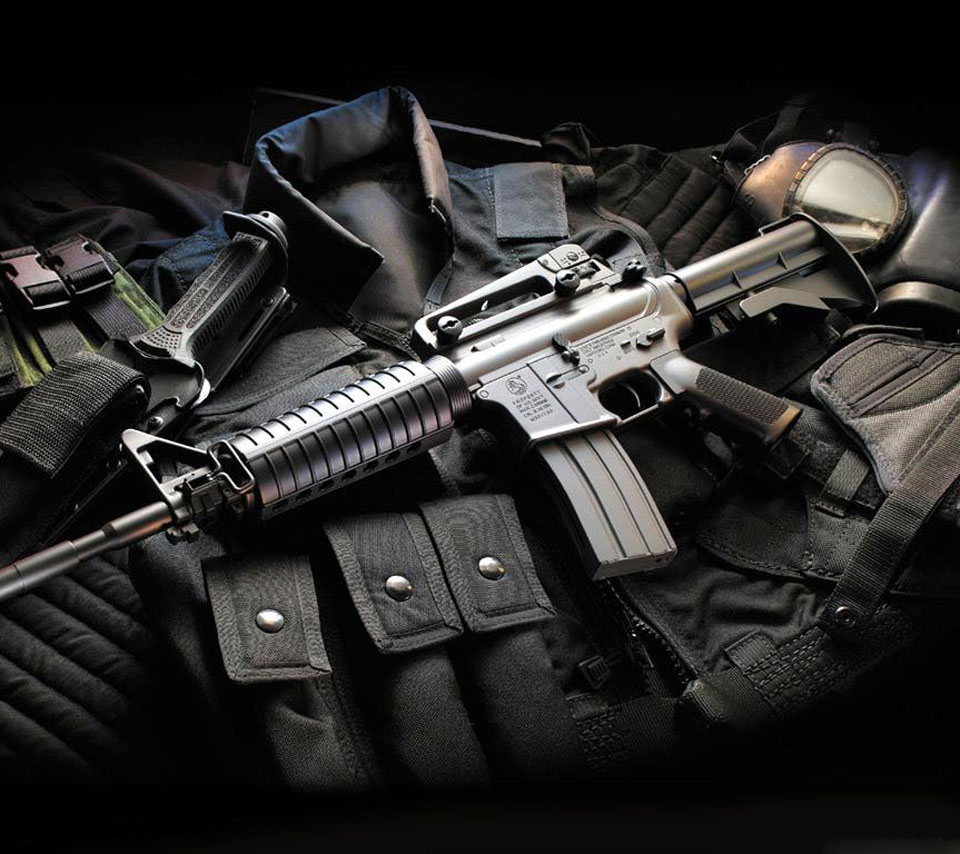
President of the West Africa Action Network on Small Arms, WAANSA, and a Member of the Nigerian Presidential Committee on Small Arms and Light Weapons, PRESCOM, Nkemakonam Dickson Orji, has revealed the number of small arms in Nigeria.
The Small Arms Survey Group in Geneva to the International Action Network on Small Arms (IANSA), including Oxfam, Grip and other researchers and international NGOs indicated that over the years there have been over 690 million illicit Small and Light Weapons (SALW) in circulation across the world.
Orji said: “They claim that approximately 100 million of these weapons are in sub-Saharan Africa, 8-9 million in West Africa and 2 to 3 million in Nigeria.”
He said he is aware that the Presidential Committee on SALW is currently conducting a comprehensive national SALW survey in Nigeria to ascertain the true figure, and understand the gravity of the proliferation in order to develop a suitable national action plan.
Orji said locally-made weapons are not too popular with insurgents, but mainly found with armed robbers, kidnappers and cults across the country.
He said that the current Nigerian firearms Act was adopted during colonial rule in 1959, which makes it obsolete and unable to tackle present-day security challenges. “It is also very important that offenders are made to face the law,” he added.
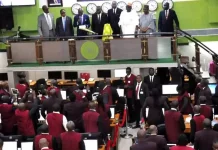
Trading activities on the floor of the,Nigerian Stock Exchange, NSE, ended in the Green zone on Friday, March 11, as market capitalization surged marginally by N22 billion or 0.25 per cent.
Transaction closed at N8.94 trillion from the N8.92 trillion recorded on Thursday, March 10.
Also, the All-Share Index, which opened at 25,923.77 improved by 64.63 points or 0.25 per cent to close at 25,988.40.
Mobil led the gainers’ chart by N11.05 to close at N171 per share.
Total Oil followed with a gain of N7.05 to close at N150 per share, while Nigerian Breweries grew by N3.5 to close at N100 per share.
FlourMill appreciated by N1.78 to close at N20.16 per share and Oando Oil rose by 49k to close at N5.35 per share.
On the other hand, Nestle led the losers’ with a N10 loss to close at N690 per share, while Dangote Cement depreciated by N1.01 to close at N164 per share.
Access Bank lost 22k to close at N4.42 per share, while GTBank and Zenith bank dipped by 5k each to close at N16.25 and N12.35 per share, respectively.
FBN Holdings emerged as the most traded equity, accounting for 23.98 million shares worth N88.62 million, while Fidelity Bank followed with an exchanged 16.12 million worth N19.91 million.
Trascorp sold 15.68 million shares worth N18.91 million and Zenith Bank traded 15.22 shares valued at N188.75 million.
In all, investors exchanged a total of 165.98 million shares worth N1.30 billion in 2,895 deals.
The volume represented 46 per cent decrease over the 310.65 million shares valued at N2.06 billion traded in 3,010 deals on Thursday.
Brent crude posted its third weekly gain on Friday, March 10, supported by an optimistic report from the International Energy Agency.
However, analysts warned that a large glut of oil remained, with Goldman Sachs warning that U.S. crude could saturate storage in the coming months.
U.S. crude futures were trading at 38.64 dollars a barrel, up 80 cents from their last close, having hit a 2016 high of 38.96 dollars earlier in the day. Brent crude futures were at 40.65 dollars a barrel, up 60 cents, and on track for their third weekly gain in a row.
“We expect a decision next week on imposing sanctions on these three,”one EU diplomat said.
He stressed that EU foreign ministers are not expected to decide on Monday but that a decision could come later in the week.
The Price of Premium Motor Spirit also known as petrol has jumped to N180 per litre at some filling stations owned by Independent Marketers in Benin City
At the black market, fuel sold for N200 per litre and above.
Fuel was sold at some NNPC mega filling station and some major marketers that were supplied fuel from Benin Depot of the NNPC sold fuel at the approved pump price.
Fuel chart released at the Benin depot showed that about 800,000 liters of fuel were supplied to filling stations across the state.
A manager at one of the fuel station where fuel was sold for N160 said they got the product at a price of N120 per litre.
Prices of transport fares have also leaped within Benin City and environs.
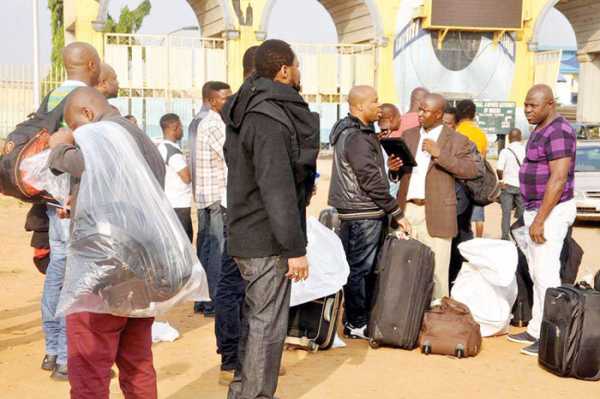
The Libyan Government on Friday, March 11, deported 172 Nigerians over several immigration irregularities.
The deportees arrived the hajj camp area of the Murtala Muhammed International Airport around 7:00am comprising 166 males and six females.
The Public Relations Officer, Nigeria Immigration Service, NIS, Ekpedeme King, who confirmed the deportation did not give the registration number of the aircraft that brought them into the country.
The returnees were received by various agencies such as Immigration that checked their identities to ascertain their nationalities, Police, National Agency for Protection and Trafficking in Persons, NAPTIP, and other relevant stakeholders.
As at the time of filing this report, the returnees had moved away from the Lagos Airport to their various destinations.
King said the deportees were returned to the country for overstaying their visas in Libya and other immigration offences in the North African country.
He said: “What I can tell you is that some Nigerians were deported today (yesterday) for immigration offences. Most of those brought overstayed Libya.
One of the deportees, who simply identified himself as Chris claimed that he travelled out of Nigeria about two years ago in search of greener pastures.
He however insisted that he didn’t commit any crime in Libya that would warrant his deportation back to Nigeria.
Last November, about 76 Nigerians were deported from three European countries including United Kingdom.
The Nigeria Union of Petroleum and Natural Gas Workers, NUPENG, on Friday, March 11, said that the ongoing fuel scarcity in the nation might linger till the end of March.
The South-West Chairman of the union, Tokunbo Korodo, disclosed this in an interview with the News Agency of Nigeria (NAN) in Lagos.
He said that from all indications, loading of petrol at both NNPC depots and private depots were very slow.
“The pace of loading of fuel at NNPC depots in Mosinmi and Ejigbo is very slow as most tankers drivers that wanted to load, left the depots with nothing.
“Even at private depots where they sell above the ex-depot price, the pace of loading is very slow. Presently, we need massive loading of petrol nationwide to get over the present scarcity.
“I am imploring the government to improve on supply of fuel to all depots nationwide so that our tanker drivers can get the product and transport it to filling stations,’’ he said.
Access Bank Plc has inaugurated various strategies to ensure gender parity in its organisation adding that it has taken a decision to speed up the process and also pledged to make gender parity a priority. The financial institution noted that the move would help include and advance women in every society.
In commemoration of the 2016 International Women’s Day celebration recently, Access Bank also stated that it promoted gender empowerment and equality during a two-day programme which focused on advocacy and gender awareness.
This, it stated served as a demonstration of its commitment to gender equality, women empowerment and inclusiveness, to which its ‘W’ initiative is dedicated.
As part of the outlined programmes, the bank hosted a workshop on Gender Balance for its male staff and customers aligned with the theme for this years’ celebration ‘Pledge for Parity’ to elicit participants’ commitments on helping women and girls achieve their ambition, challenge conscious and unconscious bias and subscribe to the concept of gender balanced leadership.
The session was mainly targeted at male participants and leading organisations, would also encourage equal valuation of the contributions of women and men in the workplaces and the society at large.
Nigeria’s Minister of Communications, Adebayo Shittu, has asked telecom operators to roll over subscribers’ unused monthly data to the new month.
Mr Shittu, who made the request on Wednesday at a meeting with the operators in Abuja, also urged the operators to desist from fraudulent and unauthorised charges or risk sanctions from the Ministry, saying that many Nigerians had sent in petitions to his Ministry over unauthorised charges or deduction for unsubscribed or unsolicited messages.
The Minister also frowned at the poor quality of service across all networks and cautioned against wiping out unused data of subscribers.
Mr Shittu also expressed concerns over the disengagement of Nigerian employees through outsourcing to foreign companies and discrimination against them by operators.
Africa’s largest tower company IHS, has agreed to buy its Nigerian rival, Helios Towers for an undisclosed sum.
According to the Mobile Telecom Infrastructure’s Chief Executive Officer, Mr Issam Darwis, the company will acquire 1,211 towers spread across 34 of Nigeria’s 36 states.
“IHS will acquire the full control of the entire issued share capital of Helios Towers, its underlying business as well as market independent infrastructure sharing services to mobile network operators and internet service providers in Nigeria,”
IHS already has about 23,000 towers across Ivory Coast, Cameroon, Zambia and Rwanda, but its biggest market remains Nigeria with about 15,000 towers spread across the country.
The deal is expected to be reached in the second quarter of 2016.
Minister of the Federal Capital Territory (FCT) Malam Muhammad Bello has called for a multi-disciplinary meeting of all professionals involved in the building industry to help create better housing conditions for residents in the territory, with affordable prices.
He reiterated that the meeting was imperative in order to enable professionals to brainstorm and ensure that sanity is brought to the sub-sector, thereby providing more housing delivery to the populace.
The Deputy Director/Chief Press Secretary, Muhammad Sule, stated that the minister urge architects, engineers, town planners, surveyors and builders should all come together to find a better way to fast track the entire process from the drawings, building plan approvals, setting out and the entire building construction process in the territory.
Mallam Bello condemned a situation where houses are built in estates without giving enough space for greening, planting of trees and at least a garden at the backyard as well as space for children play area.
The Lagos State Governor, Akinwunmi Ambode, has disclosed that the state government plans to transform the 294 Primary Health Care centres in the state to international standard.
Ambode, who was represented by his Special Adviser on Primary Health Care, Dr Olufemi Onanuga, said the government also planned to revamp dilapidated schools across the state in the next six months.
“Lagos State has a lot of PHC centres on ground. There are 294 PHC centres in the state; some are disused, some are dilapidated and some are functioning well.
“Our emphasis now is on the health care delivery system, education and social welfare in terms of empowerment and employment of the people.
“If you look at all our schools, they are in a serious state of disrepair and we want to focus the next six months on education by making our schools to be of international standard. All our primary health care centres will also be of international standard, as well as social welfare in terms of empowerment and employment opportunity.”
Executive Secretary of the council, Alhaja Fausat Olajokun, appealed to the governor to upgrade the newly commissioned health care centres to general hospitals and provide equipment and workers for optimal service delivery.
The Lagos State Governor, Mr. Akinwunmi Ambode, has praised teachers for their commitment to preparing pupils for excellence in public debates.
The governor stated this on Thursday at the grand finale of the Lagos State Schools’ Debate, where he was represented by his deputy, Dr. Idiat Adebule.
According to him, the programme is aimed at helping pupils gather relevant skills that would develop their mental intelligence and development.
“The good performance of our pupils in this debate is a proof that the teachers in our public schools are doing well and are justifying government’s huge investment in education and our government will continue to implement policies that can bring out the best in our children, knowing they are our future leaders. As a government, we will continue to be committed to providing the best not only in terms of quality education, but in terms of good and enabling environment for these pupils to learn and flourish properly,”.
Aside from the Individual Speakers category, pupils from C.M.S. Girls Grammar School, Bariga, and the Lagos Progressive Senior Secondary School, Surulere, battled for the third place position, while pupils from Ogudu Senior Grammar School, Ogudu and Badagry Senior Grammar School, Badagry, fought for the first position.
While pupils from Badagry Senior Grammar School emerged the winner, their counterparts from Ogudu Senior Grammar School came in the second position. The third position went to pupils of the Lagos Progressive Senior Secondary School.
The moderator, Mrs. Omolara Iruewe, said the pupils were assessed on comportment, power of persuasion, articulation and content of delivery.