Key Points
- ADC chieftain Kenneth Okonkwo has criticised the removal of petrol subsidy, saying it has worsened economic hardship and weakened Nigerians’ purchasing power.
- He defended Atiku Abubakar’s proposed fuel affordability plan, arguing that it would reduce production costs rather than restore the former subsidy regime.
- Okonkwo also criticised the performance of the naira under President Bola Tinubu, linking its decline to inflation and currency depreciation.
- His comments come amid renewed debate over petrol prices and the economic consequences of subsidy removal.
Main Story
ADC chieftain Kenneth Okonkwo has faulted the Federal Government’s decision to remove petrol subsidy, arguing that the policy has intensified economic hardship and eroded the purchasing power of Nigerians.
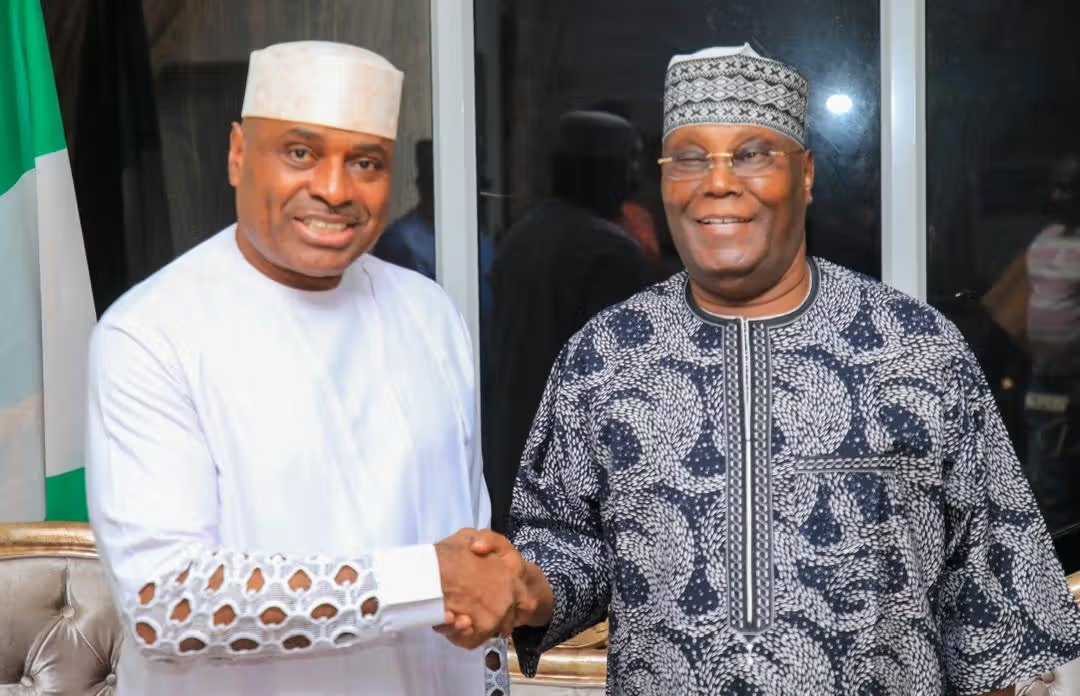
Okonkwo made the remarks during an appearance on Channels Television’s Sunday Politics, while explaining former Vice President Atiku Abubakar’s proposal to make petrol more affordable if elected president in 2027.
He described the subsidy removal as an ill-advised policy and argued that Nigerians had not seen sufficient benefits from the savings the government says the policy has generated.
Okonkwo cited the current petrol price, which he put at around N1,300 per litre, as an illustration of the pressure facing households. He noted that filling a vehicle with a 100-litre tank would cost about N130,000, compared with the N70,000 minimum wage.
He argued that Atiku’s proposed approach would not amount to a return to the previous subsidy regime. Instead, he said it would focus on making crude oil available to domestic refineries at affordable rates in order to reduce the cost of refined petroleum products.
The former actor also argued that nominal wage increases under the Tinubu administration had not translated into improved living standards because of inflation and the depreciation of the naira.
He said Atiku’s proposed Atiku Fuel Affordability Plan (AFAP) would focus on lowering production costs rather than subsidising fuel consumption.
The Issues
The debate over fuel subsidy has remained one of the most contentious aspects of President Tinubu’s economic reforms since he announced its removal during his inauguration on May 29, 2023.
The policy triggered an immediate increase in petrol prices, with the government subsequently defending the decision on the grounds that subsidy savings have increased funds available to the Federation.
Okonkwo, however, argues that the financial gains to government must be weighed against the impact of higher fuel costs and inflation on household purchasing power.
He also compared the N30,000 minimum wage under the previous administration with the current N70,000 minimum wage, arguing that the nominal increase had not necessarily translated into greater purchasing power.
The disagreement reflects a broader debate over whether Nigeria should prioritise direct fuel-price intervention or focus on reducing production and refining costs to make petroleum products cheaper.
What’s Being Said
“N130,000 is almost two times the minimum wage of a Nigerian. Meaning 70,000 naira paid to a Nigerian can only afford him half a tank of his vehicle. No rent, no food, no medical, nothing,” said Kenneth Okonkwo.
“Atiku is not going back to that. And cannot even go back to that. Why? We have our local refineries now working,” he further explained.
“Naira has become useless in Tinubu’s government. This government is destroying our currency, destroying our economy,” he added.
“What Atiku is talking about is that oil is our product. We do not have any basis for producing it in our land by ourselves and still selling it to Nigerians at an unaffordable price,” he maintained.
“50% of the 30,000 Naira people were earning before Tinubu came into office has greater value than the 70,000 he’s offering Nigerians,” he further argued.
“Atiku is aiming at increasing the quality of Naira, not the quantity of it,” he stated.
What’s Next
The Federal Government’s position on subsidy removal remains centred on the fiscal savings generated by ending the policy.
On Wednesday, Finance Minister and Coordinating Minister of the Economy Taiwo Oyedele said the removal of the petrol subsidy generated N15.8 trillion in savings for the Federation between June 2023 and December 2025.
Atiku has nevertheless proposed a targeted intervention to make petrol more affordable if elected president in 2027, keeping fuel pricing and subsidy policy firmly within the emerging political debate ahead of the election.
Bottom Line
Okonkwo’s criticism puts the economic consequences of subsidy removal at the centre of the 2027 political conversation, particularly its effect on fuel prices, household purchasing power and the value of the naira.
His defence of Atiku’s proposal rests on a different model: reducing the cost of producing and refining petroleum rather than returning to the former subsidy system.