







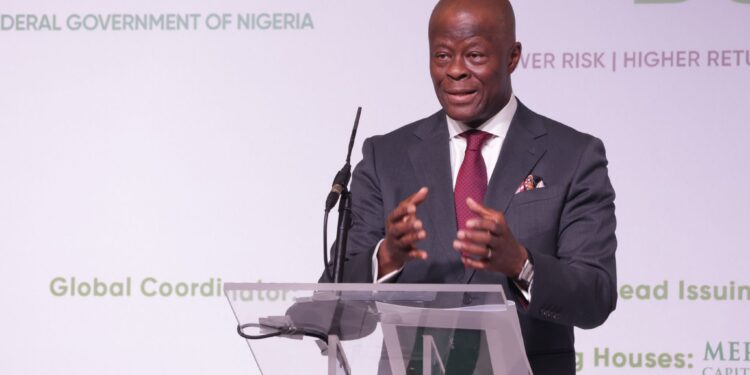
Nigeria’s Minister of Finance and Coordinating Minister of the Economy, Wale Edun, has emphasised the need for the country to depend more heavily on domestic resource mobilisation to drive sustainable economic expansion in an increasingly uncertain global environment.
Speaking at a press briefing in Abuja, Edun stated that the international economic landscape has become more fragmented, with reduced multilateral cooperation and elevated global financial risks.
He noted that discussions at global forums, including meetings of the G-24, highlighted the growing financial strain on developing economies. According to him, many emerging markets are experiencing net negative capital flows as debt servicing obligations outpace foreign direct investment (FDI) and overseas development assistance (ODA).
“In 2024 alone, developing countries paid approximately $163 billion in debt servicing. In comparison, ODA amounted to about $42 billion, while FDI stood at roughly $97 billion. The implication is clear: more capital is leaving than entering these economies,” he explained.
Edun said Nigeria’s engagement at international investment platforms reinforces the reality that, amid slow global growth and persistently high interest rates, developing countries must increasingly rely on internal revenue generation and productivity improvements.
“We must mobilise domestic revenues, strengthen investment inflows, raise productivity levels and generate employment opportunities to reduce poverty,” he stated.
Nigeria currently chairs the G-24 group and has used the platform to advocate reforms in the global financial system, including fairer sovereign credit assessments. Edun argued that conservative credit rating methodologies have contributed to higher borrowing costs for African economies.
He also observed that artificial intelligence (AI) could initially exacerbate inequality before delivering long-term productivity gains and broader economic benefits.
On macroeconomic performance, Edun pointed to improving growth momentum. Nigeria’s GDP expanded by 3.1 percent in the first quarter of 2025, accelerated to 4.23 percent in the second quarter, and moderated slightly to 3.98 percent in the third quarter.
The government projects fourth-quarter growth between 4.2 and 4.5 percent.
According to him, the upward shift from roughly two percent annual growth to above four percent demonstrates reform impact, with a long-term target of achieving at least seven percent yearly expansion.
He argued that sustained seven percent growth would exceed population growth rates and significantly reduce poverty, citing the development experiences of China and India as examples.
Edun further highlighted structural changes within the economy. Oil and gas now contribute less than four percent of GDP, down from 5.65 percent in 2019. Oil exports also account for approximately 65 percent of total exports, compared with 87 percent in 2019, reflecting gradual diversification into non-oil sectors.
He credited macroeconomic stabilisation measures, including monetary tightening by the Central Bank of Nigeria, for moderating inflation, stabilising the exchange rate, strengthening reserves, and restoring investor confidence.
Looking ahead, the next reform phase will prioritise scaling investment to sustain growth, particularly in a high global interest rate environment.
The 2026 Appropriation Bill currently before the National Assembly, he said, is structured to promote investment-led growth, enforce fiscal discipline, and ensure efficient resource allocation.
The economic management team has engaged the Senate Appropriations Committee to clarify budget provisions and strengthen implementation mechanisms.
Edun also commended President Bola Tinubu for issuing an executive order mandating the direct remittance of specific oil sector revenues to the Federation Account, describing the directive as a move that would enhance fiscal federalism, strengthen public finances, and improve government capacity to fund essential services.