





Nigeria has entered the global carbon removal market with its first industrial-scale carbon credits, signaling a strategic shift as the country seeks to diversify beyond oil and capture a share of what analysts project will become a trillion-dollar climate economy.
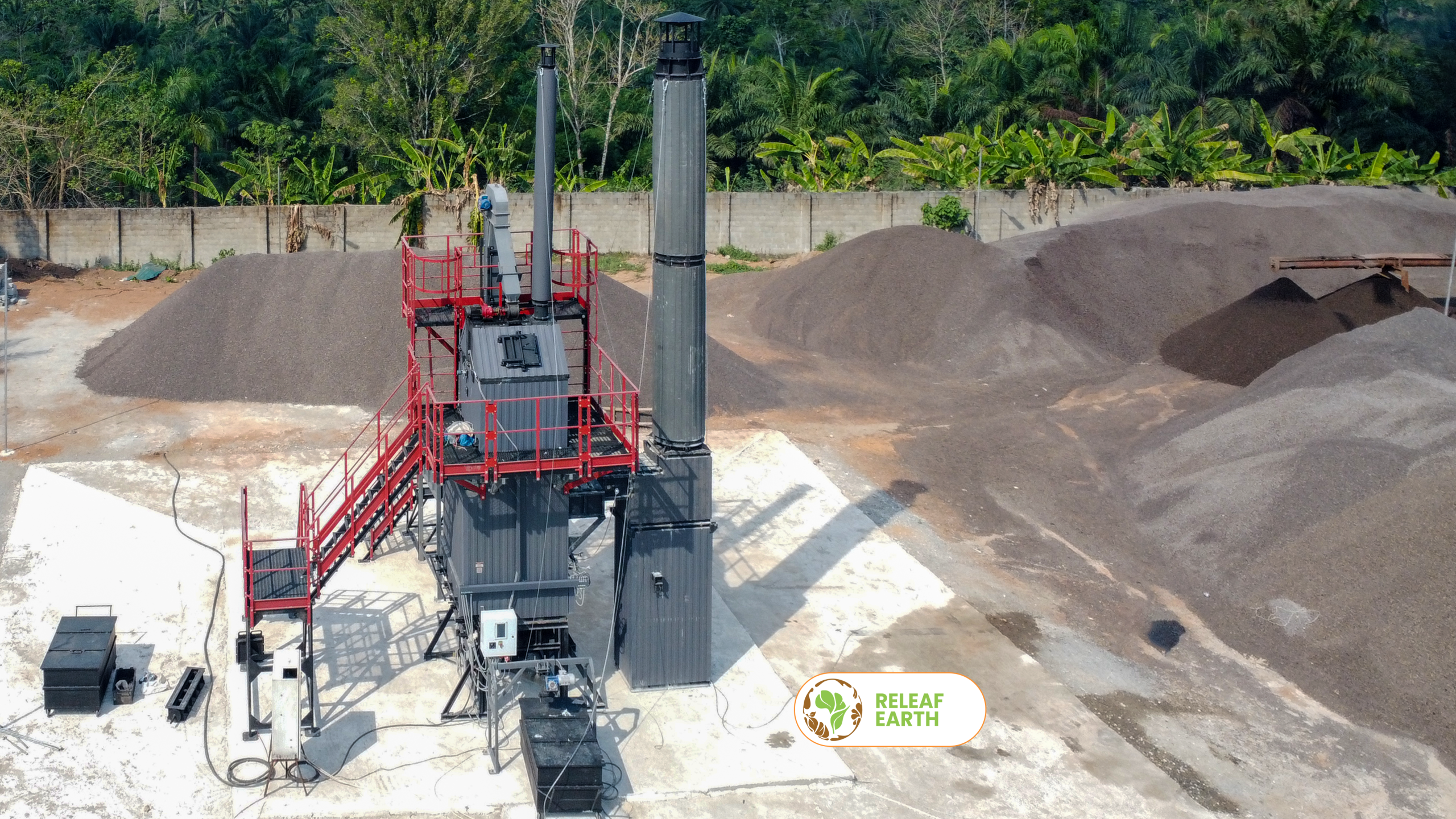
Climate technology company Releaf Earth announced the successful issuance of 190 tonnes of verified carbon dioxide equivalent (tCO₂e) credits, generated from its biochar production facility in Iwuru, Cross River State. The credits have already been purchased by multinational corporations, including Salesforce, through the climate funding platform Milkywire.
The development comes as President Bola Tinubu’s administration targets $3 billion annually in carbon market revenue by 2030, part of broader economic diversification efforts as the country faces pressure to reduce oil dependency and stimulate foreign investment.
Physics-Based Permanence Addresses Market Skepticism
Unlike traditional forestry offsets that have drawn criticism for reversibility risks from wildfires or deforestation, Releaf Earth’s approach relies on biochar – a thermally stabilized form of carbon created through pyrolysis that is chemically resistant to decay once applied to soil.
The company converts agricultural waste into biochar through high-heat processing in low-oxygen environments, transforming organic carbon into an inert, solid form that can remain stable in soil for centuries. This process has earned Releaf Earth’s Inertinite Gold Certification, representing the highest standard for carbon storage security.
“The permanence is guaranteed by physics, not policy promises,” explained Ikenna Nzewi, CEO and co-founder of Releaf Earth. “We are removing carbon dioxide more cost-effectively than anywhere else in the world.”
The credits were issued through the Rainbow Standard, a data-first registry built on international frameworks including ICROA, CRCF, and ICVCM standards. Releaf Earth has also deployed its proprietary SITE geospatial tracking system, layered with the Rainbow Protocol, to trace every tonne of carbon from farm source to final soil application.
Trillion-Dollar Market Opportunity for African Continent
With Africa producing over one billion tonnes of biomass annually, the continent is positioned to become a major supplier in the emerging carbon removal market. Industry analysts project global demand for high-integrity carbon removal will reach trillion-dollar valuations as corporations worldwide race to meet net-zero commitments.
For Nigeria specifically, the carbon market represents a new export category alongside traditional commodities. The country’s agricultural sector generates substantial organic waste that can be converted into both carbon credits and soil amendments, creating dual revenue streams.
Smallholder Farmers Set to Benefit
Releaf Earth’s business model includes returning biochar to smallholder farmers, who are seeing crop yield increases of up to 23% – a significant boost as fertilizer costs surge globally. Combined with new revenue from monetizing agricultural waste previously discarded or burned, the company projects farmer incomes could increase by over 50%.
The “Circular Wealth Engine” approach addresses a key criticism of carbon markets: that benefits often flow primarily to intermediaries rather than local communities. By enhancing agricultural productivity while generating carbon credits, Releaf Earth’s model aims to demonstrate that climate action can align with rural economic development.
Testing Global Appetite for African Climate Solutions
The successful sale to global technology giants like Salesforce serves as a market validation test for Nigeria’s climate solution exports. If sustained, the model could demonstrate that African countries can compete not just on price, but on integrity and verification standards that increasingly matter to corporate buyers facing scrutiny over carbon credit quality.
The immediate question for Nigeria is whether the country can scale from this initial 190-tonne issuance to the volumes needed to reach the government’s $3 billion annual target by 2030 – a timeline that will require significant infrastructure investment and regulatory support.
For Releaf Earth, the challenge will be expanding biochar production capacity while maintaining the verification standards that gave these first credits their market appeal. The company’s ability to scale while preserving traceability and permanence guarantees will likely influence investor confidence in Nigeria’s broader carbon market ambitions.