




Keypoints
- NEMSAS National Coordinator, Dr. Doubra Emuren, identified poor telecommunications and inconsistent 112 emergency number coverage as major barriers to saving lives.
- Nigeria currently has fewer than 1,000 paramedics and 500 ambulances, significantly below the required 4,000 units needed for the population.
- The agency has successfully transported 47,000 pregnant women and neonates across 132 LGAs through the Maternal Mortality Reduction initiative (MAMII).
- NEMSAS is advocating for a “Good Samaritan” law to protect citizens who assist victims during emergencies from legal or security harassment.
Main Story
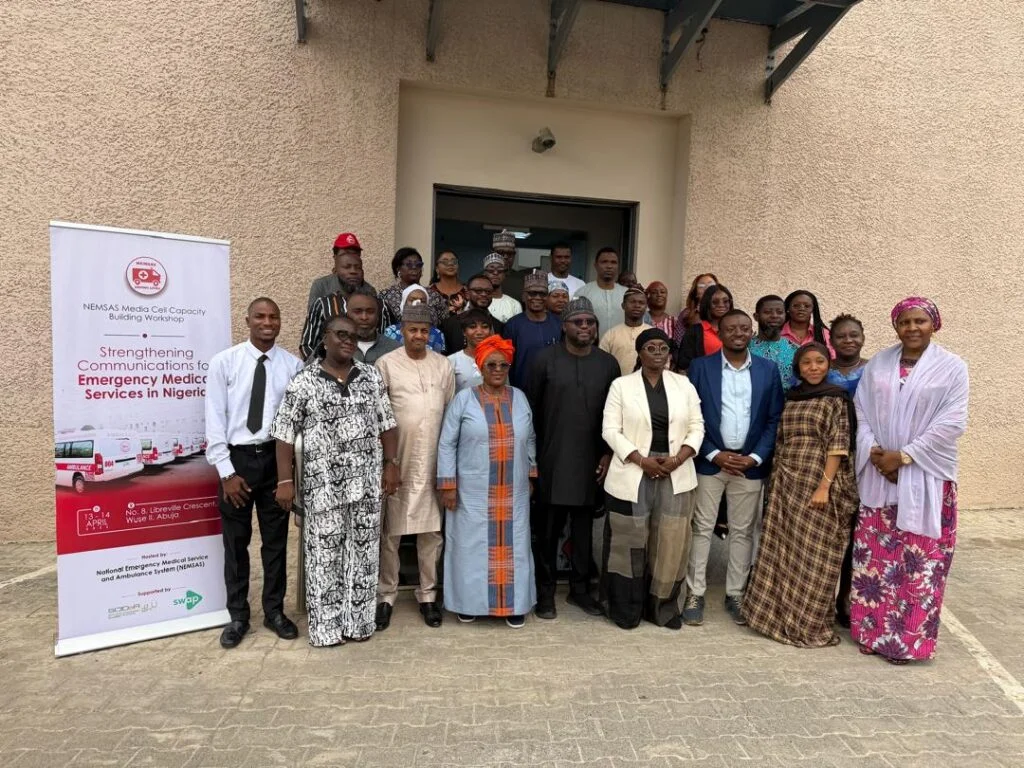
At a media workshop in Abuja on Monday, Dr. Doubra Emuren stated that unreliable network coverage is directly risking lives by disrupting emergency call systems. He explained that when connectivity fails, response times are significantly affected, making it difficult for the National Emergency Number (112) to function consistently.
He further noted that the country faces a massive manpower deficit, with a desperate need to scale up the training of Emergency Medical Technicians (EMTs) to bridge the gap in pre-hospital care.
The coordinator mentioned that NEMSAS has already established operational structures in 33 states and the FCT, providing free services for road accidents, gunshot injuries, and communal clashes. He observed that logistical hurdles like poor road access and insecurity continue to complicate ground operations.
He added that the integration of air ambulances and increased private sector investment are now essential to reaching congested or remote areas that traditional ambulances cannot easily access.
The Issues
The primary challenge for NEMSAS is the infrastructure-technology gap, where medical readiness is rendered useless if the telecommunications “bridge” between the victim and the responder is broken. Authorities must solve the problem of regulatory enforcement to ensure that ambulances are given priority in traffic and that security agencies do not over-interrogate “Good Samaritans.” Furthermore, there is a severe resource mismatch; with only 500 ambulances for over 200 million people, the system is permanently overstretched. To achieve a more responsive system, the government must now treat the 112 emergency line as a “critical national asset” that requires 100% uptime from telecom providers.
What’s Being Said
- “When networks fail, response time is affected, and lives are put at risk,” stated Dr. Doubra Emuren.
- Dr. Lawal Bakare of the Federal Ministry of Health emphasized that the Sector-Wide Approach (SWAp) is designed to improve equity and accountability in healthcare delivery.
- Mrs. Moji Makanjuola of the ISMPH highlighted that accurate media reporting is vital to countering misinformation regarding emergency services.
- Health stakeholders at the workshop argued that without a Good Samaritan law, many Nigerians will remain hesitant to help accident victims for fear of police complications.
What’s Next
- NEMSAS is expected to push for a memorandum of understanding (MoU) with the NCC to prioritize the stability of the 112 emergency frequency.
- A national recruitment drive for Emergency Medical Technicians is anticipated to help reach the 4,000-manpower target set by the agency.
- Legislative efforts to draft and pass a Good Samaritan Bill are likely to gain momentum in the National Assembly following the coordinator’s advocacy.
- The Federal Ministry of Health is expected to expand the MAMII initiative to the remaining states to further reduce maternal and neonatal mortality rates.
Bottom Line
NEMSAS is making strides in maternal health and accident response, but its effectiveness is being throttled by Nigeria’s “dead zones” in telecommunications. Until the 112 system becomes a reliable lifeline, the agency’s 500 ambulances will continue to struggle against the clock.