










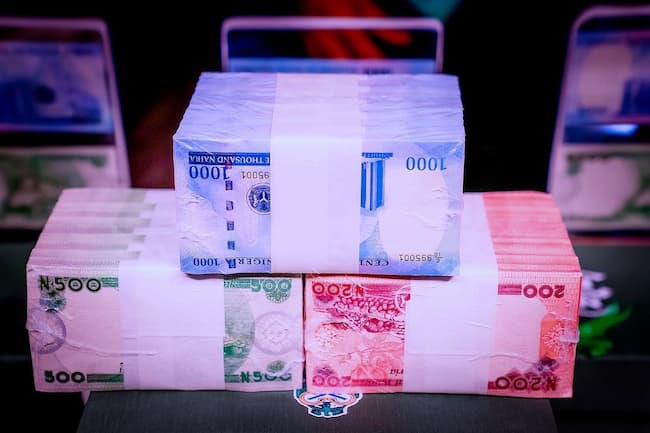
The Nigerian naira experienced mixed trading across foreign exchange (FX) markets on Tuesday, as surging dollar demand from corporates seeking overseas payments weighed on the local currency.
Data from investment banking firms showed that the naira appreciated by ₦3 in the parallel market, closing at ₦1,547/$1. However, at the official Nigeria Foreign Exchange Market (NFEM) window, the naira slipped by 6 basis points, exchanging at ₦1,537.75/$1, compared to ₦1,536.42/$1 in the previous session.
Analysts at AIICO Capital Limited noted that the NFEM interbank market was pressured by heightened FX demand against limited supply, with the local currency trading between ₦1,537/$1 and ₦1,539/$1. In response, the Central Bank of Nigeria (CBN) intervened last week, selling $50 million to banks to ease pressure on the system.
Meanwhile, Nigeria’s external reserves rose to $41.19 billion as of August 25, 2025, reflecting an increase of $85.58 million from the previous day. Analysts said the uptick in reserves could help sustain exchange rate stability in the near term.
Global market developments further shaped outlook for the naira. Crude oil prices fell sharply, with Brent crude sliding 2.3% to $67.22 per barrel, while U.S. West Texas Intermediate (WTI) declined 2.4% to $63.25 per barrel. Market watchers linked the dip to renewed U.S. tariff concerns, the Ukraine conflict, and uncertainty over Russian fuel supplies.
On the other hand, gold prices advanced to a two-week high, supported by safe-haven demand after U.S. political tensions rattled investor confidence. Spot gold rose 0.5% to $3,382.19, while U.S. gold futures for December delivery also gained 0.5% to $3,433.00.
Market analysts noted that investors may remain cautious in the oil market due to the lingering uncertainty surrounding geopolitical risks and global trade tensions.











 markets on Tuesday, as surging dollar demand from corporates...)