








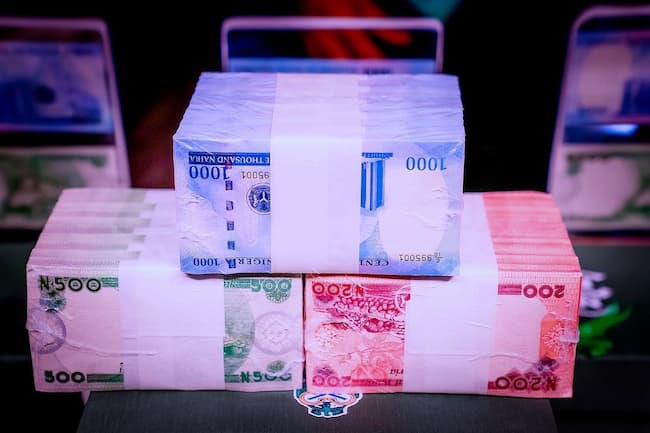
The Nigerian naira appreciated further against the US dollar on Thursday, supported by improved foreign exchange inflows and rising investor confidence. According to data from the Central Bank of Nigeria (CBN), the official exchange rate settled at ₦1,466 per dollar, marking a 0.27% gain from the previous day’s closing rate.
The local currency reached an intraday low of ₦1,463.50 and an intraday high of ₦1,472 before stabilizing at the closing rate. Analysts attributed the appreciation to healthy FX inflows from exporters, international oil firms, and foreign portfolio investors, which helped balance market liquidity and corporate demand.
The CBN disclosed that the Nigerian Foreign Exchange Market (NFEM) rate of ₦1,466 represents the day’s volume-weighted average, serving as the official exchange rate benchmark.
In the parallel market, the naira also strengthened to ₦1,495 per dollar, buoyed by subdued demand pressures and increasing FX supply from private sources.
Meanwhile, Nigeria’s gross external reserves continued to rise, increasing from $42.35 billion at the end of September to $42.57 billion, bolstered by sustained inflows from crude oil sales, remittances, and foreign investments.
On the global commodities front, oil prices slipped as geopolitical tensions eased following a ceasefire between Israel and Hamas. Brent crude fell by $1.31 (1.71%) to $65.12 per barrel, while WTI crude declined by $1.12 (1.79%) to $61.43 per barrel.
Gold prices also moderated, dipping below the $4,000 per ounce mark for the first time this week, as investors booked profits amid a stronger US dollar. Spot gold fell by 0.87% to $3,976.69/oz, while US gold futures dropped by 0.96% to $3,991.57/oz.
Market analysts predict that the commodities market may remain mixed in the coming sessions, with gold expected to consolidate after its record rally and crude oil likely facing additional pressure from fading geopolitical risk premiums.