








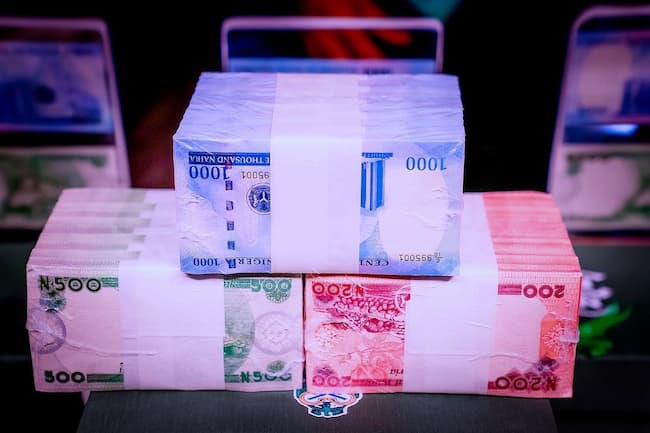
On Tuesday, Nigeria’s currency, the naira, saw widespread gains as pressures from international transactions and import settlements lessened. The Central Bank of Nigeria (CBN) has continued to supply funds to meet the growing need for U.S. dollars amid ongoing reductions in foreign exchange inflows.
Recent FX figures indicate that the naira improved by 0.45% to ₦1,449.99 per dollar in the official market. With reduced strain on foreign currency, the highest intraday rate was N1,455.500, marking a clear betterment from the prior day’s N1,466 quote.
The spot rate hit a daily low of N1,447.5000 and ended at N1,452 against the dollar, based on the CBN’s daily foreign exchange report.
In a recent analysis, Coronation Merchant Bank Limited noted that foreign exchange inflows into Nigeria’s FX market dropped by roughly 50% on a weekly basis to $741 million last week, down from $1.46 billion the week before.
The merchant bank’s research team highlighted that the CBN played the primary role in liquidity provision, contributing 27.73% of the total FX supply for the period.
Trailing the central bank were exporters at 24.52%, followed by foreign portfolio investors at 24.23%, non-bank corporations at 13.78%, individuals at 7.37%, and other sources at 2.37%.
For the first time this month, the CBN released data showing a slight 0.58% drop in gross external reserves, closing at US$45.21 billion on Friday.
This minor reduction in reserves highlights persistent challenges as the CBN keeps stepping in to curb excessive fluctuations in the FX market.
In the unofficial parallel market, the naira also gained ground to ₦1,463 per dollar, indicating better overall market mood and eased tensions in both the formal and informal currency segments.
In other developments, international oil prices rose slightly on Tuesday as market participants evaluated robust U.S. economic expansion and potential threats to oil supplies from Venezuela and Russia.
Brent crude increased by 72 cents, or 1.17%, to $62.30 a barrel, and U.S. West Texas Intermediate (WTI) rose by 25 cents, or 0.43%, to $58.26.
Gold prices also advanced by 0.8% due to increased safe-haven buying. Spot gold rose 0.96% to $4,488.47 per ounce, with U.S. gold futures climbing 1.09% to $4,518.15 per ounce. Experts anticipate that oil will continue to be bolstered by geopolitical supply concerns, while gold holds steady on protective investment demand.









 has continued to supply funds to meet the growing need for U.S. dollars amid ongoing reductions in foreign exchange inflows.)