









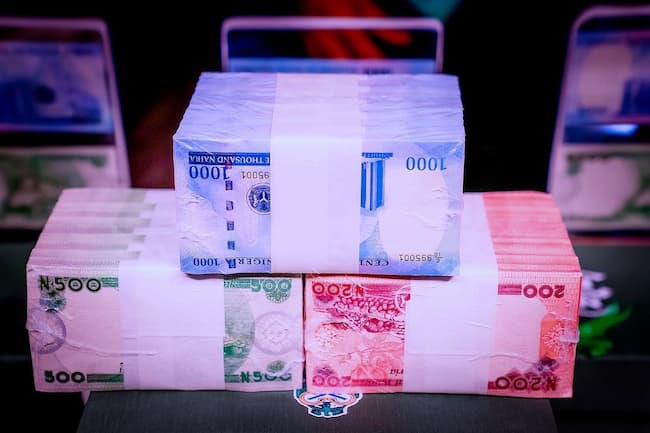
Nigeria’s currency weakened at the official foreign exchange market on Tuesday, extending its downward movement against the United States dollar despite continued liquidity injections by the Central Bank of Nigeria (CBN).
Latest data from the apex bank showed that the naira depreciated by ₦3.17 to settle at ₦1,445.68 per dollar at the Nigerian Foreign Exchange Market (NFEM). During the trading session, the local currency fluctuated within a narrow band, exchanging hands between ₦1,443.00/$ and ₦1,447.00/$ before closing weaker.
The depreciation occurred even as the CBN sustained its intervention strategy, selling an estimated $50 million to authorised dealers in a bid to improve dollar availability and stabilise market pricing. The move forms part of the central bank’s ongoing efforts to manage volatility and shore up confidence in the foreign exchange market.
Market analysts at Broadstreet noted that expectations going into year-end remain anchored on the CBN’s resolve to maintain aggressive FX supply, particularly as demand pressures persist across key sectors of the economy.
Meanwhile, Nigeria’s external reserves position strengthened further, rising to $45.45 billion. The increase represented a day-on-day gain of $177.99 million, pushing the country’s year-to-date reserve growth to 11.19 percent. The reserve accretion continues to provide a buffer for FX interventions and external obligations.
On the global commodities front, crude oil prices traded mixed as investors assessed fading optimism around a potential Russia–Ukraine peace deal alongside heightened geopolitical tensions in the Middle East, particularly around Yemen.
Brent crude edged higher by 48 cents, or 0.78 percent, to $61.97 per barrel, while U.S. West Texas Intermediate (WTI) slipped marginally by 4 cents, or 0.07 percent, to $58.04 per barrel.
In contrast, precious metals rebounded strongly after sharp losses in the previous session, as renewed geopolitical and macroeconomic uncertainties drove fresh demand for safe-haven assets. Gold’s rally capped what analysts describe as its strongest annual performance since 1979.
Spot gold climbed by 0.83 percent to $4,368.25 per ounce, while U.S. gold futures advanced 0.94 percent to $4,384.55 per ounce. Market watchers expect oil prices to remain volatile amid ongoing geopolitical risks, while precious metals could experience intermittent profit-taking following recent record highs.









.)