




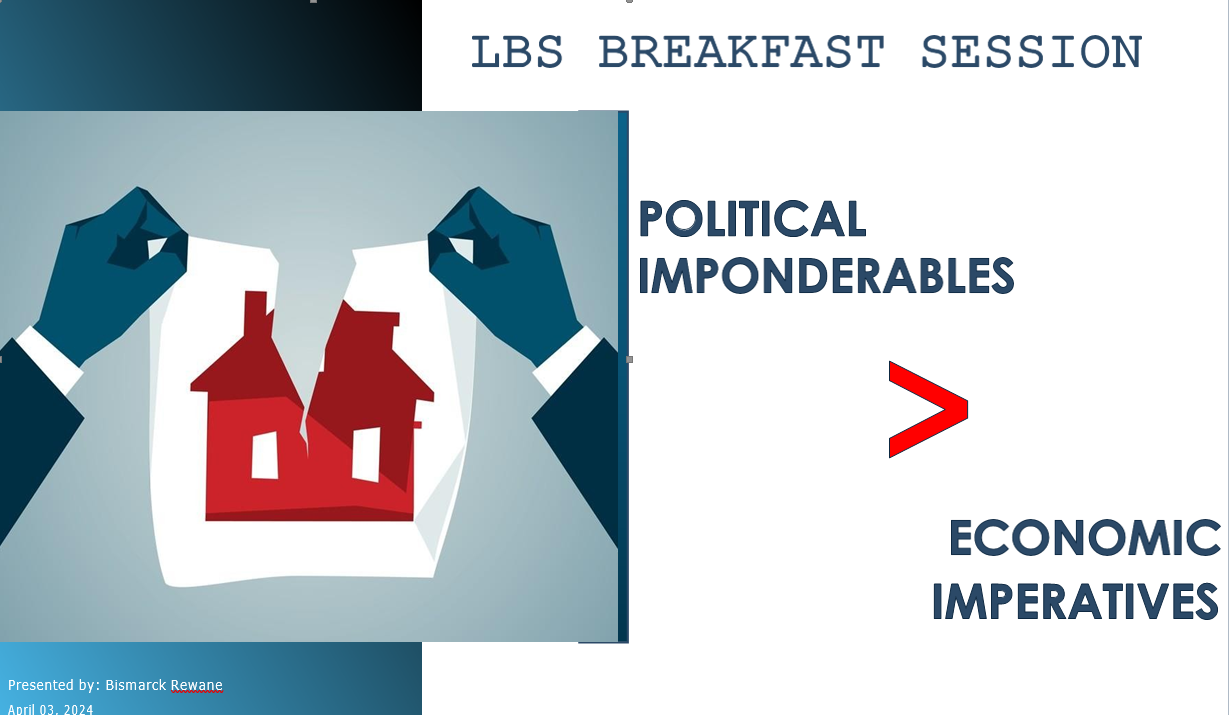
The Lagos Business School’s July 2025 Breakfast Session, led by renowned economist Bismarck Rewane, provided an incisive review of Nigeria’s economic landscape, painting a picture of modest progress amid lingering volatility. While a full-blown crisis appears to have been averted, Rewane’s presentation warned that Nigeria remains under sustained economic pressure.
A Narrow Escape: Projections vs. Outcomes
Rewane began by comparing macroeconomic projections from June with actual outcomes in July. Inflation was forecasted to decline marginally and did — falling to 22.97%, close to the 23.15% forecast. The naira also showed signs of resilience, gaining 1.5% to trade within ₦1,565/$–₦1,600/$. However, Nigerian oil production lagged behind expectations, dipping to 1.45mbpd against the projected 1.5mbpd.
Global Volatility, Local Vulnerability
On the global front, the S&P 500 surged 13.6% YTD to an all-time high, while the U.S. dollar weakened, hitting a 10-year low. Gold prices soared, reflecting investors’ flight to safety. Meanwhile, the oil market saw dramatic swings — rising to $81pb before retreating to $67pb by July 2.
Nigeria, like many developing economies, remains sensitive to such shifts. The naira’s apparent stability against a falling dollar offers only a “mirage of appreciation.” Nonetheless, reduced external debt exposure and improved trade ties with China are expected to bolster local industries sourcing raw materials from Asia.
Domestic Landscape: A Mixed Bag
Nigeria’s Q1 2025 GDP growth slowed to 3.4% from 3.84% in Q4 2024. Inflation fell slightly, and FAAC allocations remained relatively flat at ₦1.66trn. The monetary policy rate (MPR) remained unchanged at 27.5%, but questions about its effectiveness persisted, especially since NTB rates remain significantly lower.
Other key highlights:
- Diesel rose to ₦1,050/litre, while PMS dropped to ₦840/litre at ex-depot.
- Corporate profitability increased in Q2, buoyed by reduced FX losses.
- Money supply growth declined from 23.9% in March to 19.92% in May, indicating tighter monetary conditions.
Dangote Refinery & Fertilizer Plant: Nigeria’s Twin Game Changers
One of the standout themes was the impact of the Dangote Refinery. By launching a ₦720bn logistics operation with 4,000 CNG trucks and offering credit facilities for bulk buyers, the refinery has helped reduce fuel scarcity and stabilize PMS prices nationwide. It’s also expected to eliminate bridging costs and promote uniform pricing.
In the same vein, the Dangote Fertilizer Plant — the largest in Africa — is projected to generate over $2.5bn annually in forex. The company also plans to list on the Nigerian Stock Exchange by year-end, potentially opening up investor access to this strategic sector.
Investor Sentiment & Market Outlook
The NGX recorded a 16.6% YTD gain, outperforming global peers like the S&P 500 and SSE. Despite regulatory pressure on banks, investors are expected to flock to equities as fixed-income yields decline. Companies in telecoms, FMCG, and aviation stand to benefit the most.
Key Policy Shifts
- The CBN suspended bank dividends and foreign investments for lenders under regulatory forbearance.
- New tax reforms introduced development levies, crypto taxes, and digital service taxes.
- Excise duties on “sin goods” were increased, and VAT reforms maintained exemptions to encourage consumer spending.
Projections for July 2025
- Inflation to hover between 22.4% and 22.8%
- Naira to trade between ₦1,550/$–₦1,600/$
- Oil prices expected to stay between $62–$65pb
- NGX to rally further as Q2 results are published
- Airline load factors to rise due to stable forex and discounted international fares
- PMS pump prices could fall to ₦880/litre
Conclusion
Despite avoiding an economic breakdown, Nigeria’s road to recovery is paved with uncertainty. Fiscal discipline, structural reforms, and a proactive monetary strategy will be essential in transforming stability into sustainable growth. With global headwinds and domestic complexities converging, Rewane’s message was clear: The fog has lifted, but the runway remains slick.
📎 Click here to download the full LBS July 2025 PDF Presentation