


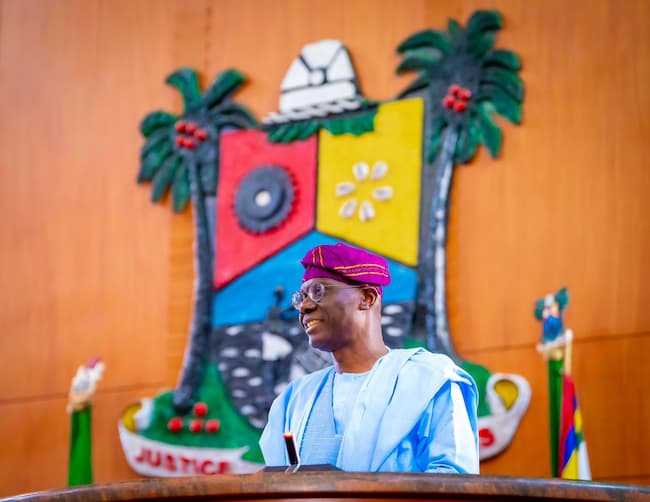
Lagos State Governor, Babajide Sanwo-Olu, has formally signed the ₦4.44 trillion 2026 Appropriation Bill into law, unveiling what the administration has branded as a “Budget of Shared Prosperity,” aimed at accelerating inclusive economic growth and improving living standards across the state.
The signing ceremony took place at the Lagos State House in Ikeja on Monday, marking the final stage of the legislative process for the state’s fiscal blueprint for the 2026 financial year. According to the governor, the budget is structured to deliver broad-based development and ensure that no segment of the population is left behind.
Governor Sanwo-Olu explained that the fiscal plan prioritises investments that directly impact residents’ quality of life, including transportation infrastructure, education, healthcare delivery, housing, security, and targeted economic interventions. He noted that the government’s objective is to stimulate sustainable prosperity across all communities, regardless of geographical location or economic sector.
Present at the event were Deputy Governor, Dr Obafemi Hamzat, and members of the Lagos State House of Assembly, led by the Majority Leader, Mr Nojim Adams, who represented the Speaker of the House.
The governor commended lawmakers for what he described as rigorous legislative scrutiny and independent oversight during the budget review process. He said the Assembly’s engagement led to a modest upward adjustment of the budget size, reflecting confidence in the state’s capacity to deliver stronger outcomes despite prevailing macroeconomic pressures.
According to Sanwo-Olu, the budget represents a renewed mandate for the executive arm to deepen governance reforms and deliver measurable outcomes in infrastructure expansion, social services, job creation, and public safety.
Earlier, the Commissioner for Economic Planning and Budget, Mr Ope George, provided further insight into the structure of the 2026 fiscal plan. He explained that the budget was initially proposed at approximately ₦4.2 trillion before being revised upward to ₦4.4 trillion following extensive consultations between the legislature and various ministries, departments, and agencies.
The approved expenditure framework allocates ₦2.3 trillion, representing 53 per cent, to capital expenditure, while ₦2.1 trillion, or 47 per cent, is earmarked for recurrent spending. George noted that the composition underscores the administration’s commitment to sustaining infrastructure investment while maintaining efficient public service delivery.
He identified key priority sectors under the 2026 budget to include transportation, agriculture, infrastructure renewal, healthcare, education, environmental sustainability, housing development, public safety, and social protection programmes.
The commissioner also highlighted the strong performance of the 2025 budget, which recorded an implementation rate of 81 per cent as of September 30, describing it as a solid foundation for the effective execution of the 2026 fiscal agenda.
Speaking on behalf of the Speaker of the House, Hon. Mudashiru Obasa, Majority Leader Mr Nojim Bello praised the governor and his cabinet for their commitment to advancing the state’s development agenda under the THEMES Plus framework.
He reaffirmed the legislature’s readiness to continue working closely with the executive to ensure Lagos maintains its reputation as a benchmark for good governance and economic leadership in Nigeria.