





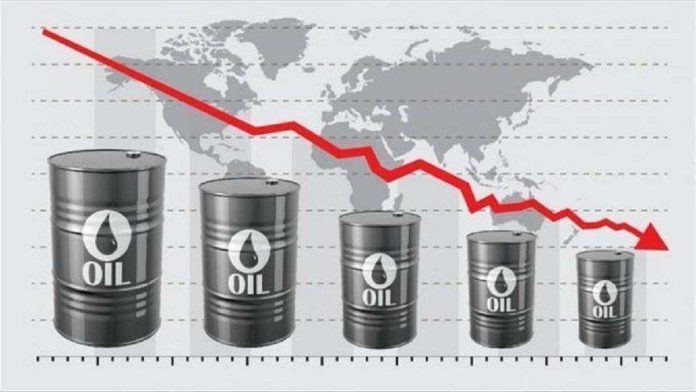
Oil prices retreated on Thursday as global markets reacted to higher US crude output and expectations of additional supply from OPEC+ producers, even as the US Federal Reserve signaled a pause in its monetary easing cycle.
Data from the US Energy Information Administration (EIA) showed that American crude production climbed, while the OPEC+ coalition is preparing to announce further output increases. These developments dampened investor sentiment and pushed prices lower.
Brent crude traded at $63.81 per barrel, down 0.57% from the previous session’s $64.18, while West Texas Intermediate (WTI) fell 0.43% to $59.93 per barrel from $60.19.
In line with market forecasts, the Federal Reserve reduced its benchmark policy rate by 25 basis points to a range of 3.75%–4%. However, it cautioned that this could be the final rate cut of the year, warning that potential government shutdown risks might affect future data availability.
The Fed reported that while the US economy continued to expand moderately, job growth had slowed and inflation pressures had persisted.
During the policy briefing, Fed Chair Jerome Powell stated that a further rate reduction in December “is not a foregone conclusion,” stressing that future decisions would depend on incoming economic data. His remarks reinforced expectations that the Fed might pause additional rate cuts, a move that typically weighs on oil demand.
Analysts observed that lower interest rates generally stimulate economic growth and fuel demand, while tighter monetary policy tends to suppress consumption and push prices lower.
According to the EIA, US commercial crude inventories dropped by about 6.9 million barrels to 416 million barrels last week, a sharper decline than market expectations of 900,000 barrels. Gasoline inventories also decreased by 5.9 million barrels to 210.7 million barrels.
Despite the inventory drawdown, US crude production rose by 15,000 barrels per day to 13.644 million barrels, easing earlier concerns about tight supply.
Attention is now shifting to the upcoming OPEC+ meeting scheduled for November 2, where member countries are expected to confirm an additional output increase of 137,000 barrels per day for December.
This anticipated boost has further eased market fears about supply shortages, keeping prices under downward pressure.
Meanwhile, renewed optimism from US-China diplomatic engagements helped limit losses. US President Donald Trump met with Chinese President Xi Jinping in Busan, South Korea, marking their first in-person dialogue since Trump’s return to office.
Xi emphasized that China and the US “should be friends and partners,” stating that cooperation aligns with both nations’ interests. Trump confirmed progress in trade discussions and announced plans to cut tariffs on Chinese goods tied to fentanyl imports to 10%, alongside a planned visit to China in April.
Analysts believe these developments could support global energy demand in the medium term by improving market sentiment and trade relations.