







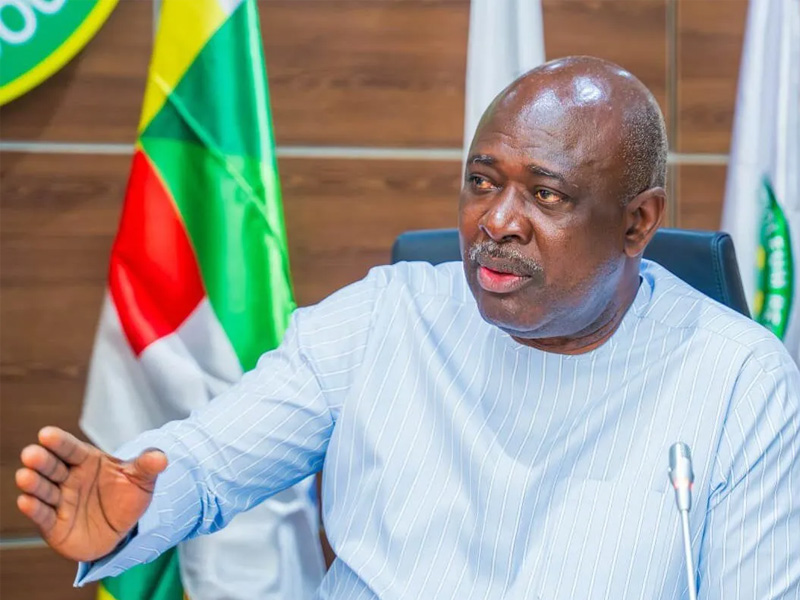
The Federal Government of Nigeria has issued a direct challenge to International Oil Companies (IOCs) to take concrete action toward ramping up crude oil production. Speaking at the 9th Nigeria International Energy Summit (NIES) in Abuja, the Minister of State for Petroleum Resources (Oil), Senator Heineken Lokpobiri, stated that the government has fulfilled its part by providing extensive tax incentives and regulatory reforms.
He emphasized that it is now time for industry players to reciprocate these gestures by delivering on production targets to support the national economy.
Minister Lokpobiri noted that while crude oil production has improved from 1.3 million barrels per day (bpd) to approximately 1.7 million bpd under the current administration, a significant gap remains. Nigeria is aiming for an ambitious output target of 2.5 million bpd by 2027, a goal that the Minister described as fundamentally tied to the success of upstream operators.
He argued that without consistent upstream production, the midstream and downstream sectors—including local refineries—will lack the necessary feedstock to operate effectively, creating a negative ripple effect across the entire energy value chain.
The government’s demand centers on the expectation that IOCs will convert policy goodwill into bankable, project-specific outcomes. Lokpobiri highlighted that the Petroleum Industry Act (PIA) and recent executive orders have shortened contracting cycles and reduced investment risks, creating an enabling environment that leaves no room for excuses.
He questioned the industry’s continued requests for more incentives, stating that the government has already given a lot in terms of tax reliefs and regulatory adjustments. The Minister urged the companies to focus on investing and producing, rather than simply demanding further concessions.
Despite the firm stance, the government reiterated its commitment to supporting all operators without discrimination between indigenous firms and international giants. The Minister noted that the increase in active drilling rigs from 14 in 2023 to over 60 in 2026 is a positive sign of renewed activity, but warned that natural production declines in deepwater assets continue to pose a challenge.
By demanding concrete steps such as the reactivation of dormant fields and faster execution of field development plans, the Federal Government aims to ensure that Nigeria remains a competitive global energy supplier while meeting its domestic fiscal requirements.



 to take concrete action toward ramping up crude oil production.Speaking at the 9th Nigeria International Energy Summit (NIES) in Abuja, the Minister of State for Petroleum Resources (Oil), Senator Heineken Lokpobiri, stated that the government has fulfilled its part by providing extensive tax incentives and regulatory reforms.)