






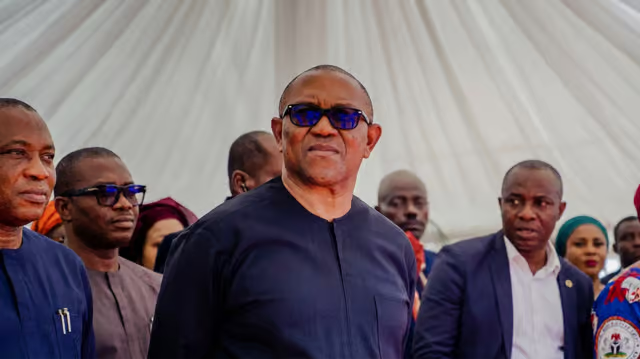
Former presidential candidate, Peter Obi, has dismissed claims that the electronic transmission of election results may be impracticable because some states lack network coverage, insisting that such arguments are no longer tenable in modern Nigeria.
Obi’s position comes amid renewed public agitation for mandatory electronic transmission of election results, following comments by Senate President, Godswill Akpabio, who suggested that real-time transmission may be difficult to implement nationwide.
Speaking at the public presentation of a book titled The Burden of Legislators in Nigeria, authored by former senator Effiong Bob, Akpabio argued that insecurity has rendered network services unreliable in parts of the country. He warned that insisting on real-time transmission could invalidate election results in affected areas.
“Real-time transmission means that in over nine states where networks are not working because of insecurity, there will be no election results,” Akpabio said. “Nationally, it means that if the national grid collapses and no network is working, no election results will be valid.”
The Senate President added that lawmakers merely recommended the removal of the phrase “real-time” from the electoral framework to avoid legal complications arising from technical failures. According to him, the final decision on the mode of transmission should be left to the Independent National Electoral Commission (INEC).
However, Obi strongly countered the position, arguing that Nigeria’s electoral system should not be exempt from technological standards already in use across other critical sectors of the economy.
In a post on X, a day after participating in a peaceful protest at the National Assembly demanding comprehensive electoral reforms, Obi said the excuse of poor network coverage was inconsistent with the realities of modern governance and commerce.
“Claims that certain states lack network coverage are no longer acceptable,” he said. “Financial institutions operate nationwide through secure digital networks to conduct transactions and collect taxes on a daily basis. If banking systems function seamlessly, our electoral system can and should do the same.”
The former Anambra State governor said the protest was aimed at pressing for reforms that would guarantee transparency and restore public confidence in the democratic process. According to him, eligibility for public office must be based on verifiable credentials and strict adherence to constitutional provisions.
“Our demands were clear and non-negotiable,” Obi stated. “Anyone seeking to hold titles such as Honourable, Distinguished, or Excellency must emerge through a transparent and honourable process, supported by verifiable records of education, age, and other constitutional requirements.”
He further stressed that beyond meeting eligibility criteria, candidates must subject themselves to open campaigns, public scrutiny and debates, as required by law, noting that credible elections remain the foundation of accountable leadership.
“Most importantly, election results must be transmitted electronically and in real time to protect the people’s mandate and eliminate manipulation,” he said.
Obi urged Nigeria to shed what he described as a pattern of governance that undermines its status on the continent, calling on leaders to build institutions anchored on order, justice and public trust.
“We owe the younger generation a nation built on integrity, not one mired in chaos and impunity,” he said, while encouraging young Nigerians to remain steadfast in their demand for reforms.
Reaffirming his long-held stance, Obi added: “I remain firmly committed to the vision of a New Nigeria—one that is not only possible, but inevitable if we stand and act together.”