Keypoints
- The Federal Government has directed the Defence Space Administration (DSA) to intensify the use of space-based technologies to bolster military intelligence and operational effectiveness.
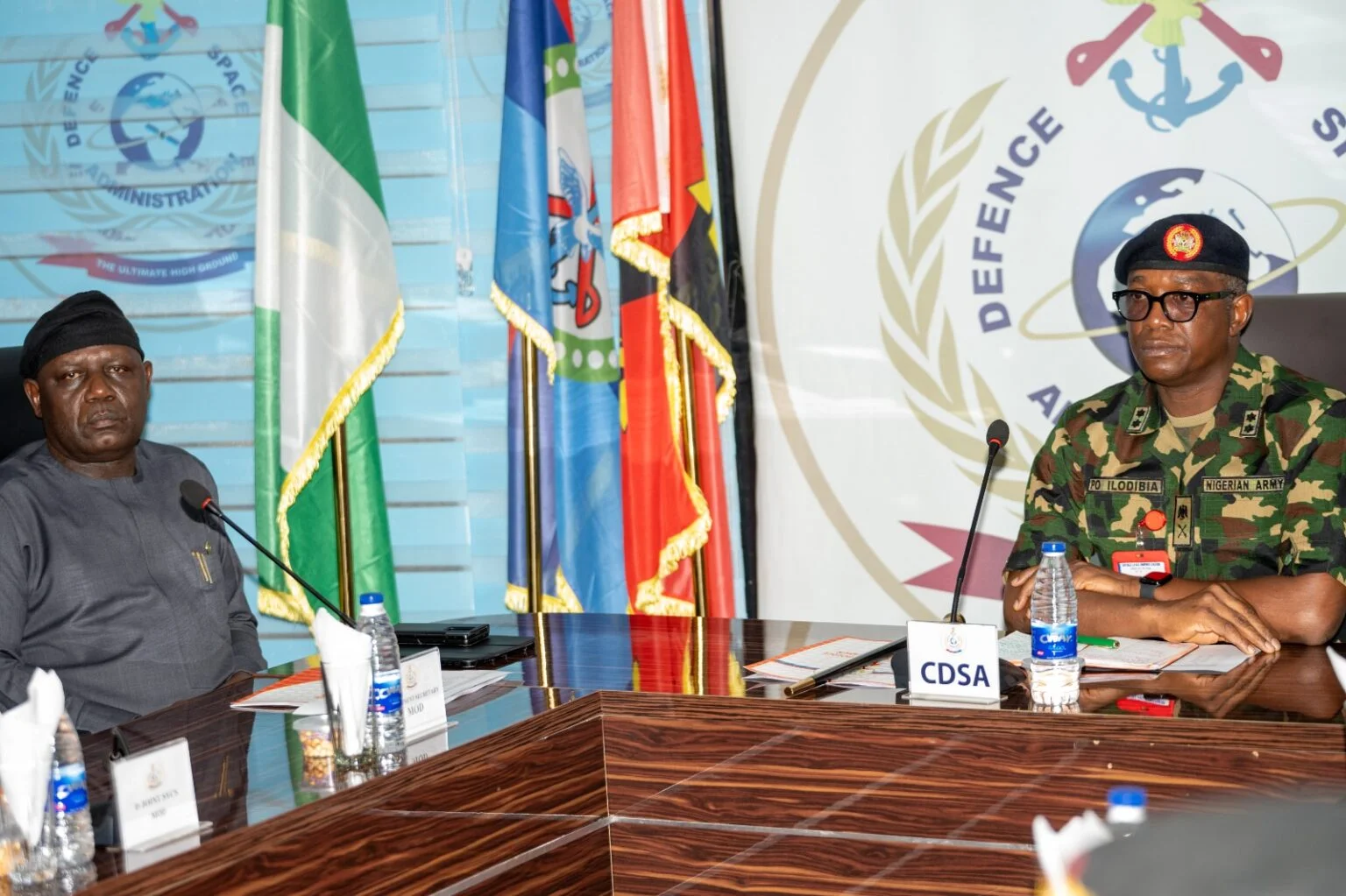
- During a familiarization visit to the DSA headquarters in Abuja on Thursday, April 9, 2026, the Permanent Secretary of the Ministry of Defence, Mr. Richard Pheelangwah, described the agency as a “critical enabler” for modern warfare.
- Maj.-Gen. Phillip Ilodibia, Chief of Defence Space Administration, highlighted the agency’s progress in geo-spatial intelligence and cyber operations but cited funding and infrastructure gaps as major hurdles.
- The visit included a tour of the agency’s high-tech facilities, including the Geo-spatial Intelligence Centre and the Data Fusion Laboratory.
Main Story
The Ministry of Defence has reaffirmed the central role of space technology in Nigeria’s national security architecture.
Speaking during a visit to the Defence Space Administration (DSA) headquarters in Abuja, the Permanent Secretary, Mr. Richard Pheelangwah, emphasized that the integration of advanced satellite imagery and real-time data is no longer optional for the Armed Forces.
He noted that the agency’s ability to provide precise geo-spatial intelligence has already led to more “coordinated and precise” outcomes in various theaters of operation across the country.
The charge comes as the DSA ramps up its capabilities in cyber operations and satellite-enabled surveillance. Pheelangwah assured the agency of the Ministry’s support, specifically targeting challenges in funding and infrastructure development.
The visit follows a broader 2026 push by the Ministry to harmonize efforts between the DSA and the National Space Research and Development Agency (NASRDA) to eliminate duplication and maximize the impact of Nigeria’s space assets on the fight against terrorism and banditry.
The Issues
The primary challenge facing the DSA remains the “infrastructure and funding gap” required to maintain cutting-edge space assets. While the agency has successfully deployed “Communication on the Move” (COTM) technologies, Maj.-Gen. Phillip Ilodibia noted that inadequate accommodation and limited budgetary inclusion in national security decision-making continue to slow progress. Furthermore, as Nigeria faces evolving threats like cyber warfare, the DSA must solve the challenge of deepening inter-agency collaboration with other intelligence bodies to ensure that “data fusion” translates into immediate, actionable intelligence for ground troops.
What’s Being Said
- “The DSA remains central to Nigeria’s efforts at addressing contemporary security challenges… modern warfare demands the integration of advanced technologies,” stated Mr. Richard Pheelangwah, Permanent Secretary, Ministry of Defence.
- Maj.-Gen. Phillip Ilodibia emphasized the agency’s technical growth, stating that its “capabilities in data fusion and cyber operations play a vital role in countering security threats.”
- Queenet Iheoma-Hart, spokesperson for the Ministry, noted that the visit aimed to assess the agency’s “situational awareness” tools, which have significantly improved reconnaissance.
- Security analysts have previously noted that Nigeria’s space programme is a matter of “national capacity and technological independence,” urging consistent investment to keep up with global military standards.
What’s Next
- The DSA is expected to push for greater inclusion in the National Security Council’s decision-making processes following the Permanent Secretary’s recommendation.
- A more formalized collaboration framework between the DSA and NASRDA is anticipated to be unveiled later in 2026 to optimize the use of recently approved radar and surveillance satellites.
- The agency will likely host more technical training sessions, such as the ongoing AI training for defence space initiatives, to build the specialized workforce needed for future satellite operations.
Bottom Line
By positioning the DSA at the heart of military planning, the Federal Government is pivoting toward a more “intelligence-led” security strategy, though the success of this transition depends heavily on bridging the funding gap for indigenous space infrastructure.