

Key points:
- At least 65 Nigerian soldiers reportedly killed in jihadist raids across the North-East in two weeks.
- Defence Minister Gen. Christopher Musa (rtd) says terrorists suffered heavier losses and troops remain in control.
- Senate honours fallen soldiers and calls for intensified military operations against insurgents.
Main story
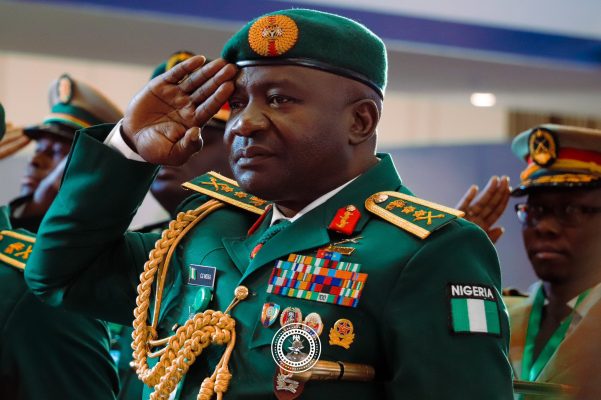
Nigeria’s Minister of Defence, Gen. Christopher Musa (rtd), has assured Nigerians that the armed forces remain firmly in control of the security situation despite recent deadly jihadist attacks that reportedly claimed the lives of at least 65 soldiers in the North-East within the past two weeks.
The minister acknowledged that the military suffered casualties during renewed assaults by insurgents in the North-East and North-West but insisted that the armed forces inflicted heavier losses on the terrorists.
Speaking after a strategic meeting with service chiefs to review operational strategies across various theatres of operation, Musa said troops were intensifying efforts to dismantle terrorist networks and protect communities.
“We are putting in every effort to ensure that we secure the country. We are aware that we have suffered some casualties, but I can tell you the terrorists, the bandits, are taking more,” he said.
According to the minister, the military is targeting insurgent commanders and operational assets as part of a sustained counter-terrorism campaign.
“We’re taking more of their commanders and assets out, and we’ll continue to do that. We want to appeal to Nigerians not to give up,” he added.
The renewed attacks were linked to fighters of the Islamic State West Africa Province (ISWAP), who reportedly overran four military bases in Borno State on March 5 and 6, killing dozens of soldiers.
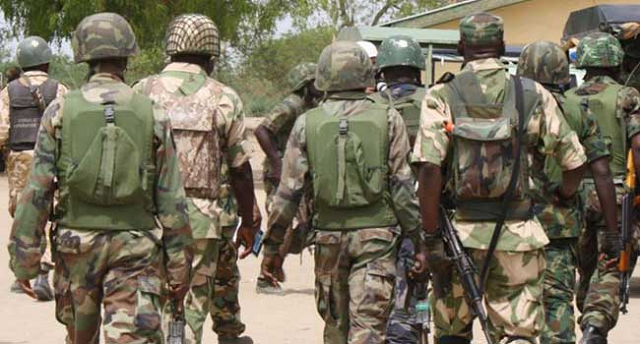
In another statement, the Nigerian Army said troops later repelled coordinated attacks launched by ISWAP on military positions in Delwa, Goniri, Kukawa and Mainok between March 8 and 9.
Data from the Armed Conflict Location and Event Data Project also indicated that about 300 civilians, including women and children, were abducted during the raids, with insurgents deploying sophisticated weapons such as anti-aircraft machine guns and drones.
The attacks are part of a pattern of coordinated assaults by jihadist groups on military facilities in northern Nigeria, where a nearly two-decade insurgency continues to challenge security forces.
The issues
The resurgence of coordinated insurgent attacks has raised concerns about the evolving tactics of terrorist groups operating in the North-East. Analysts note that the use of advanced weapons and drones indicates a growing operational capacity among insurgents.
The conflict traces back to the escalation of violence following the extra-judicial killing of Boko Haram founder Mohammed Yusuf in 2009, which triggered a prolonged insurgency that has devastated parts of northern Nigeria.
What’s being said
Musa urged the media to exercise professionalism and avoid disseminating unverified information or terrorist propaganda that could undermine troop morale.
“Responsible journalism is critical to sustaining the morale of our troops and preventing the spread of narratives that may embolden criminal groups,” he said.
Meanwhile, the Senate observed a minute of silence in honour of the soldiers who lost their lives during the attack on a military formation in Kukawa Local Government Area of Borno State.
The resolution followed a motion by Senator Mohammed Monguno (Borno North), who described the assault as a coordinated attack by suspected Boko Haram insurgents.
Monguno told lawmakers that the terrorists launched the offensive in the early hours of March 9, engaging troops in a fierce battle that lasted nearly 24 hours.
He disclosed that a senior officer, Lt-Col Umar Faru, along with several other soldiers, was killed while defending the base.
The senator also expressed concern that insurgents burned military vehicles and looted weapons during the attack.
What’s next
The Senate has called for intensified military operations to counter the renewed wave of insurgent attacks and restore stability in the region.
Security authorities are also expected to review operational strategies and strengthen intelligence gathering as part of ongoing counter-insurgency efforts.
BOTTOM LINE
Despite recent losses suffered by the Nigerian military, authorities maintain that troops remain resolute in the fight against terrorism, while lawmakers and security experts call for stronger operational responses to curb the resurgence of insurgent attacks in the North-East.





,%20has%20assured%20Nigerians%20that%20the%20armed%20forces%20remain%20firmly%20in%20control%20of%20the%20security)