






Former President Muhammadu Buhari is gone. Buried. Laid to rest. But somehow, across dusty NYSC camps and noisy parade grounds, his presence still lingers like the smell of wet khaki after morning drills.
Though power has changed hands and Nigeria now looks to a new president for direction, Buhari’s legacy, especially as it relates to the National Youth Service Corps (NYSC), refuses to sit quietly in a history book. It marches on, salutes firmly, and says: “Oga Buhari no dey again, but e remain for this khaki.”
Let’s be clear: Buhari didn’t create NYSC. The scheme was launched in 1973 by General Yakubu Gowon, as a way to heal the wounds of the civil war and force fresh graduates to face the full diversity (and humidity) of Nigeria. But if Gowon birthed the scheme, Buhari was the uncle who made sure it never missed morning devotion.
Even in his first stint as a military Head of State (1983–1985), Buhari made no effort to scrap the scheme. He understood the power of structure and discipline. And to be honest, if there’s any Nigerian government program that screams “discipline, service, and mild suffering,” it’s NYSC. So naturally, it appealed to him.
But it’s in his second coming, as a democratic president from 2015 to 2023, that Buhari truly stitches himself into NYSC’s fabric. This time, the man doesn’t just supervise the scheme from afar, he champions it with military pride and quiet loyalty. From his Daura hometown to Aso Rock, Buhari treats NYSC like a symbol of everything Nigeria should be: diverse, obedient, slightly underpaid, and always present.
Let’s talk numbers. Under Buhari, corps members’ monthly allowance moved from the legendary ₦19,800 to ₦33,000. That moment was so emotional, some corpers fainted, this time not from parade stress but from surprise. The raise was linked to the new minimum wage implementation, but many believed Buhari could have quietly ignored NYSC. Instead, he insisted corpers deserved better. It didn’t buy luxury, but it upgraded lives from garri-only diets to “garri plus egg.” Respect.
Buhari’s love for NYSC wasn’t just in naira and kobo. It was in policy seriousness. Remember the infamous case of former Minister of Finance, Kemi Adeosun? Her NYSC certificate scandal didn’t just cause political chatter, it led to her resignation. In Buhari’s Nigeria, you do NYSC or you don’t do power. No shortcuts. No influence. No “do you know who I am?” The rules applied to everyone, even cabinet members. That was Buhari’s quiet message: NYSC isn’t a casual scheme; it’s a rite of passage.
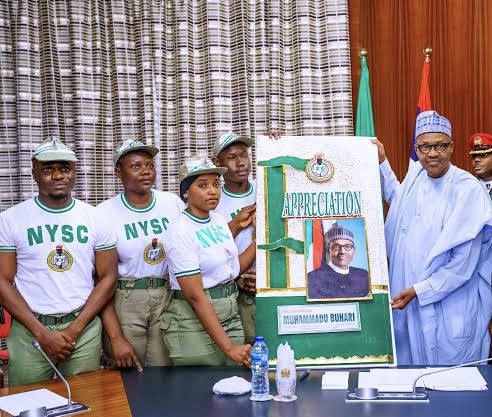
Then there were moments of heartfelt connection. Buhari would often host corps members during festive periods in Daura, his hometown, handing out cows, rice, and small token allowances. Was it just optics? Maybe. But it made a statement: this man, president or not, never distanced himself from NYSC. He saw them as part of the national fabric, literally and emotionally.
And even when calls rose to scrap NYSC, Buhari stood firm. Insecurity, kidnappings, and poorly maintained camps had many Nigerians asking, “Why are we still doing this?” But Buhari, ever the old-school patriot, held his ground. To him, the scheme represented national unity in its rawest form, a Yoruba corper teaching Hausa kids in Maiduguri, an Igbo girl learning to cook tuwo in Nasarawa. The awkwardness, the discomfort, the culture shock, that was the whole point.
And now, he’s gone. The baton has passed. Nigeria has a new president, new policies in motion, and new promises being made. But for thousands of serving corps members, Buhari still feels present. Every time they receive allawee, every time they chant “NYSC—service and humility!”, and every time they wear that slightly oversized khaki with pride, Buhari’s influence walks beside them.
Even his critics, those who blamed his government for economic hardship or insecurity, acknowledge that his commitment to NYSC was unwavering. While others laughed at the scheme, Buhari stood by it like a protective father at inter-house sports. He didn’t just believe in NYSC; he embodied its core values, discipline, unity, sacrifice, and quiet patriotism.
The emotional part? For many Nigerian youths, NYSC is where adulthood starts. It’s their first time living away from home, managing their own money (or mismanaging it), facing strange cultures, and attending community meetings that start two hours late. And Buhari understood that. He protected the scheme because he believed it builds character, probably the same way military camp builds soldiers.
Today, as we mourn his passing and debate his wider legacy, one thing is sure: his imprint on the NYSC is indelible. His name may no longer appear in government memos, but in every corper’s diary, every parade ground photo, and every “allowee don drop?” group chat, there’s a little piece of Buhari still alive.
So here’s to the man in khaki, even in death. Rest in peace, General Muhammadu Buhari. Nigeria may have buried you, but NYSC will keep wearing your legacy—creased, proud, and slightly tight at the waist.
Goodbye Baba. You may no longer be in power, but your love for service, unity, and dusty camp fields lives on.
Rest in khaki.