








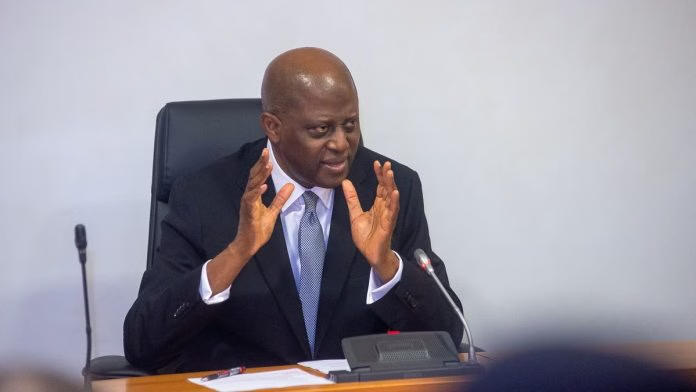
The Central Bank of Nigeria (CBN) has confirmed that 20 commercial banks have successfully met the newly introduced minimum capital requirements under the ongoing recapitalisation programme.
The recapitalisation initiative, unveiled in March 2024, mandates Nigerian banks to significantly strengthen their capital base within a 24-month window to enhance resilience and position the financial system to better support economic expansion. The programme officially commenced on April 1, 2024, with a compliance deadline of March 31, 2026.
Under the revised capital framework, banks are required to meet higher thresholds depending on the category of their operating licence. Importantly, qualifying capital must consist strictly of paid-up share capital and share premium, excluding retained earnings and reserves.
The minimum capital requirements are structured as follows:
- Commercial banks (International licence): N500 billion
- Commercial banks (National licence): N200 billion
- Commercial banks (Regional licence): N50 billion
- Merchant banks: N50 billion
- Non-interest banks (National licence): N20 billion
- Non-interest banks (Regional licence): N10 billion
Cardoso disclosed that of the 33 banks that have raised additional capital so far, 20 have already satisfied the new minimum requirements, reflecting measurable progress toward strengthening the sector.
He stated that the recapitalisation programme underscores the strategic objective of building a more robust and well-capitalised banking system capable of absorbing shocks and supporting sustainable economic growth.
The Monetary Policy Committee reaffirmed the importance of completing the recapitalisation exercise successfully, noting that a stronger financial system would reinforce resilience, improve credit capacity, and enhance the sector’s ability to navigate domestic and global economic challenges.
In addition to the recapitalisation update, the CBN Governor revealed that Nigeria’s gross external reserves climbed to $50.45 billion as of February 16 — the highest level recorded in 13 years. According to Cardoso, this reserve position provides import cover of approximately 9.68 months for goods and services.
The improved reserve position, alongside ongoing financial sector reforms, signals strengthening macroeconomic buffers at a time when policymakers are navigating inflationary pressures and currency volatility.
As the March 2026 deadline approaches, analysts expect increased capital-raising activity, mergers, and strategic restructuring within the banking industry as institutions work to meet regulatory benchmarks and maintain competitive positioning.
The recapitalisation drive represents one of the most significant financial sector reforms in recent years and is expected to shape the trajectory of Nigeria’s banking landscape for the next decade.












 has confirmed that 20 commercial banks have successfully met the newly introduced minimum capital requirements under the ongoing recapitalisation programme.)