







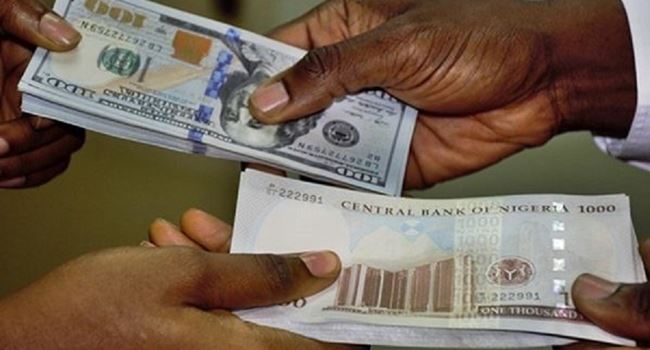
Nigeria’s foreign exchange market is once again facing renewed arbitrage concerns as the gap between official and parallel market exchange rates widens beyond the 6% mark.
Recent figures published by the Central Bank of Nigeria (CBN), alongside parallel market surveys compiled by Nairametrics, show that the premium separating both markets has expanded to approximately 6.4%, translating to a price difference of about N94 per dollar.

Although the official foreign exchange market has displayed signs of relative stability in recent sessions, the sustained spread highlights lingering liquidity constraints and the difficulty of achieving full convergence across market segments.
Midweek data indicate that while the naira strengthened modestly in the official market, it weakened slightly in the parallel market, suggesting a period of short-term calm but only incremental progress toward harmonisation.
At the Nigerian Foreign Exchange Market (NFEM), the naira closed at N1,359 per dollar on Wednesday, improving from N1,367 on Tuesday and N1,384.5 on Monday. In contrast, parallel market rates moved in the opposite direction, with the naira trading at N1,453.13 per dollar on Wednesday, compared with N1,445 the previous day.
The resulting N94 differential represents a marginal narrowing from the N96 gap recorded a week earlier. However, it remains wider than spreads observed toward the end of 2025. Notably, the premium had crossed the N100 threshold in late January, reigniting concerns over speculative trading activity.
Nigeria’s external reserves stood at $46.59 billion as of February 2, 2026, providing near-term buffers for exchange-rate management and supporting the CBN’s capacity to intervene when necessary.
Market Context
Exchange-rate differentials between official and informal markets are widely monitored as indicators of foreign exchange stability. Wider gaps often incentivise arbitrage and speculative flows, undermining policy credibility.
Following a series of foreign exchange reforms, the CBN reported that the premium between the NFEM and Bureau de Change (BDC) rates narrowed significantly to 2.11% as of December 9, 2025, down from 62.23% in May 2023.
Data compiled by Nairametrics show that the disparity remained below 5% for most of 2025 before gradually widening in early 2026. Encouragingly, the parallel market has also recorded recent gains, with the naira appreciating from around N1,490 to N1,453 per dollar within a single week.
The CBN has consistently maintained that its reform agenda is aimed at improving transparency, boosting market efficiency, and delivering long-term exchange-rate stability. While recent price movements suggest progress, full alignment between markets remains elusive.
Outlook
In its 2026 macroeconomic outlook, the Central Bank projected that exchange rates would remain broadly stable, supported by rising oil revenues, stronger diaspora inflows, and improved investor sentiment.
However, the Bank cautioned that sudden shifts in global financial conditions or unexpected capital outflows could quickly reintroduce volatility. External reserves are projected to rise to $51.04 billion in 2026, from $45.01 billion in 2025.
Further support is expected from the Dangote Refinery’s planned expansion—from 650,000 barrels per day to 700,000 bpd in 2025, and eventually 1.4 million bpd—which could strengthen Nigeria’s external position and ease foreign exchange pressures over the medium term.