







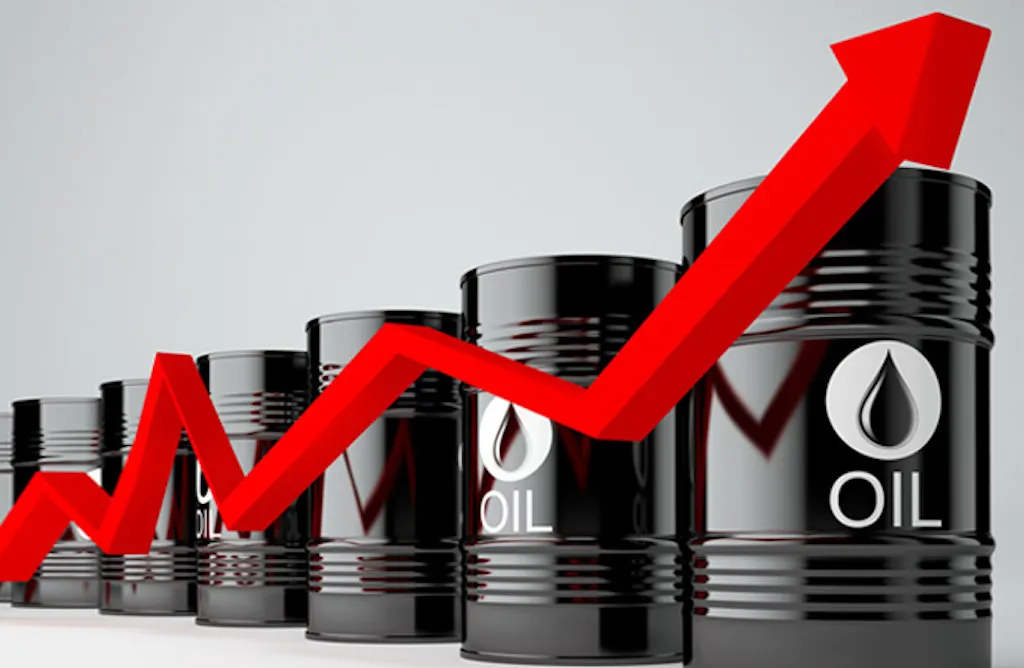
Global crude oil prices recorded modest gains at the start of the week as traders reacted to heightened geopolitical tensions and lingering uncertainty over global supply conditions.
Brent crude hovered near the $61 per barrel mark on Monday, supported by concerns over potential disruptions in key producing regions and cautious optimism surrounding diplomatic efforts to end the Russia–Ukraine conflict.
At last check, Brent futures traded at $60.87 per barrel, representing a 0.7 percent increase from Friday’s settlement of $60.43. US benchmark West Texas Intermediate (WTI) crude also advanced by around 0.7 percent to $57.27 per barrel, up from $56.86 in the previous session.
Market sentiment was influenced in part by comments from US President Donald Trump, who said significant progress had been made toward resolving the Russia–Ukraine war following talks with Ukrainian President Volodymyr Zelenskyy.
Zelenskyy confirmed that discussions had advanced on multiple fronts, revealing that approximately 90 percent of a proposed 20-point peace framework had been agreed. He added that security guarantees between the US and Ukraine were fully settled, while parallel arrangements involving Europe were close to finalisation. Military cooperation, he said, had been completely agreed, with work continuing on an economic recovery and prosperity plan.
Despite the diplomatic momentum in Eastern Europe, developments in the Middle East have continued to inject risk into energy markets. Saudi Arabia’s air operations in Yemen and fresh rhetoric from Iran’s leadership have raised concerns about the stability of oil supplies from the region.
Iranian President Masoud Pezeshkian said over the weekend that the country is engaged in what he described as a “comprehensive war” involving the United States, Israel and parts of Europe. In comments published on the official website of Iran’s Supreme Leader, Ayatollah Ali Khamenei, Pezeshkian warned that the current conflict is more complex than the Iran–Iraq war of the 1980s.
He accused Western nations of backing efforts to undermine Iran’s stability, a statement that further unsettled markets already sensitive to geopolitical risk.
However, analysts caution that upside pressure on oil prices may be limited in the medium term. Several international organisations have warned that global oil supply could exceed demand in 2026, driven by rising output from non-OPEC producers and softer consumption growth.
Additional data from the United States also pointed to increased production capacity. Oilfield services firm Baker Hughes reported that the US oil rig count rose by three in the latest week, bringing the total to 409 rigs as of December 26. Although this figure remains 74 rigs lower than the same period last year, the uptick suggests continued drilling activity.
The rig count is widely viewed as an indicator of near-term US oil output, which could add to global supply levels in the months ahead.