






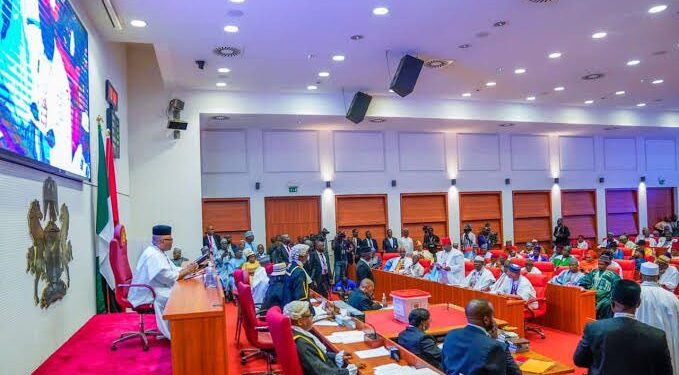
In a sweeping fiscal overhaul aimed at addressing revenue shortfalls, weak capital implementation and overlapping budget cycles, the National Assembly has approved a revised ₦43.5 trillion 2024 Appropriation Act and a reworked ₦48.3 trillion budget framework for 2025, extending the lifespan of the 2025 fiscal year to March 31, 2026.
The approvals followed prolonged plenary sessions in both chambers on Tuesday, culminating in the passage of the Appropriation Act (Repeal and Re-enactment) Bills for the 2024 and 2025 fiscal years. The bills were transmitted to the legislature by President Bola Ahmed Tinubu last Friday.
In the Senate, the revised budgets were endorsed after lawmakers adopted a consolidated report of the Committee on Appropriations, presented by its chairman, Senator Solomon Adeola (Ogun West). Lawmakers said the exercise was intended to recalibrate Nigeria’s budget architecture in line with prevailing fiscal realities, close implementation gaps and restore discipline to the budgeting process.
Presenting the report, Adeola explained that the bills sought to repeal earlier budget provisions and replace them with revised figures that reflect current revenue constraints, debt sustainability concerns and emerging national priorities.
He said the 2024 Appropriation Act was repealed from the original ₦35.005 trillion and re-enacted with an aggregate expenditure of ₦43.561 trillion, with statutory transfers, debt servicing, recurrent and capital expenditure fully detailed in the committee’s report.
On the 2025 fiscal year, Adeola disclosed that the earlier ₦54.99 trillion Appropriation Act was repealed and replaced with a revised total expenditure of ₦48.316 trillion. He noted that part of the capital allocation was rolled over into the 2026 fiscal year due to funding constraints identified during the presidential budget presentation.
According to him, extensive engagements between the committee and the economic management team informed the decision to repeal and re-enact the budgets, particularly to address concerns surrounding revenue performance, rising debt exposure and effective budget execution.
Highlighting key adjustments, Adeola said an additional ₦8.5 trillion was injected into the capital component of the 2024 budget to fund special interventions in response to pressing security, humanitarian and economic challenges.
He added that the revised framework was designed to strike a balance between responsiveness and fiscal responsibility, ensuring that debt-related spending does not undermine legislative oversight or fiscal prudence.
For the 2025 budget, the committee observed that ₦6.674 trillion was removed from the capital allocation and deferred to the 2026 fiscal year to improve budget effectiveness in anticipation of stronger revenue inflows.
Adeola cautioned against the continued practice of running multiple budget cycles concurrently, warning that extending the lifespan of one budget while another is already in operation weakens fiscal discipline, transparency and accountability.
Based on its findings, the committee recommended Senate approval of the repeal and re-enactment of the 2024 Appropriation Act to authorise total expenditure of ₦43.5 trillion from the Consolidated Revenue Fund, alongside the revised ₦48.3 trillion framework for the 2025 fiscal year and the extension of its implementation to March 31, 2026.
Meanwhile, the House of Representatives also passed the revised ₦43.56 trillion 2024 budget and the ₦48.31 trillion 2025 budget after considering and adopting the report of its Committee on Appropriations.
The passage followed clause-by-clause consideration of the estimates at the Committee of Supply and their subsequent approval at plenary, presided over by the Speaker, Rt. Hon. Tajudeen Abbas.
A breakdown of the revised 2024 budget shows that ₦1.74 trillion was earmarked for statutory transfers, ₦8.27 trillion for debt servicing, ₦11.26 trillion for recurrent (non-debt) expenditure, while ₦22.27 trillion was allocated to capital expenditure and development fund contributions for the fiscal year ending December 31, 2025.
For the revised 2025 budget, ₦3.64 trillion was provided for statutory transfers, ₦14.31 trillion for debt service, ₦13.58 trillion for recurrent (non-debt) expenditure and ₦16.76 trillion for capital expenditure through development fund contributions. As with the Senate version, the 2025 budget will run until March 31, 2026.
In his communication to the National Assembly, President Tinubu said the revisions were necessitated by the need to accommodate previously omitted budgetary items and to realign capital implementation targets with Nigeria’s execution capacity and revenue realities.
He said the revised framework adopts a more realistic capital implementation benchmark of 30 per cent, acknowledging persistent weaknesses in the execution of the capital component of the 2024 budget, which he noted had significantly undermined infrastructure delivery nationwide.
According to the president, extending the lifespan of the 2025 budget would give Ministries, Departments and Agencies sufficient time to access and utilise the targeted 30 per cent capital releases.
Tinubu said the approach forms part of a broader fiscal reform agenda aimed at correcting structural flaws in Nigeria’s budgeting process, particularly the long-standing problem of overlapping budgets. He added that ending the practice of running multiple budgets simultaneously would improve planning, strengthen implementation and enhance transparency and accountability in public expenditure.
The president stressed that the revised budget framework is designed to deliver more credible budget performance, improve coordination of government programmes and ensure better value for money for Nigerians.