


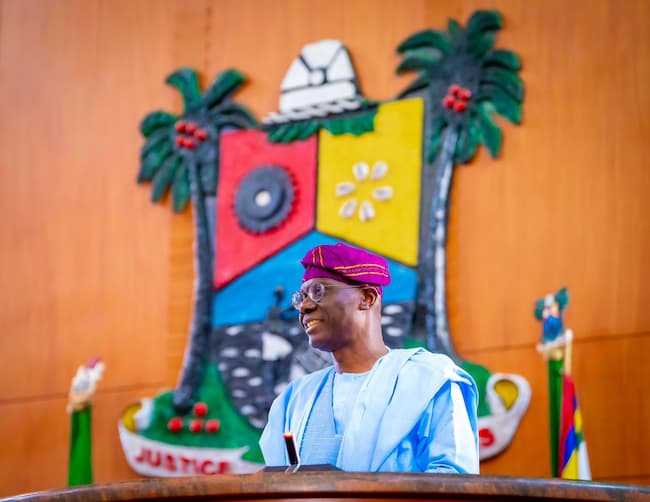
Lagos State Governor, Babajide Sanwo-Olu, on Tuesday presented a N4.24 trillion budget proposal for the 2026 fiscal year to the Lagos State House of Assembly, describing it as a strategic blueprint aimed at deepening inclusive economic growth across the state.
Presenting what he identified as his administration’s final full-year budget, the governor noted that the proposal builds on the gains of the 2025 Budget of Sustainability while aligning with the state’s long-term development vision. The 2026 spending plan has been christened “The Budget of Shared Prosperity.”
Sanwo-Olu explained that the proposal underscores his government’s commitment to reducing poverty, expanding opportunities, and ensuring that progress in Lagos is evenly distributed.
“Our intention is straightforward—the idea of shared prosperity should no longer be aspirational, but something residents feel tangibly in their daily lives,” he said.
The budget is structured around four pillars: people-centric development, modern infrastructure expansion, a competitive economy, and responsive governance, all anchored on the THEMES Plus Agenda.
The governor noted that Lagos remains Africa’s second-largest subnational economy after Cairo, a milestone he attributed to residents’ innovation, resilience, and the administration’s consistent reforms.
He highlighted major achievements recorded in 2025, including the hosting of Africa’s first E1 Electric Powerboat Grand Prix, winning hosting rights for the 2026 Creative Africa Nexus, and securing the 2027 Intra-African Trade Fair.
Sanwo-Olu also detailed progress across education, healthcare, transport, social welfare, agriculture, technology, and infrastructure. He noted the completion of more than 250 educational infrastructure projects, expansion of healthcare access, and broader coverage under the Lagos social protection register.
The state also completed several major road projects, enhanced water transport, and advanced new housing schemes. According to him, Lagos is now shifting from constructing infrastructure to creating an interconnected system that links roads, rail, waterways, power grids, and digital networks.
On economic development, the governor revealed that Lagos secured over N1 trillion in investment commitments in 2025 and signed a landmark MSME financing pact with the Bank of Industry. Additionally, the state unveiled the N500 billion Lagos Uptake Guarantee Fund to support food systems and ease household pressure.
He reiterated the administration’s focus on fiscal responsibility, transparency, and enhanced security, stating, “Good governance remains fundamental to development, and Lagosians must remain central in every decision.”
Commending the Lagos State House of Assembly for its collaboration, Sanwo-Olu said the 2026 budget will accelerate the state’s progress from stability to accelerated growth.
The proposed budget projects revenue of N3.99 trillion, with deficit financing of N243.33 billion. Internally Generated Revenue (IGR) is estimated at N3.12 trillion, while federal allocation stands at N874 billion.
Capital expenditure is set at N2.19 trillion, while recurrent expenditure amounts to N2.052 trillion, covering personnel, overhead costs, and debt servicing.
A breakdown shows allocations as follows:
General public services: N847.47 billion
Public order and safety: N147.040 billion
Economic affairs: N1.372 trillion
Environment: N235.957 billion
Housing: N123.760 billion
Health: N338.449 billion
Recreation: N54.682 billion
Education: N249.132 billion
Social protection: N70.024 billion
In 2025, the governor presented a budget of ₦3.37 trillion with ₦2.97 trillion revenue estimates.