








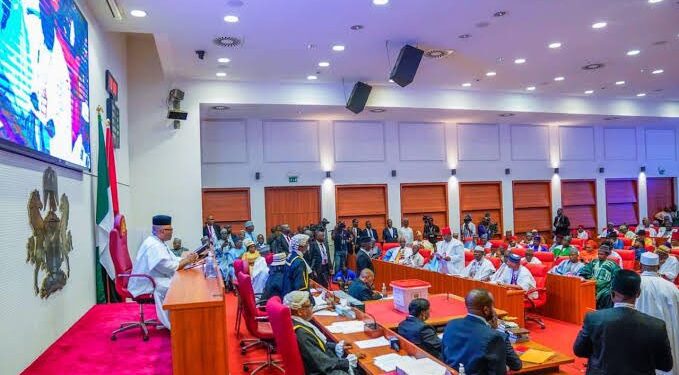
The Nigerian Senate has called on the Minister of Finance and Coordinating Minister of the Economy, Wale Edun, to urgently review the recently introduced 30 percent Capital Gains Tax (CGT) on large share sales, following a staggering N2 trillion loss at the Nigerian Stock Exchange last week.
The tax, embedded in the newly passed Nigerian Tax Act 2025, increases CGT on share disposals of N150 million and above from 10 percent to 30 percent, with implementation scheduled to begin in January 2026.

Senate Committee Raises Alarm
Senator Osita Izunaso, Chairman of the Senate Committee on Capital Market and Institutions, appealed on Wednesday while presenting a paper titled “Redefining the Rules: The Investment and Securities Act 2025 and the Future of Nigeria’s Capital Market” at the Moneyline with Nancy Investment Forum 2025 in Abuja.
Izunaso warned that the sudden tax adjustment has unsettled investors, triggering panic-driven share disposals that slashed market value by more than N2 trillion within a week. He commended President Bola Ahmed Tinubu for the renewed vibrancy in Nigeria’s capital market since 2023, crediting reforms that stabilized the macroeconomic environment and enhanced policy coherence.
“However, there is something worrisome. The recent development under the Nigerian Tax Act 2025, particularly the increase in Capital Gains Tax on share sales above N150 million, has raised understandable concern among investors. Anticipating this change, major investors have offloaded shares, resulting in a notable decline in market capitalization over the past few days,” he said.
Highlighting the need for balance, Izunaso noted that while taxation is essential for national revenue, fiscal policies must be designed to maintain investor confidence and encourage long-term investment.
“While taxation is essential, it is equally critical that fiscal measures do not inadvertently undermine investors’ confidence or discourage capital formation,” he said.
The Senate Committee plans to engage Minister Edun, urging him to explore mechanisms to address investor concerns, ensuring both domestic and foreign investors remain confident in the Nigerian market. Izunaso suggested that the Minister exercise discretion in implementing aspects of the new tax law, especially provisions with far-reaching implications for capital formation and market stability.
“We understand the new law is set to commence in January 2026. However, certain provisions should only take effect when advised by the Honourable Minister to the Executive. This is one of those measures that should not start on January 1, given its immediate impact on the market,” he explained.
Clarifications from the Federal Government
The Chairman of the Presidential Fiscal Policy and Tax Reforms Committee, Taiwo Oyedele, recently clarified that the new CGT framework will not retroactively tax investment gains made before 2026. A cost-basis reset and grandfathering clause will preserve prior gains while applying tax only to profits earned after the reform takes effect.
Meanwhile, Nairametrics reported that Minister Edun has pledged a cautious and consultative approach in implementing the tax reforms, particularly the contentious CGT on securities transactions, signalling the government’s awareness of investor sensitivities.