




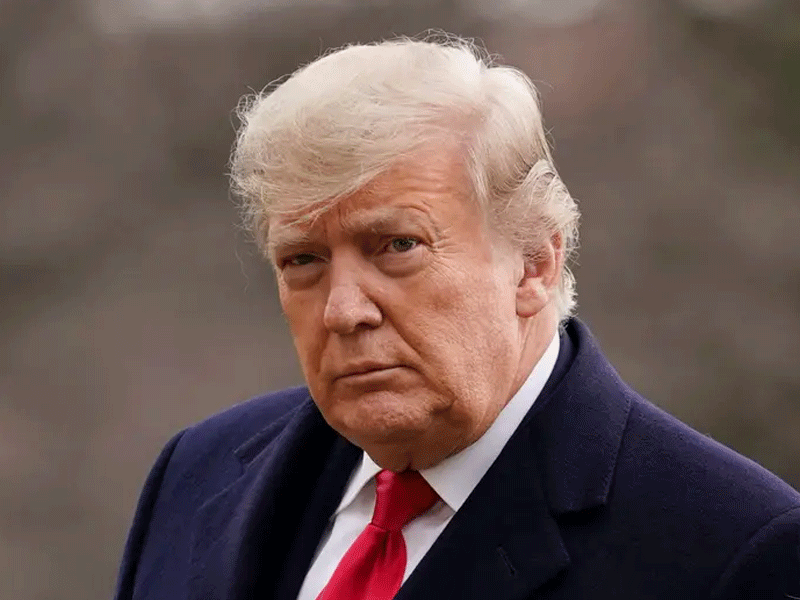
United States President Donald Trump’s decision to impose tariffs of up to 50 per cent on Indian goods took effect on Wednesday, heightening trade frictions between Washington and New Delhi despite their deepening strategic ties.
The new levy combines an earlier 25 per cent duty on a wide range of Indian exports with an additional 25 per cent penalty linked to India’s continued purchases of Russian oil. The measure now affects key exports such as garments, gems and jewellery, footwear, sporting goods, furniture and chemicals — placing India among countries facing the steepest U.S. tariff rates, alongside China and Brazil.
The move poses a serious challenge to India’s small exporters and risks significant job losses, particularly in Prime Minister Narendra Modi’s home state of Gujarat. Officials at the Commerce Ministry said the government would provide support to affected businesses and encourage them to seek alternative markets in China, Latin America and the Middle East.
A U.S. Customs and Border Protection notice offered temporary relief by allowing goods already in transit to enter at the previous lower tariff rate until 17 September. Duties imposed separately on steel, aluminium, passenger vehicles, copper and other products under U.S. national security provisions remain in place.
The tariff escalation follows five failed rounds of negotiations. Indian negotiators had lobbied for a cap at 15 per cent, in line with concessions extended to Japan, South Korea and the European Union. However, White House trade adviser Peter Navarro confirmed the administration would press ahead with the higher rate without compromise.
Trade analysts warn that the tariffs could hit more than half of India’s $87 billion merchandise exports to the U.S., creating openings for competitors such as Vietnam, Bangladesh and China. The development also threatens India’s ambition to position itself as a viable alternative to China in the global electronics and smartphone supply chain.
The dispute unfolds against the backdrop of expanding security and diplomatic cooperation between the two democracies. Only a day before the tariffs took effect, the U.S. State Department and India’s Ministry of External Affairs issued identical statements reaffirming their partnership, including collaboration through the Quad alliance with Australia and Japan.
With two-way trade valued at $129 billion in 2024 and a U.S. trade deficit of $45.8 billion, both sides are under increasing pressure to find a resolution before economic tensions begin to erode broader political relations.