







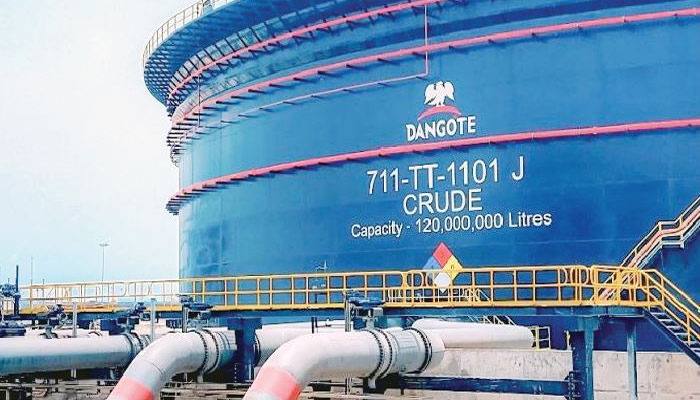
The Dangote Petroleum Refinery located in Lagos is undergoing a significant enhancement process aimed at increasing its processing capacity from 650,000 barrels per day (bpd) to 700,000bpd, according to an update shared by the President of the Dangote Group, Alhaji Aliko Dangote.
The capacity upgrade, which adds an additional 50,000bpd, is scheduled for completion in the final quarter of 2025. During a recent guided tour of the Lekki-based facility with journalists and stakeholders, Dangote revealed that the ongoing modifications have temporarily limited the refinery from achieving full operational output this year.
He noted that while the Residue Fluid Catalytic Cracking (RFCC) unit — a crucial component used to transform heavy petroleum fractions into lighter fuels like gasoline and diesel — is currently functioning at 85% efficiency, other divisions within the refinery have exceeded 100%, with some even reaching 145%.
“Our RFCC is currently at 85 per cent capacity. We’re not yet at 100 per cent due to the technical modifications under way. Once those are finalized by year-end, we anticipate the plant will operate at 700,000 barrels daily,” Dangote stated.
In terms of crude sourcing, he disclosed that the refinery secured 19 million barrels of crude oil from the United States between June and July. Ten million of those barrels were acquired in early July alone, accounting for roughly 55% of the refinery’s current feedstock.
Dangote also recounted his earlier ambition to purchase existing state-owned refineries, a plan that was halted in 2007 under former President Umar Musa Yar’Adua. That decision became the catalyst for his commitment to build the $20 billion mega-refinery aimed at addressing Africa’s long-standing fuel dependence.
Reflecting on the journey, Dangote admitted the challenges were more complex than anticipated: “People often compare building a refinery to constructing a house, but the truth is that if I had known the hurdles involved, I probably wouldn’t have embarked on it. But we kept pushing forward, driven by our belief that nothing is impossible.”
He highlighted the strategic importance of a functioning refinery in Africa, given that most African nations, with the exception of Algeria and Libya, are heavily reliant on fuel imports. “If you look around Sub-Saharan Africa, you’ll see massive oil tankers in ports like Lome — a testament to the continent’s dependence on imported fuel, which continues to undermine local industry,” Dangote remarked.