








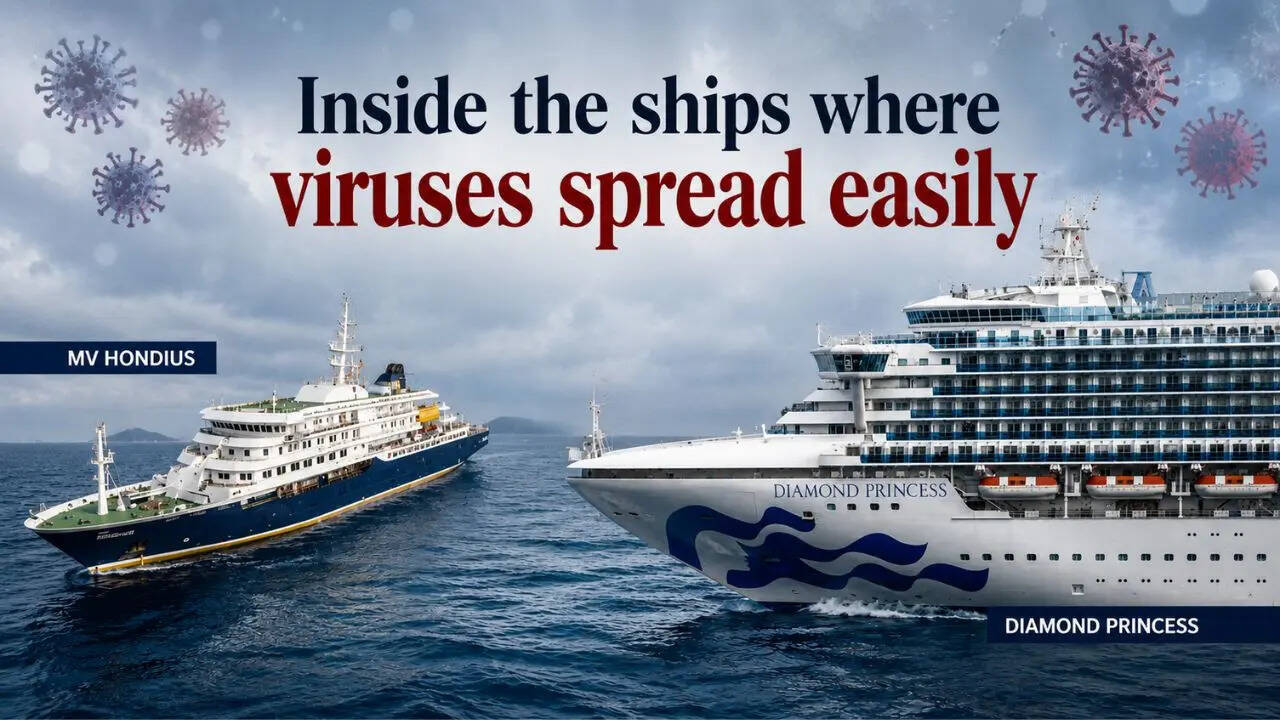
Two eerily parallel stories of contagion, quarantine, and international crisis playing out on the high seas — one common thread is where the lessons begin.
The virus that came from rodents
Long before it made headlines on a luxury expedition ship, Hantavirus was already one of nature’s more quietly terrifying pathogens. The virus was first identified during the Korean War in the 1950s, when American soldiers stationed in Korea began exhibiting mysterious symptoms of severe respiratory illness. The disease was linked to the Hantaan River in South Korea and the name stuck.
Hantaviruses are zoonotic viruses that naturally infect rodents and are occasionally transmitted to humans. Infection can result in severe illness and often death, although the diseases vary by type of virus and geographical location.
The hantavirus linked to the cruise ship outbreak is the Andes virus which, is the only type that can spread from person to person. This is rare and typically limited to close, prolonged contact. The CDC notes that at this time, there is no indication of wider community spread.
Hantavirus disease surveillance in the United States began in 1993 during an outbreak of severe respiratory illness in the Four Corners region — the area where Arizona, Colorado, New Mexico, and Utah meet. That outbreak put the scientific world on alert: here was a rodent-borne pathogen lurking in ordinary environments, spread not through touch or a cough but through something as incidental as breathing dust near infected droppings.
Hantavirus is a rare but potentially dangerous rodent-borne virus that can cause flu-like symptoms and severe lung or organ problems. Humans can contract the disease when they come into contact with infected rodents or their saliva, urine, and droppings. What makes it especially treacherous is how deceptively it begins. Early diagnosis can be challenging because early symptoms are common with other febrile or respiratory illnesses, such as influenza, COVID-19, viral pneumonia, leptospirosis, or dengue.
Globally, the picture is grim. Hantavirus infections are associated with a case fatality rate of less than 1–15% in Asia and Europe, and up to 50% in the Americas. There are no specific treatments nor vaccines for hantavirus.
The MV Hondius: A floating outbreak in real time
In a story that has gripped global health authorities this week, an expedition cruise ship called the MV Hondius has become the centre of an unprecedented hantavirus cluster at sea and as of today, May 9, 2026, the drama is far from over.
The vessel departed Ushuaia, Argentina, on 1 April 2026 and followed an itinerary across the South Atlantic, with multiple stops in remote and ecologically diverse regions, including mainland Antarctica, South Georgia, Nightingale Island, Tristan da Cunha, and Saint Helena. It was exactly the kind of voyage that attracts adventurous nature lovers — people who go ashore to observe penguins, seabirds, and remote wildlife. Those very landscapes, it now appears, may have been the incubation ground for a deadly virus.
On 2 May 2026, a cluster of passengers with severe respiratory illness aboard the ship was reported to the World Health Organization. As of 4 May 2026, seven cases had been identified, including three deaths, one critically ill patient, and three individuals reporting mild symptoms. Illness onset was characterized by fever, gastrointestinal symptoms, rapid progression to pneumonia, acute respiratory distress syndrome and shock.
The toll then rose further. The WHO confirmed that eight people have now fallen ill, with six confirmed cases of hantavirus and two probable cases — three of whom have died. After sequencing the virus, health authorities confirmed the outbreak was caused by the Andes strain, which is known to have previously had some limited spread between people.
Investigators believe the origin traces squarely to South America. Both the first man and his wife — the second passenger to fall ill, had travelled in Argentina, Chile, and Uruguay prior to boarding, and officials currently suspect that is when they were exposed. Both individuals have since died. The Argentine health ministry published a report showing the index case had gone on a four-month road trip between 27 November 2025 and 1 April 2026, spanning Chile, Uruguay, and Argentina.
Heading to Tenerife: Politics, fear, and a ship at sea
The ship left Cabo Verde on May 6 and is currently heading to Spain’s Canary Islands, where passengers are expected to disembark, but the path there has been anything but smooth.
The Canary Islands, an autonomous region of Spain, refused to allow the MV Hondius to dock at any of its ports, despite the Spanish central government saying it would be permitted to do so. Canary Islands President Fernando Clavijo said regional authorities could not allow the ship to enter the archipelago, saying authorities lacked enough information about the outbreak to guarantee public safety.
The WHO bluntly countered, stating Spain has a moral and legal obligation to assist those on board. Spain’s central government ultimately prevailed. Spanish authorities on Friday were preparing to receive more than 140 passengers and crew members on board the hantavirus-stricken cruise ship. The vessel is expected to arrive Sunday at Tenerife, and passengers will be taken to a “completely isolated, cordoned-off area,” said the head of Spain’s emergency services.
Oceanwide Expeditions said the situation on board “remains calm.” The boat is scheduled to arrive early Sunday, though that timetable is subject to change. Crew members of the MV Hondius are being interviewed by epidemiologists during the voyage.
Life aboard, remarkably, has taken on an eerie normalcy. In interviews with the Associated Press, two Spanish passengers said that despite the outbreak, their days aboard have passed with relative tranquility — some people are bird-watching, others gathering in common areas to read or attend talks, while wearing masks and social distancing. Both passengers said they were worried about how they’ll be treated in Spain and once home. “We’re scared by all the news that’s coming out, by how people are going to receive us, by how people see us,” one said.
The international response has been rapid and multi-continental. Both the U.S. and the U.K. have agreed to send planes to evacuate their citizens from the cruise ship. The 17 Americans on board will be quarantined at the National Quarantine Unit at the University of Nebraska Medical Center and Nebraska Medicine — the only federally funded quarantine unit in the U.S., with 20 single-occupancy rooms with individual negative air pressure systems. Health authorities across four continents are tracking down and monitoring more than two dozen passengers who disembarked the ship before the deadly outbreak was detected.
Spain’s Gómez Ulla protocols: Lessons institutionalized
For passengers arriving in Spain, the Ministry of Health has announced rigorous mandatory quarantine measures at the Central Hospital of the Gómez Ulla Defense in Madrid. All people considered contacts — those who remained on the ship between April 1 and May 10, or who were in contact with a confirmed case, must report for quarantine. Passengers will stay in individual rooms with no visitors, undergo a PCR test upon arrival and again seven days later, and have their temperature recorded twice daily for early symptom detection.
The evacuation of passengers is set to begin in the archipelago from May 11, Spain’s interior ministry confirmed. These protocols represent exactly what epidemiologists argued, too late, should have been in place during the COVID-19 cruise ship era.
The Diamond Princess: When Coronavirus boarded a ship
Six years earlier, a different virus and a far larger ship created the world’s first floating COVID-19 catastrophe.
SARS-CoV-2, the virus that causes COVID-19, was first identified in Wuhan, China, in December 2019 as the origin point – the city where the pathogen crossed from animals to humans and began its global journey.
The connection to the Diamond Princess is direct. An 80-year-old Hong Kong man was diagnosed with COVID-19. He had visited Shenzhen in Guangdong Province, boarded the Diamond Princess in Yokohama on January 20, and disembarked in Hong Kong on January 25. That single passenger, himself infected through the Wuhan outbreak already spreading in China, set off a chain reaction that would reshape global public health policy.
Of the 3,711 people on board, 712 became infected with the virus. By 20 February 2020, the WHO stated that the ship accounted for more than half of the reported infections worldwide outside of China. In the earliest weeks of 2020, before the pandemic became truly global, the Diamond Princess was the pandemic — a sealed vessel of contagion that scientists and governments watched with dread and fascination in equal measure.
The transmission dynamics aboard were extraordinary. The mean reproduction number in the confined setting reached values as high as approximately 11 — far higher than estimates from community-level dynamics in China and Singapore. Airborne transmission likely accounted for more than 50% of disease transmission on the ship. Food service workers were found to have likely been the main early route of spread.
Perhaps the most consequential finding to emerge was what no one had yet quantified at scale: 46.5% of the infected passengers and crew members had no symptoms at the time of testing. This was among the earliest hard evidence that COVID-19 could spread silently and invisibly, a fact that would define global containment strategy for years.
Models later calculated that an early evacuation could have reduced the case count to just 76 cases, while the quarantine as applied reduced the number by approximately 2,300 cases — a bittersweet arithmetic that showed intervention both saved and, by keeping people enclosed too long, also cost lives.
The eerie parallels
Set side by side, these two cruise ship outbreaks reveal a recurring pattern in how pathogens exploit human mobility:
The land-based origin. COVID-19 came from Wuhan. The Andes hantavirus came from the wilderness of South America. Neither virus was born at sea.
The political stalemate. The Diamond Princess sat off Yokohama for weeks while governments argued. The Hondius was rejected by the Canary Islands before Spain’s central government overruled its own territory. In both cases, fear in port communities delayed the humanitarian response.
The silent spreader problem. In both outbreaks, infected individuals moved freely among others before anyone knew they were sick. The long incubation windows of both viruses make cruise ships, with their shared dining, excursions, and confined air — uniquely dangerous amplification environments.
The scientific windfall. The closed environment of a ship, terrible for passengers, is invaluable for science. The Diamond Princess gave researchers their first clear view of COVID-19’s asymptomatic transmission and real-world reproduction numbers. The MV Hondius is already yielding critical new data on the Andes hantavirus’s rare and poorly understood capacity for person-to-person spread.
The quarantine evolution. Spain’s Gómez Ulla protocols — individual rooms, no visitors, dual PCR testing, twice-daily temperature monitoring — are the Diamond Princess lessons institutionalized. In 2020, those protocols were improvised in real time and often failed. In 2026, they are being applied from day one.
What it all means
Factors that facilitate spread on cruise ships include the mingling of travelers from multiple geographic regions and the closed nature of the environment, particularly concerning for older passengers, who are at increased risk for serious complications. That structural vulnerability has not changed.
The Diamond Princess was a warning written in 712 infected passengers and at least 9 deaths. The MV Hondius, now cutting through the Atlantic toward Tenerife with its masked, anxious, bird-watching passengers, is a test of whether the world retained the lesson.
The WHO has emphasized the current hantavirus outbreak does not pose a broader public health risk. But six years ago, very similar reassurances were offered about a novel coronavirus in a city called Wuhan and the world spent the next two years learning what confined spaces, silent spreaders, and hesitant ports can do when a pathogen finds its moment.
This article reflects information available as of 9 May 2026. The MV Hondius is currently en route to Tenerife, with arrival expected early Sunday, May 10. The outbreak remains active and under international monitoring.