









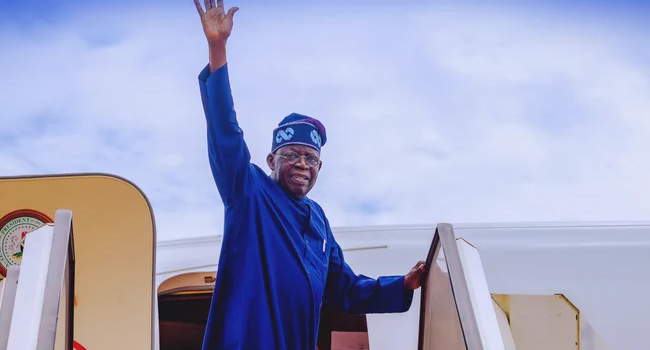
The Federal Government has spent approximately N26.38 billion on the Presidential Air Fleet (PAF) within the first 18 months of President Bola Tinubu’s administration, spotlighting the steep cost of maintaining executive air transport at a time of growing economic strain. According to spending data tracked by Govspend, a civic technology platform monitoring government finances, the payments were made between July 2023 and December 2024, covering operational and logistical costs tied to the fleet.
This figure draws fresh scrutiny when compared with the N81.80 billion former President Muhammadu Buhari allocated between 2016 and 2022. That included N62.47 billion for fleet operation and maintenance, N17.29 billion for local and foreign trips, and N2.04 billion for related overheads.
During Buhari’s tenure, the Presidency maintained 10 aircraft. While many aviation professionals blame the high cost of maintenance on the weakening naira and dollar-denominated aviation expenses, others attribute it to the size and diversity of the fleet.
The disbursement under Tinubu started with N846.03 million paid on July 14, 2023, followed by N674.82 million two days later. August 2023 marked a surge in releases, including a N2 billion payment on August 16, and additional transfers of N387.6 million and N713.22 million.
In November, N1.26 billion was spent, while March 2024 saw two separate N1.27 billion outflows. The largest single transaction was made on April 23, amounting to N5.08 billion.
Further breakdown shows more than N5.6 billion was spent in August 2024 alone, with significant payments of N1.25 billion and N2.21 billion on August 5, and N902.9 million and N1.24 billion on August 6.
Spending tapered slightly by the year’s end, but continued with N160.4 million paid on August 8, N35 million on September 11, and N133 million on September 29. December saw smaller disbursements including N290 million, N102.95 million, N25.25 million, and N8.7 million.
The PAF, managed by the Nigerian Air Force, provides air transport for the president, vice president, and top government officials. Yet the cost of maintaining the fleet remains a flashpoint amid Nigeria’s rising debt and calls for tighter fiscal discipline.
Frank Oruye, former Deputy Director of Engineering at the now-defunct Nigerian Airways, said the fleet’s diverse mix of aircraft is a key driver of cost. He explained that different aircraft types require different support systems, parts, and maintenance protocols — leading to duplication of ground equipment and increased spending.
“The fleet includes a French-made aircraft, a Canadian jet, an American Gulfstream, and larger carriers like the Boeing 737 and the recently acquired Airbus A350,” he noted. “Each one demands unique servicing, which drives up costs.”
Oruye also pointed out geopolitical considerations: “You can’t source all your jets from one country. Diplomatic issues could ground your entire fleet.”


 within the first 18 months of....)