




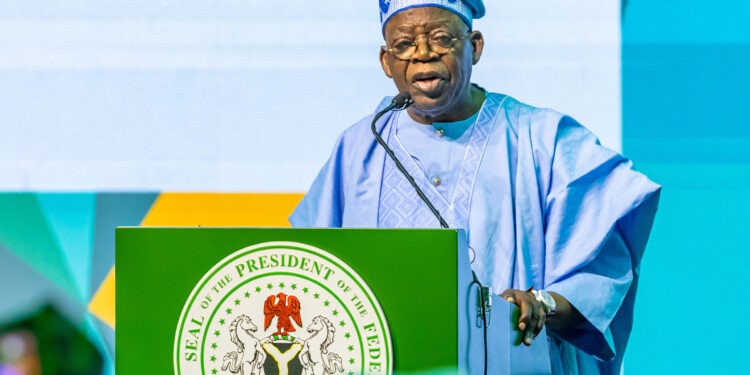
President Bola Tinubu has issued a sweeping executive directive mandating the immediate remittance of oil revenues by the Nigerian National Petroleum Company Limited (NNPC Ltd.) directly into the Federation Account, effectively suspending a range of deductions that had previously reduced distributable inflows to the federal purse.
The directive was formalised through an Executive Order signed last week and publicly disclosed by the Federal Ministry of Finance on Wednesday. According to the ministry, the order is designed to restore constitutional compliance in oil revenue administration and eliminate fiscal practices that have weakened remittances to the Federation Account.
Suspension of Deductions and Management Fees
Under the new framework, NNPC Ltd. is no longer permitted to deduct management fees or frontier exploration funding from oil proceeds before remittance. The Executive Order halts deductions tied to frontier basin exploration and suspends the collection of management fees that had been embedded within the Petroleum Industry Act (PIA) revenue structure.
In addition, gas flare penalty payments previously channelled into the Midstream Gas Infrastructure Fund will cease under the new directive.
Going forward, statutory payments — including taxes, royalties, and profit oil derived from Production Sharing Contracts (PSCs) — must be transferred directly to the appropriate fiscal authorities without deduction at source. This effectively blocks retention mechanisms that had allowed substantial portions of oil income to be withheld before distribution through the Federation Account Allocation Committee (FAAC).
Constitutional and Regulatory Realignment
The Finance Ministry stated that the Executive Order seeks to realign petroleum revenue management with the 1999 Constitution, which vests ownership of mineral resources in the Federation and requires all revenues derived from those resources to be paid into the Federation Account for appropriation.
The order also clarifies regulatory responsibilities between the Nigerian Upstream Petroleum Regulatory Commission and the Nigerian Midstream and Downstream Petroleum Regulatory Authority to prevent overlaps and ambiguities that may have contributed to revenue leakages.
An inter-agency implementation committee chaired by the Minister of Finance and Coordinating Minister of the Economy, Wale Edun, has been constituted to oversee enforcement of the directive and ensure compliance across relevant institutions.
Background: Revenue Pressures and PIA Allocations
The action follows growing concern over declining oil and gas receipts despite improved production volumes and relatively stable global oil prices.Officials argue that fiscal arrangements introduced under the Petroleum Industry Act 2021 enabled significant off-budget allocations. Under the PIA framework, 30 percent of Production Sharing Contract profits were allocated monthly to frontier exploration, while an additional 30 percent was earmarked as management fees — a structure critics contend eroded distributable revenues.
Recent disclosures from FAAC documents revealed that NNPC received N318.05 billion between January and August 2025 for frontier oil exploration alone. The Director-General of the Budget Office of the Federation had previously stated that nearly 60 percent of gross oil revenue was being absorbed by various deductions under the existing model.
President Tinubu had earlier instructed the Economic Management Team to review the 30 percent management and 30 percent frontier exploration allocations and propose structural reforms.
Immediate Effect and Fiscal Implications
The Executive Order takes immediate effect and is described as an interim corrective measure pending potential legislative amendments to embed the reforms within statutory law.
Economic analysts say the directive represents a significant tightening of federal oversight over oil revenue administration and could materially alter NNPC’s funding model, cost recovery mechanisms, and cash flow architecture under the PIA regime.
If fully implemented, the reforms could substantially increase net oil receipts flowing into the Federation Account, potentially reshaping revenue allocations for federal, state, and local governments at a time of heightened fiscal pressure and rising public expenditure demands.