








KEY POINTS
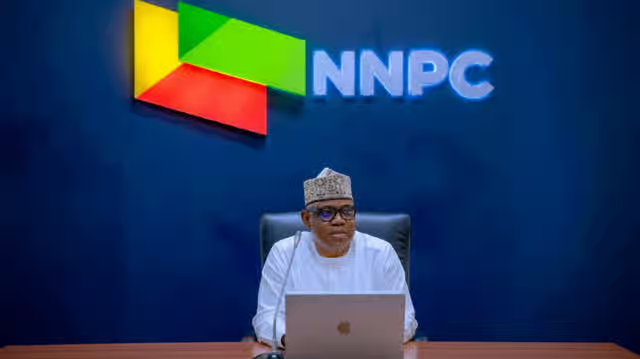
- The People’s Wellbeing Association (PWA) has commended NNPC Ltd. CEO Bayo Ojulari for transformative reforms since his appointment in April 2025.
- Under Ojulari, NNPC’s upstream subsidiary achieved a crude oil production peak of 355,000 barrels per day, the highest level recorded since 1989.
- Key transparency milestones include the reinstatement of monthly financial reports and the creation of Chief Compliance and Sustainability offices.
- The PWA urged President Tinubu to overhaul pipeline surveillance contracts, suggesting a shift in responsibility to the Nigerian Army and Navy for more equitable stakeholder involvement.
MAIN STORY
The Nigerian National Petroleum Company Limited (NNPC Ltd.) is undergoing a structural “rebirth” aimed at commercial accountability and operational efficiency.
In a statement released on Monday in Abuja, the PWA’s Head of Communication, Abba Abubakar, credited CEO Bayo Ojulari with breaking decades of stagnation. Ojulari’s leadership has been defined by a “skin in the game” strategy, particularly in the rehabilitation of refineries.
Moving away from traditional contractor-led models, NNPC is now seeking global partners to co-own and operate assets, ensuring long-term profitability and technical competence.
Operational discipline has also seen a significant upgrade through the introduction of modern Delegation of Authority (DoA) and Delegation of Financial Authority (DoFA) frameworks.
These reforms are designed to eliminate the “political pressure” that Ojulari admitted had previously forced state-owned refineries to run at monumental losses.
By repositioning the company as a commercially driven entity, the current leadership aims to insulate Nigeria’s primary revenue generator from the “greedy oil thieves” and political interference that hampered previous administrations.
THE ISSUE
The primary challenge remains the “Pipeline Security Contention.” While internal reforms are progressing, the “Surveillance Monopoly”—where specific groups hold massive security contracts—is creating friction among Niger Delta stakeholders. The PWA argues that this creates an “Equitable Distribution Gap” that could threaten regional peace. To resolve this, the group is advocating for a “Security Professionalization” model, where the military takes the lead in protecting national infrastructure, while surveillance contracts are split more fairly among various host community stakeholders to ensure collective “buy-in” and protection.
WHAT’S BEING SAID
- “Ojulari has put the company on the path of greatness… despite facing opposition from greedy oil thieves,” stated Abba Abubakar, PWA Head of Communication.
- “We are not looking for contractors anymore. We want companies that run refineries successfully… they will co-own the assets,” Bayo Ojulari disclosed at the NIES 2026.
- “He has proven that visionary leadership, coupled with accountability, could redefine an institution,” noted the Coalition of Civil Society for Transparency (CCSTEI).
- “The Nigerian Army and Navy should take over pipeline surveillance contracts… they are better positioned to handle critical infrastructure,” Abubakar suggested.
WHAT’S NEXT
In the second quarter of 2026, NNPC Ltd. is expected to finalize its first batch of “Equity-Partner” agreements for the Port Harcourt and Warri refineries. Industry experts will be watching closely to see if the 355,000 bpd production level can be sustained or exceeded as new marginal fields come online. On the security front, the Presidency is expected to review the PWA’s proposal regarding pipeline surveillance before the current contracts expire. If the transition to military-led surveillance is approved, it would mark one of the most significant shifts in Niger Delta security policy in over a decade.
BOTTOM LINE
The bottom line is that NNPC is finally acting like a business, not a bureaucracy. By hitting a 36-year production high and admitting to past political failures, Bayo Ojulari is attempting to strip away the “closed-door” culture of the old NNPC. For Nigerians, the real win will be whether this “commercial discipline” eventually translates into a stable domestic fuel supply and a stronger Naira.







 is undergoing a structural "rebirth" aimed at commercial accountability and ...)