








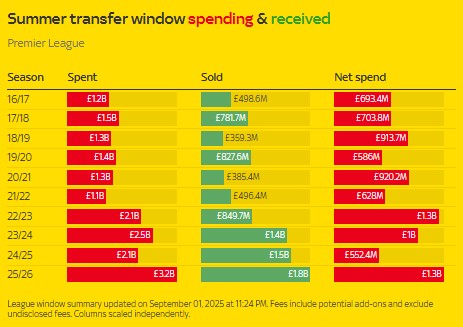
The 2025 Premier League transfer window didn’t just raise eyebrows—it smashed records and rewrote the rules of squad building. With total spending crossing the £3 billion mark, this was a summer where strikers were suddenly back in fashion, mid-table clubs were raided, and player power reared its head once again.
So, what exactly went down? Let’s break it all down—seven big storylines that made this transfer window unforgettable.
1. The £3 Billion Barrier Gets Blown Apart
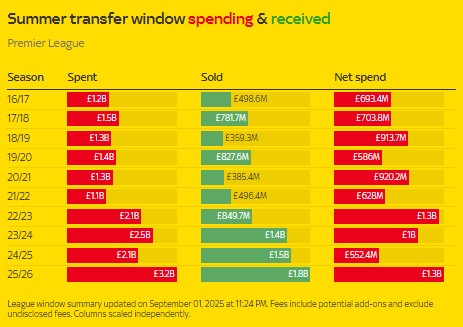
Clubs didn’t just spend big; they obliterated previous records. The £2.44bn benchmark set in 2023 suddenly looked modest compared to this year’s £3bn spree. On top of that, clubs managed to cash in like never before, banking £1.8bn from sales.
That left us with a net spend of around £1.2bn—a number that makes even the most seasoned accountants wince. It’s a stark reminder that in football finance, sustainability rules may be in place, but ambition often overshadows caution.
2. Liverpool’s Record-Breaking Outlay
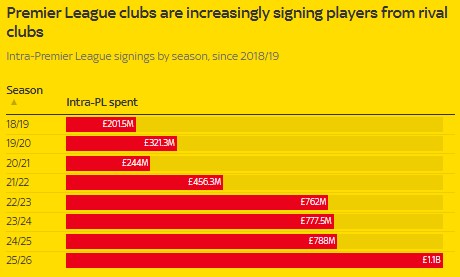
If there was one club splashing the cash louder than anyone else, it was Liverpool. They spent a jaw-dropping £446.5m, topping the charts for total outlay. But when you zoom in, it was Arsenal who recorded the highest net spend at £257m, edging past Liverpool’s £218.4m.
On the other end of the spectrum? Bournemouth walked away with £65.8m in profit after shipping off a cluster of their best defenders. It’s a reminder that while some clubs go shopping, others make a living off being the supermarket.
3. The Return of the No. 9
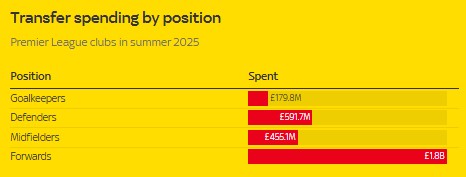
Remember when pundits were saying the traditional striker was extinct? Well, this summer proved the reports were greatly exaggerated. The market went crazy for forwards, and suddenly, every top club wanted a proper No. 9 again.
- Liverpool: Alexander Isak (£125m) and Hugo Ekitike (over £80m combined)
- Chelsea: Joao Pedro and Liam Delap (£90m)
- Arsenal & Man United: Viktor Gyokeres (£63.5m) and Benjamin Sesko (£73.7m)
- Spurs: Randal Kolo Muani (loan from PSG)
Even further down the league, Wolves, Brighton, and Everton all snapped up target men. Clearly, the striker renaissance is real.
4. Isak to Liverpool: The Blockbuster Move
The single biggest headline-grabber was Alexander Isak’s £125m switch from Newcastle to Liverpool. For months, Newcastle had resisted, but financial fair play realities eventually forced their hand.
The Swede wanted Champions League football and wasn’t shy about voicing his frustrations. Newcastle’s response? “No promises were broken.” In the end, though, Liverpool got their man, and Isak got his stage.
5. Player Power Still Packs a Punch
Isak wasn’t alone in flexing his influence. Yoane Wissa pushed hard for a move away from Brentford, making public statements about “broken promises” and lack of trust. Eventually, he too got his transfer.
Not everyone was so lucky, though. Wolves striker Jorgen Strand Larsen also hoped for a big move—this time to Newcastle—but stayed put after refusing to force the issue. His professionalism may be admirable, but in today’s game, quiet loyalty doesn’t always get rewarded.
6. Mid-Table Clubs Raided, Agai
If you’re a Brentford, Brighton, or Bournemouth fan, this summer might have felt like déjà vu. Once again, the so-called “middle-class” clubs became shopping grounds for Europe’s elite.
- Bournemouth lost Huijsen, Kerkez, and Zabarnyi—nearly £150m worth of defensive talent.
- Brentford cashed in on Bryan Mbeumo and Yoane Wissa for £120m+.
- Brighton sold Joao Pedro to Chelsea for £60m.
- Wolves waved goodbye to Cunha and Rayan Ait-Nouri (£95.8m combined).
For these clubs, the strategy remains the same: recruit smart, sell high, and hope the cycle can be sustained without falling into a relegation scrap.
7. The New Premier League Reality
So, what’s the big takeaway from this record-breaking window? In a way, the financial gaps feel bigger than ever—Liverpool, Arsenal, and Chelsea are playing in a different economic universe compared to the likes of Crystal Palace or Brentford.
Yet, the middle-tier clubs aren’t doomed. They’ve mastered the art of reinvestment, constantly scouting the next big thing before the giants swoop in. It’s a high-risk model, sure, but it keeps the league unpredictable—and isn’t that why we love it?
Final Whistle
This transfer window wasn’t just about the money (though the numbers are dizzying); it was about shifts in power, changing strategies, and the return of the classic striker. Alexander Isak’s move may go down as the symbol of this summer, but the story is much bigger.
From Liverpool’s lavish spending to Wolves’ reluctant compromises, the 2025 window tells us something clear: the Premier League is evolving, fast—and everyone’s scrambling to keep up.