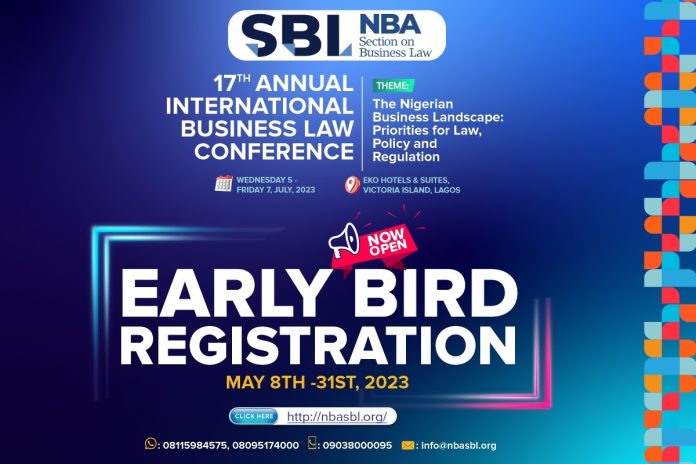
Registration for the 17th edition of the Annual International Business Law Conference of the Nigerian Bar Association Section on Business Law (NBA-SBL) has commenced.
The theme for this year’s edition is “The Nigerian Business Landscape: Priorities for Law, Policy and Regulation”. The 2023 edition of the annual conference is scheduled to hold over a three-day period from Wednesday, July 5th to Friday, July 7th at the Eko Hotels and Suites, Victoria Island, Lagos State.
Announcing the commencement of the early bird registration, Ayoyinka Olajide-Awosedo, Chairman of the 2023 NBA-SBL Conference Planning Committee, urged intending attendees to take advantage of the early bird period to register to attend the conference.
She said, “The Nigerian Bar Association – Section on Business Law is cordially inviting both lawyers and non-lawyers to register and attend this year’s edition of its annual conference. I urge every intending attendee to take advantage of the discounted early bird registration fees.
One cardinal principle of business is taking advantage of cost-saving opportunities. Registering as an Early Bird allows attendees to put this cardinal principle into practice.”
Olajide-Awosedo stated that this year’s Conference fees are as follows:
Category Fees (N)
Early Bird Rates
Young Lawyers (0-7yrs) (Members of SBL) 20,000
Young Lawyers (0 –7yrs) (Non-members of SBL) 30,000
Senior Lawyers (8yrs and above) (Members of SBL) 45,000
Non-members of SBL 60,000
Regular Rates
Young Lawyers (0-7yrs) (Members of SBL) 25,000
Young Lawyers (0 –7yrs) (Non-members of SBL) 35,000
Senior Lawyers (8yrs and above) (Members of SBL) 50,000
Non-members of SBL 65, 000
Virtual Attendance Rates
Young Lawyers (0-7yrs) (Members of SBL) 10,000
Young Lawyers (0 –7yrs) (Non-members of SBL) 15,000
Senior Lawyers (8yrs and above) (Members of SBL) 25,000
Non-members of SBL 35, 000
Opening Dinner (Members and Non-members of SBL/ Lawyers and non-Lawyers 20,000
The Conference Planning Committee Chair further emphasized that attendance at this year’s NBA-SBL conference is not exclusive to lawyers.
She stated that business practitioners will benefit from attending the conference – gaining knowledge of legal perspectives on issues that impact the Nigerian business terrain and also networking with several key players and decision-makers in Nigeria’s economic ecosystem.
The link to the registration portal for the NBA-SBL Annual International Business Law Conference is www.nbasbl.org and early bird registration ends on Wednesday, May 31st, 2023.
Since its commencement in 2004, the NBA-SBL conference has served as a platform for decision-makers, policy formulators, regulators and industry practitioners to deliberate on pertinent issues and seek solutions to the numerous challenges impacting the Nigerian business terrain.
For additional Information, Sponsorship and Exhibition opportunities, interested participants can contact the NBA-SBL secretariat through the phone lines and email listed below:
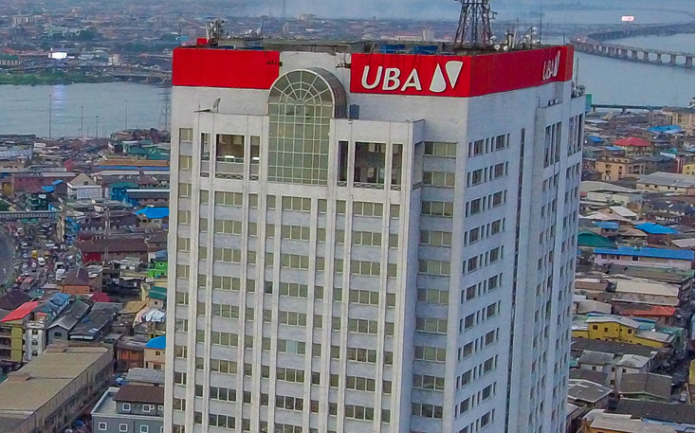
Sennaike David, a security architect, has revealed that United Bank for Africa, UBA, and other Nigerian banks had their customers’ data exposed to hackers, who sell it to fraudsters.
In a post shared on his LinkedIn profile, David recalled that in January 2023, he came across a post on the dark web stating they were selling the private data of a Nigerian fintech, access to servers, username and password and API keys, and private customer data.
”I saw the post and couldn’t buy the items because of how expensive they were, so I decided to check the validity of some of their sample data. To my surprise, they were valid, and the security situation of the fintech was lacking. From investigations, I could view any user’s profile (including BVNs, phone numbers, Names, and Emails), edit all users, and manipulate different details.
”The manipulation of some details would have led to a total compromise of the fintech. I stopped there and reported it to the organisation. After a back and forth for a while, they temporarily patched,” he revealed
”It is alarming that every bank has at least five critical vulnerabilities that could be exploited to gain complete access to its infrastructure. After all, they conduct penetration tests every quarter. This begs the question of who are the professionals conducting these penetration tests, and are they just running tools and scanners blindly and not doing the manual work? I say this because doing the manual work guaranteed the exploitation of every bank on that Wikipedia page. Is the Nigerian banking system a ransomware disaster waiting to happen?” David queried.
The cyber security expert, however, encouraged financial institutions in Nigeria to adopt Bug Bounty programmes, which he said exposes you to many talented hackers willing to test your platforms and reports crucial vulnerabilities
Full Implementation of PIB Will Boost Oil Production, Investment - Fitch
Nigeria’s crude oil output fell by 38,102 barrels per day in March, for a total loss of around 1,181,162 barrels in the month under review, and was the first dip in oil production in seven months. According to industry statistics gathered in Abuja on Monday, Nigeria’s oil output has been increasing since September 2022, as a result of coordinated efforts by the Federal Government and partners to reduce oil theft in the sector.
The increase in oil output, however, was not continued in March, as the Nigeria Upstream Petroleum Regulatory Commission reported that although the country produced 1,306,304 barrels of crude per day in February, the rate dipped to 1,268,202 barrels per day in March. This was a daily loss of 38,102 barrels, implying that Nigeria lost around 1,181,162 barrels of petroleum in March.
According to Country Economy, a global statistical agency, the average price of Brent, the international benchmark for oil, in March 2023 was $78.43/barrel. As a result of the 1,181,162 barrels lost in March, Nigeria failed to earn a total of $92,638,535.66 (N42.71 billion at the official currency rate of N461/$) during the review period.
In September 2022, Nigeria achieved its lowest oil production output of 0.937 million barrels per day. The Federal Government and oil industry participants blamed it on significant petroleum theft in Nigeria’s oil-rich Niger Delta. The situation also led to humongous revenue losses for the country, international oil companies operating in NIgeria, as well as indigenous operators in the industry.
But the country’s oil output started improving after September, following concerted efforts by security officials and oil operators, as industry figures showed that crude production rose to 1.014 million barrels per day in October.
This indicated an increase of 0.077mbpd when compared to the 0.937mbpd output in September. In November, the country pumped 1.185mbpd crude, representing an increase of 0.171mbpd when matched against what was produced in October. The rise in output continued in December last year, as Nigeria produced 1.253mbpd in that month, indicating an increase of 0.05mbpd when compared to its output in November.
The 1.258mbpd oil production in January 2023 was about 23,000bpd higher than the 1.235mbpd crude oil output in December 2022. The momentum was sustained in February, with an output of 1.31mbpd. But the volume dropped to 1.27mbpd in March, putting an end to the seven-month run in Nigeria’s oil output.
The country targets to meet the 1.8mbpd quota approved for it by the Organisation of Petroleum Exporting Countries. Nigeria generates bulk of its foreign exchange from crude oil and gas sales. The Federal Government, since last year, intensified efforts to shore-up Nigeria’s crude oil production and reduce its theft by vandals and thieves.
“Admittedly, one major area of value erosion in the industry is the menace of crude oil theft. Our records indicate that the menace of oil theft has negatively impacted the oil and gas sector for about two decades with attendant huge financial losses to our nation,” the Chief Executive, NUPRC, Gbenga Komolafe, stated recently.
He said the commission, in collaboration with the various arms of the security forces, the Nigerian National Petroleum Company Limited and the host communities, had been able to suppress the ugly trend of hydrocarbon value decimation.
“Now, our nation has continued to record good dividends of these collaborative efforts as production figures are progressively increasing. The January 2023 volume is approximately 1.5 million barrels per day of oil and condensates.
“It is expected that this number will continue to increase as further measures are introduced and sustained to remove all illegal connections that aid crude oil theft,” the NUPRC boss stated.
Renowned billionaire, Femi Otedola has accused Transnational Corporation of Nigeria (Transcorp) Chairman, Tony Elumelu, of backstabbing him multiple times.
BizWatch Nigeria understands that Otedola’s accusation follows his failure to become the largest shareholder of Transcorp.
The billionaire recently divested his newly acquired stake in Transcorp to Elumelu, pulling the plug on the scramble for the top ownership of the group.
Otedola sold his substantial shareholding of 6.3 per cent, a haul of 2.6 billion shares bought in separate transactions, to Mr Elumelu.
Earlier, within days of his acquisition of a substantial shareholding, Elumelu had racked up his interest from 2.07 to 25.9 per cent.
Sources with details of the matter said Otedola’s move to take the peak spot in the conglomerate’s ownership upset the Transcorp chair, prompting him to open talks. He eventually agreed to compensate the businessman with millions of dollars, sources revealed.
Breaking his silence on the situation, Otedola released a statement, in which he revealed that he offered to buy Transcorp for N250 billion.
While noting that this is not the first time Elumelu would backstab him, Otedola revealed that he did the same with UBA and Ughelli Power Plant.
The statement read; “In 2005, while Tony was the Managing Director of Standard Trust Bank he approached me to get funds to acquire UBA. I enthusiastically gave him $20million, which was N2 billion at that time to buy the necessary shares in UBA for the acquisition. After a short period of time the share price moved up and I decided it is was a good moment to sell and get out of the bank. However, Tony appealed to me to hold on to the shares as he was convinced that there were future prospects – so I kept the shares,” Otedelo said.
“I became Chairman of Transcorp Hotel in 2007 with a shareholding of 5% and unknowingly Tony gradually started buying shares quietly.
“By the following year in 2008 I went bankrupt in Nigeria. Tony proceeded to take my shares in UBA to service the interest on my loans and he also took over my shares in Africa Finance Corporation, where I was the largest shareholder.
“Shortly after, Albert Okumagba informed me that an American firm wanted to acquire my shares in Transcorp, which I then agreed to sell. However, this supposed American firm turned out to be Tony Elumelu. The revelation of this prompted me to resign as Chairman of the hotel.
“Years later in 2012 Tony said he wanted to see me so we met in my office where I had previously had a meeting with foreign investors who had not yet departed the premises. Curious to know, he asked what sort of meeting I had had and I disclosed that I wanted to go into the power business, specifically Ughelli Power Plant. Tony quietly went ahead to bid for Ughelli and he outbidded me by offering to buy the plant for $300million.
“And as a some would say: the rest is history.
“Fast forward to the present…
“I offered to buy Transcorp Plc for N250 billion, but unfortunately, my offer was rejected. My goal was to maximize the company’s potential as a Nigerian conglomerate with a market cap of at least N2 trillion instead of the current N40 billion, but it seems some shareholders have a different vision.
“As a businessman, I believe in healthy competition and market dynamics. Two captains cannot man a ship, and I respect the majority shareholder’s decision to buy me out. This is the nature of the game.
“But let me be clear: my offer was made with the best intentions for Transcorp Plc and its shareholders. I saw an opportunity to unlock the company’s full potential and create value for everyone involved.
“It’s important for investors to understand that free entry and free exit are crucial to healthy markets. The scramble for shares after my acquisition is a testament to the value that Transcorp Plc can offer, and I hope the company continues to thrive under new leadership.
“My message to Transcorp Plc and its shareholders is this: I remain committed to the growth and success of Nigerian businesses, and I will always be looking for ways to create value for all stakeholders. Stakeholders are unfortunately always shortchanged by getting stipends while the owners and managers of the business live a jet set lifestyle, which is detrimental to the stakeholders. Thank you for the opportunity to engage in this exciting chapter of Transcorp’s history.”
Musk-mandated reforms at Twitter, such as employee cuts and the elimination of free verification check marks viewed as signs of authenticity, have alienated users and advertisers.
Twitter’s blue ticks were reinstalled on select media, celebrity, and other high-profile accounts late in April, prompting outrage from many of the receivers.
Femi Falana, SAN, a human rights lawyer, has criticised the dollarization of the Nigerian economy, saying the country has no business selling crude oil in dollars.
He stated that he led a campaign against the dollarization of the Nigerian economy to the leadership of the Central Bank of Nigeria (CBN), who vowed to solve the matter but were unable to do so.
Falana, who was a guest on a program on Monday, also questioned Nigeria’s position among the BRICS (Brazil, Russia, India, China, and South Africa) countries’ and others’ efforts to develop an international currency to compete with the dollar.
“Along our campaign (against dollarization of the economy), the world is moving. The BRICS is now campaigning that it is going to have an international currency to challenge the dollar.
“About 24 countries have applied to join the body in their next summit that will take place in South Africa. I am simply asking, what is the position of Nigeria?
“Have we reduced ourselves to the footnote of history as far as international affairs are concerned? When you look at section 19 E of the Constitution, provides that it shall be the duty of the government of Nigeria to promote a new international economic order and that is and that is the world before us.
“We have no business selling our oil, gas, and other products in dollars, we are supposed to ask the buyers to pay in naira so that you can shore up your currency. And that is what Russia is doing currently, China is doing the same, India is doing that,” Falana said
He chastised the central bank for following the advise of the International Monetary Fund (IMF) and the World Bank, both of which feel the naira is overpriced.
Falana also bemoaned the fact that in some regions of the country, house rent and school fees are now paid in dollars.
On Monday, the dollar stayed somewhat lower versus most of its major counterparts as traders waited for the Federal Reserve to signal the end of its rate hike cycle while attempting to hedge against the danger of a recession. The dollar index, which measures the currency against six competitors, was down 0.1% in late morning trade at 101.21, a stronger performance than last month’s one-year low of 100.78.
The Fed hiked interest rates by 25 basis points last week, but sounded significantly more pessimistic on the outlook than peers, reducing advice on the necessity for further rises.
“Everybody keeps looking for the economic activity and the data to support the idea that there’ll be a recession in the U.S. whether it’s in the second half of this year (or) in the final quarter,” said Joe Francomano, portfolio manager at Gelber Group LLC in New York.
“But then you keep getting these strong U.S. employment data that shows strength and continued wage pressures. So, it seems we keep putting off the inevitable or the inevitable will never come as far as the recession is concerned.”
Fed funds futures traders are now pricing for the fed funds rate to reach 4.993 in July, and remain below that all year. The Fed’s target range stands at 5% to 5.25%, having risen rapidly from 0% since March 2022.
“Central bank policy divergence remains in the driver’s seat and continues to underpin European currencies at the dollar’s expense,” said Joe Manimbo, senior market analyst at Convera.
“The Fed’s latest rate hike could be its last while the Bank of England is expected to hike this week and further over the coming months, buoying the pound.”
Sterling reached a more than one-year high against the dollar on Monday, trading as high as $1.2668, its highest level since April 2022, before falling slightly below that level and closing up 0.11% at $1.2641. The pound has been firming against the euro this week as the Bank of England is poised to raise interest rates on Thursday.
The euro has gained about 16% against the dollar from September lows, and is trading barely changed on the day at $1.1022, buoyed by hopes that the European Central Bank would maintain interest rates high for longer than the Fed. The ECB likewise reduced the pace of its interest rate hikes last week, but warned that more tightening was on the way. Traders are keeping an eye on the debt limit deadlock on Capitol Hill, where the Treasury Secretary has warned that the country may be unable to pay its bills by June 1. Meanwhile, US inflation statistics anticipated on Wednesday might show if the Fed has to do more to keep inflation under control.
In other news, the dollar was unchanged versus the yen at 134.885.
In April, US consumers’ inflation forecasts were mixed, according to a New York Fed survey.
According to the regional Fed bank’s April poll of Consumer Expectations, respondents expect inflation to be 4.4% a year from now, down from 4.7% in the March poll. Inflation was anticipated to reach 2.9% three years from now, compared to 2.8% in March, and 2.6% five years from now, compared to 2.5% in the prior month.
The New York Fed report also found that the banking sector stress that began nearly two months ago, spurring fears about the health of the financial system and forcing the central bank to provide extensive liquidity to the financial system, hasn’t left much of a mark on consumers’ attitudes so far.
The April survey found “mixed” views on credit access, noting “both the share of households reporting it is easier and the share reporting it is harder to obtain credit now than one year ago declined.”
The report also found that perceptions in April surrounding respondents’ current financial situation improved, while their expectations “deteriorated slightly, with fewer respondents expecting to be better off a year from now.”
It also said that households still expected to see rising earnings, although spending was projected to moderate to a 5.2% gain, the weakest since September 2021, from the 5.7% forecast in March. Survey respondents also said they expect higher unemployment and a greater probability of losing their jobs, as well as a harder time finding new work.
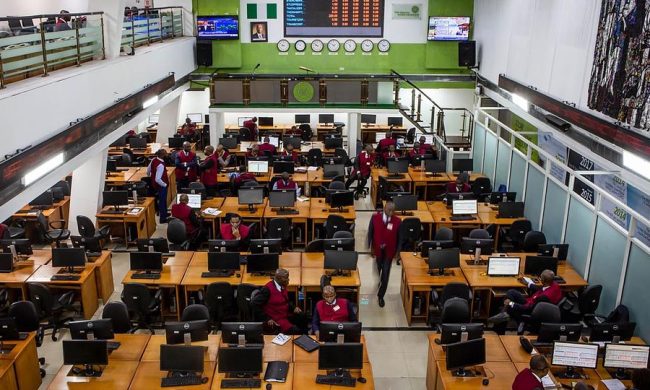
Trading on the Nigerian Exchange (NGX) began well, with the All-Share index rising 0.2% to 52,579.52 points. Today, the stock market gained N62 billion as investors bought Tier-1 banks shares. Nigerian Breweries, Nigerian Exchange Group, Ardova Plc, Stanbic IBTC Holdings, and Guaranty Trust Holding Company (GTCO) were among the major gainers.
Market mood was good, as judged by market breadth, with 29 equities gaining versus 27 losers. Multiverse Mining and Exploration had the largest price increase of 10%, closing at N3.41 per share.
Red Star Express followed with a 9.96% gain to conclude at N2.65, while CWG gained 9.85% to settle at N1.45, per share. McNichols increased by 9.23% to close at 71k, while International Breweries increased by 6.82% to conclude at N4.70 per share.
C & I Leasing, on the other side, led the losers’ chart by 9.8 percent, closing at N3.59 per share. Transnational Corporation (Transcorp) followed with a 7.73 percent drop to N1.79. Meanwhile, FTN Cocoa Processors fell 6.9% to settle at 27k per share.
Chams Holdings down 6.45 percent to end at 29k, while Custodian Investment fell 4.8% to settle at N5.95, per share. The total volume traded advanced by 6.0 per cent to 511.38 million units, valued at N7.14 billion, and exchanged in 5,883 deals.
Transactions in the shares of Access Holdings topped the activity chart with 167.62 million shares valued at N1.92 billion. FBN Holdings (FBNH) followed with 91.29 million shares worth N1.09 billion, while United Bank for Africa (UBA) traded 78.06 million shares valued at N623.44 million.
Transnational corporations (Transcorp) traded 29.557 million shares valued at N53.202 million, while AXA Mansard Insurance sold 18.151 million shares worth N45.687 million.
Sectoral performance was broadly positive. The Insurance index popped up by 0.8%, Banking inched up by 0.6%, Consumer Goods sector index gained 0.6%, and Oil & Gas advanced 0.4%. Meanwhile. the Industrial Goods index closed flat.
Overall, equities market capitalisation rose by N62 billion to close at N28.63 trillion as against N28.568 trillion posted on Friday.
The Nigerian Labour Congress (NLC) and the Trade Union Congress (TUC) have decided to call a halt to their strike in Imo state.
The state government and the unions signed a Memorandum of Understanding (MoU) on Monday, condemning the conditions that led to the alleged disruption of the NLC delegates’ conference and the May Day celebrations in Imo.
The parties committed to investigate and address areas of contention between the government and labor.
The labor unions have promised to conduct all of their activities in the state in a peaceful manner.
“Following the strike action declared by the Nigeria Labour Congress and the Trade Union Congress of Nigeria, and, the subsequent suit filed at the industrial court in an effort by both parties to resolve the impasse for industrial harmony to reign in the state, all parties have resolved and agreed as follows,” the MoU reads.
“That a tripartite committee of the representatives of the state government, the Nigeria Labour Congress and the Trade Union Congress headed by the secretary to the state government should expeditiously look into the areas of disagreement and or misunderstanding between government and labour and resolve same.
“While the government is not culpable, it undertakes to seek ways to remediate those who may have suffered confirmed losses as a result of the aforementioned disruptions.
“The leadership of the Nigeria Labour Congress and the Trade Union Congress agree to suspend its ongoing industrial action in Imo state to enable peaceful resolution of all outstanding issues in an atmosphere of mutuality.
“Both parties undertake not to punish any worker or official as a result of his/her actions or inactions arising from this industrial action.”
NLC’s Strike In Imo
BizWatch Nigeria recalls that NLC has called on workers in Imo State to withdraw their services over what it describes as “anti-worker practices.”
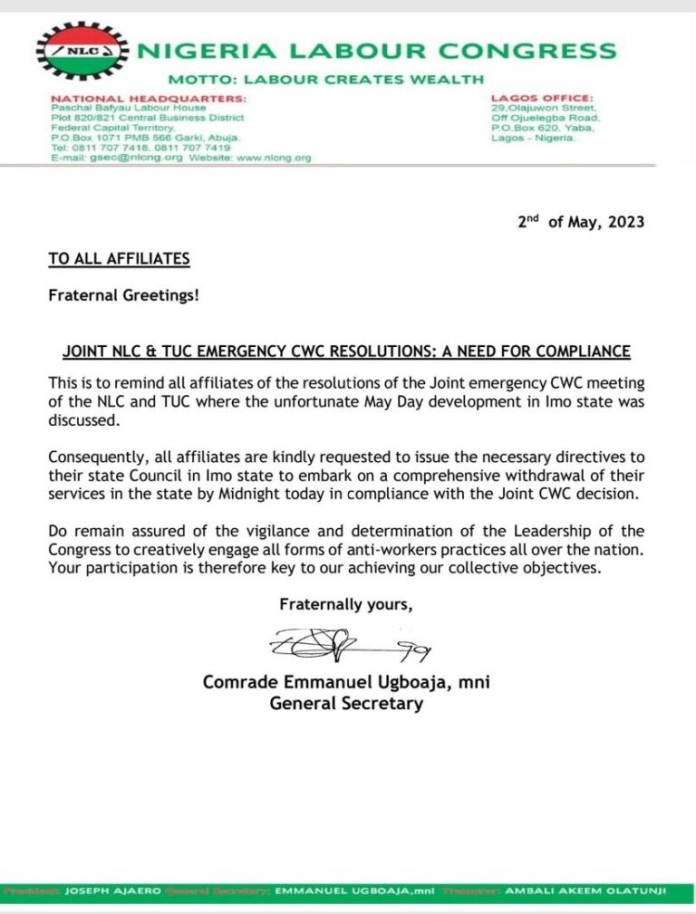
The decision is based on the resolutions of a combined emergency meeting of the NLC’s Central Working Committee (CWC) and the Trade Union Congress of Nigeria (TUC), according to a circular sent by the NLC General Secretary, Comrade Emmanuel Ugboaja, on May 2, 2023.
The circular stated that “the unfortunate May Day development in Imo state” was discussed during the conference without going into further detail.
The Board of Directors of PZ Cussons Nigeria Plc has approved the appointment of Dimitris Kostianis as a member of the Board and as the Chief Executive Officer (CEO) of the Company with effect from Thursday, June 1, 2023.
He has spent more than 25 years at PZ Cussons, 13 years of which were in senior leadership roles for PZ Cussons Africa and until his appointment, served as PZ Cussons MD for Asia.
The Acting company secretary, PZ Cussons Nigeria, Olubukola Olonade-Agaga in a signed statement on the Nigerian Exchange Limited (NGX) announced the retirement of Mr Panagiotis (Panos) Katsis as the Chief Executive Officer of the Company and from the Board with effect from May 31, 2023.
The Board is grateful for his outstanding performance and for setting the Company on the path of profitability and wishes him the best in his future endeavours.
Commenting on the changes, PZ Cussons Nigeria Board Chair, Ifueko M Omoigui Okauru in a statement said, “On behalf of the Board I would like to thank Panos for his service to the Nigerian business, where he has played a number of important roles during his 25 years with the PZ Cussons group.
“He will leave a significant legacy, successfully implementing our simplification strategy and creating the foundations for a strong future. I would also like to welcome Dimitris back to Nigeria, to build on those foundations and to bring his deep experience in the business and the region.
“Finally, I am delighted to congratulate Oghale and Raj on their appointments to strategic roles that will further facilitate the implementation of our strategy and enable the Nigerian business to leverage more regional opportunities.”
PZ Cussons Group CEO, Jonathan Myers in a statement also said, “I want to add my thanks to Panos for his 25 years of service to the PZ Cussons group, and to welcome the incoming management team who take over at an exciting time in our evolution as a company. I am pleased that for the first time we will have a Nigerian national leading our African consumer business.
“Panos has built the foundations for a return to profitability and growth in our Consumer business, while continuing to deliver strong performance in the electricals business. We are fully committed to building on those foundations, and excited about the potential for our business in Nigeria as we continue to execute our simplification strategy.”
UEFA to Allow Limited Number of Spectators Watch Champions League Games in Stadium
The UEFA Champions League is one of the most prestigious football competitions in the world. With the semi-finals just around the corner, four teams; Real Madrid, Man City, AC Milan, and Inter Milan, are preparing to clash in two epic matches, all with the same dream: to lift the coveted trophy and become Europe’s Champions.
In the semi-finals, Manchester City will face Real Madrid. Manchester City have been on fire in the 2022/2023 season. Just two points behind Arsenal in the Premier League table, dominating that league looks achievable. The FA Cup has also fallen within the ‘Cityzens’ grasp as they gear up for the cup finals.
Manchester City appear to aim for three trophies this year. Judging from how far they have come, they seem to be able to rewrite history. Because of their free-flowing attacking style, Haaland and DeBrunye continue to score goals at every opportunity. They need to be on top of their game to overcome Real Madrid. Real Madrid has won 14 Champions League titles. Spanish giants shine in big moments. They will look to stars like Karim Benzema and Vincious Junior to lead them to victory. Their UCL quarter-final match against Chelsea was successful.
The second semi-final battle features AC Milan VS Inter Milan, a historic derby between two of Italy’s most iconic football clubs. AC Milan have been in excellent form this season, with their young squad blending experience and flair to devastating effect. On the other hand, Inter Milan will be led by their talismanic striker, Romelu Lukaku, who has been prolific all season.
The semi-final stage set in two thrilling matches, in two legs, with the winners progressing to the final. Each team will fight tooth and nail to lift the trophy, but only two will make it to the finals. In the end, it will come down to which teams can handle the pressure and deliver when it matters most. Manchester City and Real Madrid will look to their star players, such as Erling Haaland, Vinicius Junior, Kevin De Bruyne, and Karim Benzema, to lead them to victory. Meanwhile, AC Milan and Inter Milan will count on Oliver Giroud and Romelu Lukaku to win.
These matches will be a feast for football fans globally as we are about to witness some of the most impressive teams compete for glory. Four teams, two games, one dream. Who will come out on top and lift the UEFA Champions League trophy? We cannot wait to find out in the coming days, starting tomorrow, Tuesday, May 9 to Wednesday, May 17, 2023 at 8 pm, on DStv SS Football Plus Ch. 202.
No need to fret about missing out on these and other matches, as DStv has got you covered! You can catch all the action Live across SuperSport channels. Also, stream your favorite matches on the go without additional charges by downloading the MyDStv App. For more details, visit www.dstv.com
The Unstructured Supplementary Service Data (USSD) platform is experiencing an extensive crisis, and although talks between the banks and telecommunications operators are ongoing at the regulatory level to find a cooperative solution, the service providers claimed that the debts owed them by defaulting banks have reached N120 billion.
There were estimated to be N100 billion in indebtedness as of the first quarter of 2023. However, despite the fact that the amount still owing has increased by N20 billion, the Association of Licensed Telecoms Operators of Nigeria (ALTON) claimed that the banks are still withholding remittances.
ALTON Chairman Gbenga Adebayo stated that the company’s debt had reached N120 billion. Adebayo, who verified that there had been regulatory-level conversation, stated: “Discussions are ongoing, and there has been very high-level regulatory intervention by the Central Bank of Nigeria (CBN) and the Nigerian Communications Commission (NCC). While some banks are making payments, others appear to be holding off until the service is discontinued in an effort to test our persistence in getting them to do so.”
“We would temporarily stop providing USSD service to debtor banks if the CBN/NCC intervention fails. No industry can endure the amount of the mounting debt, which is currently in the neighborhood of N120 billion, He said.
“Because these are services for which money has been taken from their customers, the banks have a moral obligation.” The Ministry of Communications and Digital Economy, CBN, and NCC had underlined that starting on March 16, 2021, USSD services would be taxed at a flat rate of N6.98k per transaction, despite the fact that the crisis has been ongoing for more than five years.
According to the agreement, banks would not charge customers extra fees for using the USSD channel and would instead collect the new USSD fees directly from customers on behalf of mobile network operators (MNOs).
A typical USSD session, which lasted for 20 seconds, had a pricing cap set at $4.98 for each session prior to the N6.98k per transaction regime. When the N6.98k problem reached a breaking point, NCC and CBN issued a joint statement that said: “This replaces the current per session billing system, providing a considerably cheaper average cost for subscribers to improve financial inclusion. This method is open and will guarantee that the sum stays the same regardless of how many sessions are involved in a single transaction.
While ePayment transactions reached N49.48 trillion in March, service quality difficulties in the area continue unabatedly and pose a threat to the sector’s successes.
Investigation revealed that customers are still dissatisfied with the bank apps and USSD platforms they use to access services, which they complained were frequently very slow and unresponsive.
Due to this problem, many clients now swarm the banking halls virtually every day to voice their objections. Kehinde Alesh, a Zenith Bank client, revealed that the bank’s app was unresponsive last week. “We were unable to use the banking app for over two days. Even more shocking, the app crashed. Many transactions are still pending. The Central Bank of Nigeria must take action on this issue, He stated.
Banks must make greater infrastructure investments! The software is sluggish, and USSD transactions don’t work. To witness the crowd, you ought to have been at the bank. Just annoying, really. Before the sector collapses, the CBN needs to move quickly.
In addition to the demand for the availability of the new notes, Gabriel Okeowo, Country Director of BudgiT Foundation Nigeria, recently discussed the bank’s IT infrastructure.
If the old Naira notes are what are now in use, even the new Naira notes cannot be purchased. Additionally, as we speak, the lines are still present, electronic transactions are still declining, and money is typically not refunded within 24 hours.
“In addition, the Internet infrastructure is not sufficiently developed to support efficient electronic transactions. I see a potential of extending the deadline for the usage of old naira notes through December 31 if all of these are not implemented, he said.
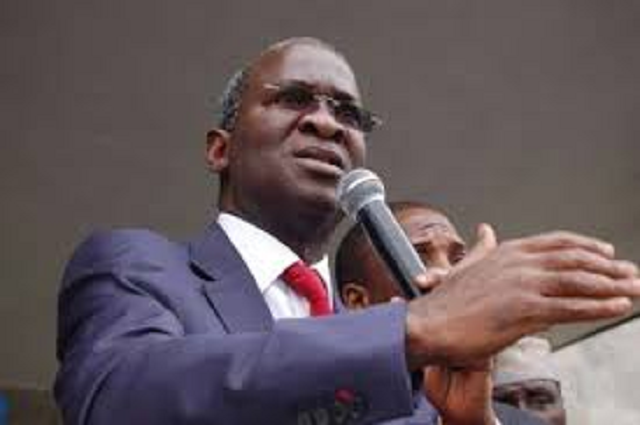
Babatunde Fashola, Minister of Works and Housing, has stated that Nigeria now owns 15.8 percent of Shelter Afrique, with donations totaling slightly more than $30 million since 2016.
Fashola revealed the information in his opening remarks Thursday in Abuja at Shelter Afrique’s 42nd Annual General Meeting/Symposium. A firm called Shelter Afrique was founded with the purpose of funding affordable housing for Africa.
According to the minister, Nigeria contributed a total of $22.5 million, which included $5.9 million in 2016, $9.3 million in 2020, and another $7.1 million in 2022.
Fashola stated, “As a result, Nigeria now owns 15.80 percent of the company’s shares, which are currently valued at $30,724,961.00”.
“This was a much-needed injection of life-restoring funds for a company that was having financial difficulties in 2016, and I must say that other member states have reciprocated in like.”
“In addition to financial capital, Nigeria has also provided the most valuable capital, human capital, by providing Mr. Femi Adewole to run the company temporarily during what may have been its most difficult time,” He added.
Fashola further said, “Given this context as we meet today, I can state with some assurance that Shelter Afrique’s gloomy clouds have passed and that a hopeful future lies ahead, thanks in part to the leadership shown by our company’s board and management, respectively by Dr. Chii Akporji and Mr. Thierno-Habib Hann.”
“On the domestic front, I am also happy to announce that the private sector is becoming more involved in the delivery of a range of housing types to meet demand from both low- and high-income groups.”
State governments are playing their parts in the provision of homes from Abia to Zamfara as a result of their sovereignty over land under the terms of our federal constitutional framework.
These contributions to increasing housing supply are complemented by the Federal Government through initiatives like the National Housing Programme, which has delivered homes across 35 states and the Federal Capital Territory of Abuja.
These initiatives are complemented by the Federal Housing Estates across our six geo-political zones, the Federal Mortgage Bank, Ministerial Housing Scheme, and co-operative housing initiatives across the 36 states of our nation.
According to the African Refiners and Distributors Association, replacing charcoal with clean cooking gas, also known as liquefied petroleum gas (LPG) , will cost Nigeria and other African nations around $7.5 billion for downstream infrastructure and stoves.
In spite of its enormous gas supply, the continent’s per capita consumption remained the lowest, and it was stressed that it was past time for stakeholders to develop financial plans and solutions to deal with the barriers to clean cooking gas usage on the continent.
Anibor Kragha, the Executive Secretary of ARDA, revealed this during a group LPG virtual workshop. He said that while sub-Saharan Africa had 14.4% of the world’s population, it consumed less than 1% of the world’s LPG.
According to Anibor, “many countries have little to no bulk handling facilities.” However, he pointed out that since 2010, LPG usage in Africa has more than doubled, with an average annual growth rate of 9.7% over that time.
In sub-Saharan Africa, he claimed that Nigeria continued to be the region with the highest LPG use rates. Cooking gas is essential to Africa’s energy security, according to David Appleton, vice president of Argus’ LPG business for Europe, the Middle East, and Africa.
He stated that infrastructure development remained a major concern and added that safety, price, culture, and finance were crucial for the sector’s expansion in Africa.
Investors in the industry, according to Appleton, would undoubtedly anticipate returns on their investments. He said that there must be a mechanism to reduce investment risk as much as feasible.
According to him, Africa must consider long-term investments and that regulatory improvement and consistency are essential.
In order for Africa to attract investments, better governance and institutions are required, according to Moussa Dabo, Senior Associate, Investments, African Finance Corporation, who revealed at the event that the company has invested $10.5 billion across 36 nations in Africa.
Dabo remarked that lenders felt more at ease making loans to businesses who were eager to adopt best-in-class operating procedures.
He believed that cash flow consistency and viability might greatly lower borrowing costs while encouraging more investment in LPG.
“Securing favorable, diversified, long-term supply contracts with established global traders is necessary, and players in the sector should recalibrate their capital structure before seeking financing,” Debo said, adding that adding equity to the company could reduce financing costs.
Additionally, Wagl Energy Limited’s stakeholders noted in a presentation that if Africa was committed to resolving issues with gas production that prioritized the local market, shipping, storage, as well as distribution to other end-users, the potential for LPG consumption in Africa could improve.
One of the infrastructure problems preventing LPG expansion in the region, according to the company, is the insufficient number of LPG vessels owned and operated by sub-Saharan African businesses.
It criticized the lack of LPG storage facilities in the area and emphasized that many sub-Saharan African ports and jetties, especially in countries like Nigeria, also have draft restrictions, with their drafts typically falling between 8 and 8.5 meters.
The gas company also pointed out that, of the three issues, the storage bottleneck presented the most opportunity because there were so few LPG storage facilities in the sub-Saharan region.
The Offshore Technology Conference (OTC) which brought together energy professionals from around the world recently concluded a successful edition. The event welcomed 31,000 participants and over 1,300 exhibiting companies.
Hosted in Houston, Texas from 1 – 4 May 2023, the annual event offered a collective platform for stakeholders to discuss global energy demands, the offshore sector’s role in meeting critical energy requirements, and its importance in the energy transition.
Participants had the opportunity to connect with top industry leaders, to learn about as well as showcase the latest innovations and technological advancements for the future of offshore energy while exploring cutting-edge technology for offshore drilling, exploration, production, and environmental protection.
One of the distinguished participants at the 2023 edition was Dorman Long Engineering Limited, a leading Oilfield Equipment, Structural Steel, Marine Structures Engineering, and Fabrication Company in West Africa. Dorman Long, a leading member of the Petroleum Technology Association of Nigeria (PETAN), supported the national association by sponsoring PETAN’s program for the Nigerian Pavilion which was newly opened at this year’s event.
The company, chaired by Dr. Timi Austen-Peters, was the proud sponsor of a networking golf session held on the final day to conclude the conference.
According to the data at the FMDQ Security Exchange where forex is traded officially, the dollar to naira exchange rate stood at (undisclosed).
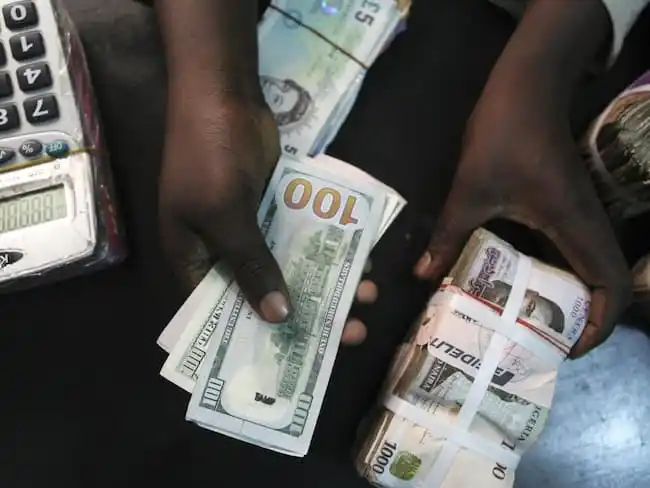
This would mean that the Nigerian currency either gained or lose in value against the United States dollar, as the foreign exchange (forex) trading closed at N460.5 per $1 on Friday, May 5.
How much is the dollarto naira at the black market today?
Going by sources at the Bureau De Change (BDC) in Lagos, the dollar to naira last traded ₦742 in the black market in the state.
It is, however, pertinent to note that the Central Bank of Nigeria (CBN) does not recognise the parallel market (black market), as it has directed individuals who want to engage in forex to approach their respective banks.
Stanbic IBTC Pension Managers Limited, a subsidiary of Stanbic IBTC Holdings PLC, has received an Initial Management Quality Rating of MQ2(NG)(mq) with a Stable Outlook from Global Credit Ratings (GCR). The rating demonstrated the company’s commitment to excellence in all aspects of its operations.
GCR, the rating agency, gained expertise in assessing the creditworthiness of financial institutions, corporates, and government entities, and had established itself as a leading rating agency in Africa. GCR adopted a Management Quality (MQ) rating system that ranked from the highest rating of ‘MQ1’ to the lowest rating of ‘MQ5’.
These ratings served as indicators of an entity’s organizational structure, risk management capabilities, and operational controls. They also hinted at markets of the overall quality, management characteristics, and operating practices of organizations.
The MQ2 rating assigned to Stanbic IBTC Pension Managers was an indicator of the institution’s strong management team with robust organizational structures, adequate controls, and sound risk management practices. It also accentuated the company’s clear strategy and solid financial position.
In a statement, Dr. Demola Sogunle, Chairman, Board of Directors of Stanbic IBTC Pension Managers, expressed delight in the rating. He stated that it was evidence of the company’s dedication to achieving excellence in all areas of its operations.
“We are very delighted to have received this rating from GCR, which recognizes our concrete efforts to maintain the highest standards of corporate governance, risk management, and financial performance,” Demola said.
Demola noted that the rating would boost confidence among Stanbic IBTC Pension Managers’ clients and stakeholders and would affirm the company’s dynamic capability to manage risks and deliver on its commitments.
Olumide Oyetan, Chief Executive, Stanbic IBTC Pension Managers, attributed the rating and success of the organization to its commitment to better serve customers without compromising operational excellence.
He said, “We are a member of the Standard Bank Group, Africa’s largest banking group by assets, totaling US$170 billion, as of 31 December 2022. This feat has enabled us to leverage the Group’s resources for our portfolio management functions.
“Our sister company, Stanbic IBTC Bank, is also the only AAA-rated Bank in Nigeria today, lending further credence to the Group’s strength and stamina, especially in its leadership and governance structures”.
“We deliver pension fund administration and management services to over 1.9 million private and public sector Retirement Savings Accounts (RSA) holders under the Contributory Pension Scheme) through our extensive network of 29 branches and ten service centers nationwide.”
Olumide said the organization also managed defined benefit plans for large corporates and provided value-added services, including retirement planning advice and personal financial planning. He described Stanbic IBTC Pension Managers as an organization equipped with a stable and experienced management team with sound management experience to keep the organization ahead of the pack in its operations and practices.
“Our portfolio management is sound, and our investment style is value-based with a long-term bias. We implement a top-down approach in securities selection, which is monitored monthly by the executive committee.
“We also offer our clients transparency and ease of account access through channels such as our secure web portal, 24/7 multilingual contact center, telephone, email, SMS, and our growing loop of client experience centers,” Olumide said.
The PFA’s Chief Executive noted that the company maintained an adequate operational risk management framework. He said, “We manage cyber, and data privacy risks using internal controls reviewed annually by independent third parties to reassure all our stakeholders of our commitment to doing business correctly and safely”.
Stanbic IBTC Pension Managers is committed to maintaining the highest professional and operational standards in delivering exceptional services to its growing clientele. The company website, www.stanbicibtcpension.com, has more information on Stanbic IBTC Pension Managers.
The Management of CMC Connect LLP, one of Africa’s leading perception management and public affairs consulting firms, is set to host public and regulatory affairs practitioners in the private and public sectors to a national discourse in the area of fiscal policy direction for the incoming government.
The program is billed for Thursday May 11, 2023 via an online webinar platform between 10:00am and 12:00 noon. Theme: “Setting a Fiscal Policy Agenda for the Bola Tinubu Administration”. Keynote Speaker is Dr Abiodun Adedipe, a distinguished economist with expertise in fiscal policy, banking, finance, and public sector consulting.
The program will be moderated by Mr Yomi Badejo-Okusanya, founder and Lead Partner at CMC Connect LLP. The dialogue will have a panel of discussants drawn from different sectors of the economy. They include Mr Tilewa Adebajo, Chief Executive Officer at The CFG Advisory; Mr Vivian Ikem, Corporate Affairs and Communications Director at Japan Tobacco International, among others.
The discourse is designed as a convergent platform for private sector players in public and Regulatory affairs to make case for their business interest on key issues around fiscal policies and regulatory challenges in Nigeria.
Speaking on the policy dialogue session, Adetola Odusote, Partner, Public Affairs at CMC Connect LLP, explained that “as Nigerians await the swearing of the President Elect, many businesses are anticipating with bated breath, the direction of the new administration’s fiscal policy.
The last eight years have been very challenging for most Nigerian businesses and the hope is that the new administration will institute significant pro-business policy reforms that will re-inflate the economy.
“CMC Connect’s 3rd National Policy Dialogue, a non-political, non-partisan, pro-business platform, will bring together key stakeholders with the objective of aggregating views and making very incisive recommendations on how best the next government can move the Nigerian economy forward”, Odusote stated.
The Office of the Attorney General of Switzerland (OAG) has ordered SICPA SA to pay CHF 81 million for corporate criminal liability in connection with acts of corruption.
A former sales manager of SICPA was also handed a conditional prison sentence of 170 days. The proceedings against the CEO and major shareholder of SICPA are being discontinued.
With the penalty order issued by Art. 102 para. 2 SCC in conjunction with Art. 322septies SCC, SICPA SA (SICPA) has acknowledged that it failed to take all necessary and reasonable organizational precautions to prevent bribes to foreign public officials. The OAG has accordingly ordered the company to pay a fine of CHF 1 million and imposed an equivalent claim for compensation amounting to CHF 80 million under Art. 71 para. 1 SCC.
Organisational deficiencies
The proceedings identified organizational deficiencies that made it possible for employees of SICPA to bribe public officials in the conduct of business in Brazil, Colombia, and Venezuela. Organizational deficiencies were particularly evident in the areas of corporate governance, risk management, and compliance.
Bribery of foreign public officials
In the penalty order, the OAG finds the former sales manager of SICPA, who took advantage of the deficiencies, guilty of bribery of foreign public officials under Art. 322septies SCC. He is being sentenced to a conditional prison term of 170 days. The order states that he paid bribes to high-ranking officials in the Colombian and Venezuelan markets between 2009 and 2011.
The proceedings conducted against the same former sales manager on suspicion of embezzlement and money laundering are being discontinued under Art. 319 para. 1 lit. a Criminal Procedure Code (CrimPC), because suspicions justifying an indictment have not been corroborated.
Criminal proceedings discontinued
The proceedings against the CEO and main shareholder of SICPA are also being discontinued under Art. 319 para. 1 lit. a SCC. However, the OAG is ordering him to bear a portion of the costs of the proceedings and has not awarded him any compensation. SICPA and its former employee have declared that they will not be appealing against the penalty orders, which will be legally binding.
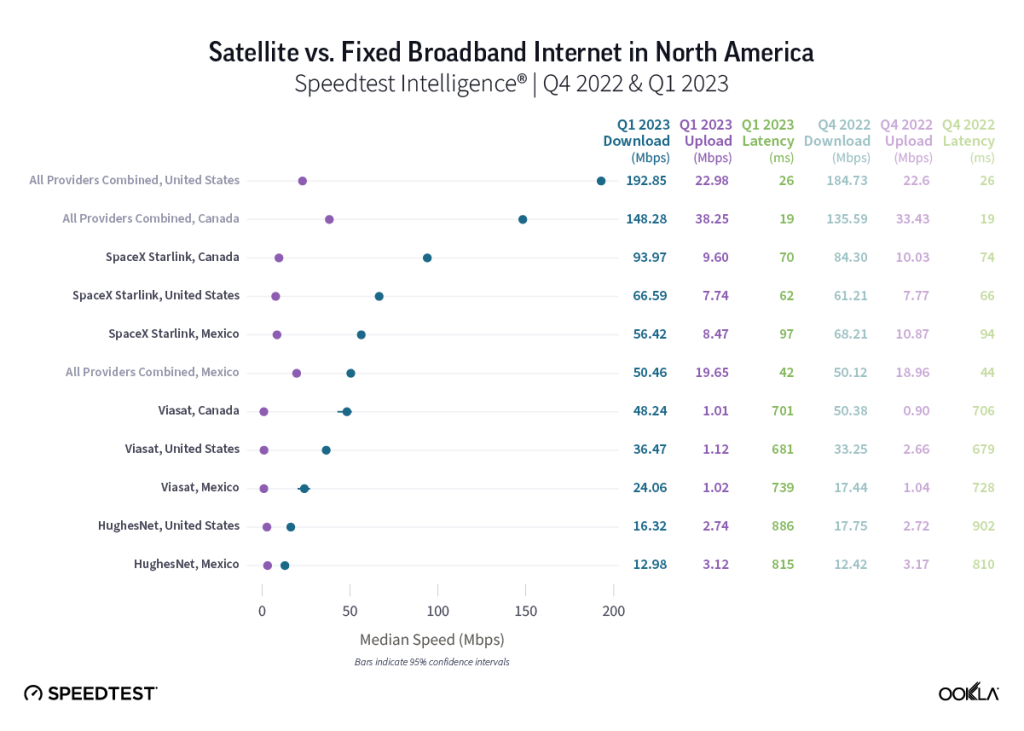
Ookla® has released data from Q4 2022 and Q1 2023 for HughesNet, SpaceX’s Starlink, and Viasat in North America, South America, and the Caribbean, as well as additional Starlink markets not yet covered in our ongoing satellite internet series.
This research contains Starlink Net Promoter Score (NPS) for metro and nonmetro internet connections in the United States, Starlink year-over-year statistics in Canada, Chile, Mexico, and the United States, and Starlink results from three new nations (Philippines, Nigeria, and Peru).
Starlink users in metro and nonmetro areas love Starlink, fixed broadband users dislike their internet service providers
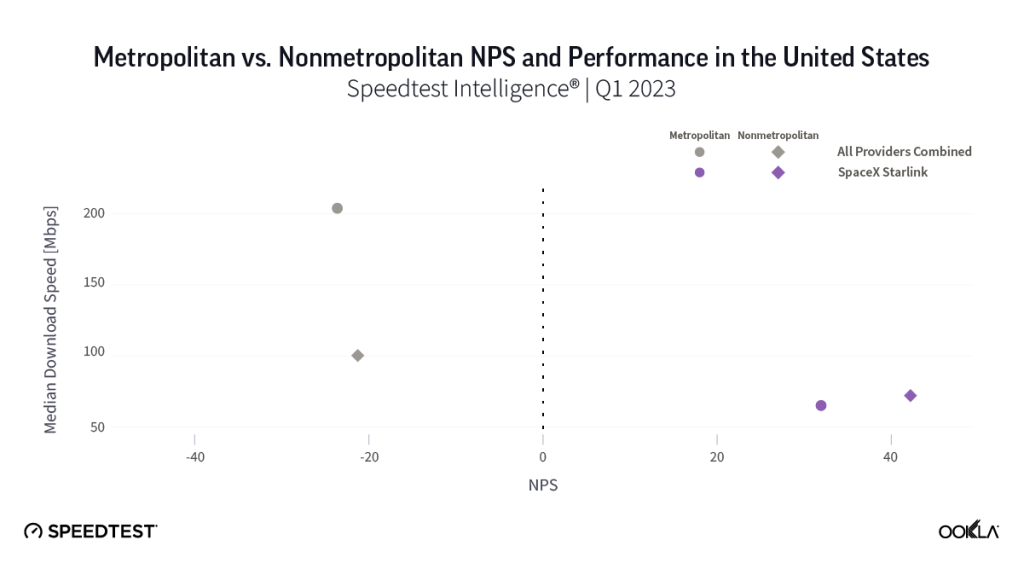
Using Speedtest Intelligence®, we examined NPS ratings by Starlink users and all fixed broadband providers combined for “metropolitan” and “nonmetropolitan” counties as defined by the U.S. Office of Management and Budget.
NPS based on Speedtest® user responses after being asked how likely they are to recommend their provider to friends or family on a 0 to 10 scale. NPS ratings are categorized into Detractors (score 0-6), Passives (score 7-8), and Promoters (score 9-10), and is calculated as (% Promoters – % Detractors) x 100. Any NPS score above 0 indicates that a provider’s audience is more loyal than not.
As you see above, the difference in NPS between Starlink and all fixed broadband providers combined is stark: both metro and nonmetro Starlink far outperformed metro and nonmetro ISPs combined for NPS.
Metro Starlink had a score of 31.94 compared to -23.62 for all metro fixed broadband providers combined, despite Starlink having a median download speed of 65.29 Mbps compared to 203.93 Mbps for all metro fixed broadband providers combined.
Nonmetro Starlink had an even higher NPS at 42.21 compared to nonmetro ISPs at -21.27 — that’s especially notable given that Starlink’s median download speed was much closer to the median nonmetro fixed broadband speed at 72.18 Mbps to 100.41 Mbps.
Clearly, Starlink provides a much loved option for more rural, nonmetro users who often don’t have many good — if any — internet options. And the message is loud and clear: Starlink users are more than willing to recommend the service and love the internet they are getting.
Starlink speeds increased in Canada and the U.S. over the past two quarters, but are mixed year-over-year
As Starlink continues to become an increasingly popular and beloved option for users, especially those in more rural areas, steady increases in speeds in two large markets like Canada and the U.S. bode well for the internet provider. These increases come as major upgrades to Starlink’s satellite array are beginning, with Starlink having just launched 46 nextgen satellites on April 27, so we wouldn’t be surprised if speeds keep climbing across the globe.
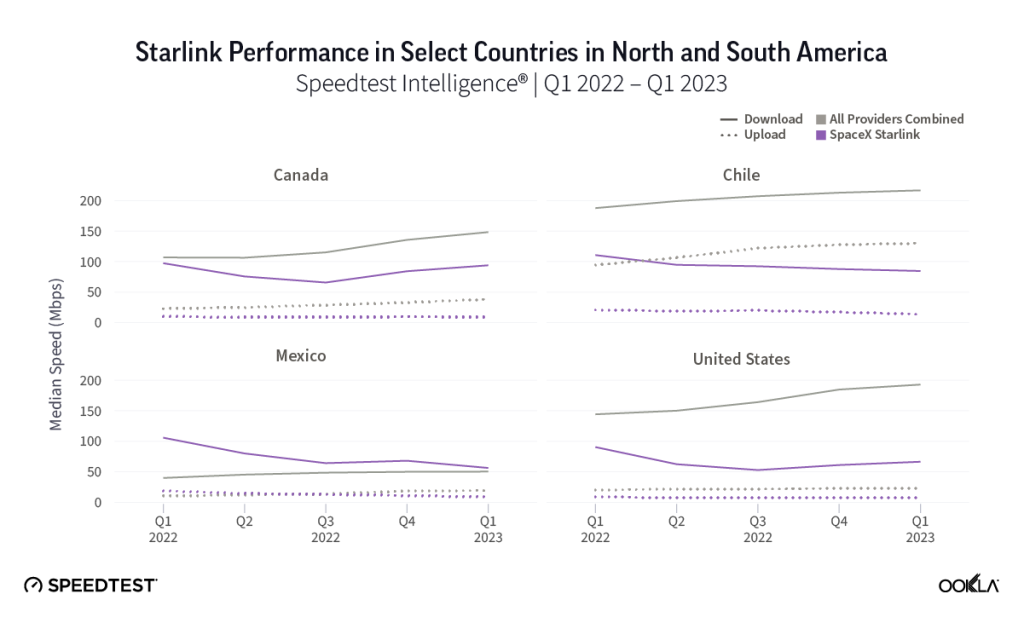
In North America, all of the countries we surveyed saw slower median download and upload speeds during Q1 2023 than Q1 2022. However, Canada saw just about a 3 Mbps decrease in download speed from Q1 2022 to Q1 2023, with about a 28 Mbps increase over the past two quarters.
The U.S., where Starlink has many more users, saw about a 24 Mbps decrease year-over-year for median download speeds, but at least a 13 Mbps increase during Q4 2022 and Q1 2023. Mexico, which saw 100+ Mbps median download speeds during Q1 2022, saw a roughly 49 Mbps dip year-over-year as more users signed up for the service; however, speeds leveled slightly with only an overall dip of about 8 Mbps during the past two quarters.
In South America, Chilean Starlink speeds slowed about 22 Mbps from Q1 2022 to Q1 2023, however, speeds only slowed about 8 Mbps over the past two quarters. Chile has continually ranked in the top four for fastest fixed broadband speeds on the Speedtest Global Index™ for over a year now.
Starlink in Canada blazed ahead as the fastest satellite provider in mainland North America
Speedtest Intelligence reveals that Starlink in Canada had the fastest download speed among satellite providers in mainland North America at 93.97 Mbps.
That was about 40% faster than the runner-up, which was Starlink in the U.S. at 66.59 Mbps. Starlink in Mexico was next at 56.42 Mbps, and was faster than all fixed broadband providers in Mexico combined at 50.46 Mbps.
Viasat in Canada, Mexico, and the U.S. made noticeable performance leaps over download speed from Q3 2022 when we last measured North American satellite providers. Canada went from 24.36 Mbps in Q3 2022 to 48.24 Mbps in Q1 2023, the U.S. from 28.07 Mbps to 36.47 Mbps, and Mexico from 16.14 Mbps to 24.06 Mbps. Hughesnet trailed over download speed in the U.S. (16.32 Mbps) and in Mexico (12.98 Mbps).
For upload speeds, all satellite providers trailed fixed broadband speeds in their respective countries, with Starlink in Canada achieving the fastest satellite upload speed at 9.60 Mbps, followed by Starlink in Mexico (8.47 Mbps) and the U.S. (7.74 Mbps). Viasat and HughesNet trailed behind.
Multi-server latency showed the stark difference of satellite internet’s real limitations, with the huge distances between satellite and users adding up to longer lag times than fixed broadband.
Starlink had the only latencies under 100 ms among satellite providers, with Starlink in the U.S. having the lowest latency at 62 ms, followed by Canada (70 ms) and Mexico (97 ms). Viasat and HughesNet, which have farther geosynchronous orbits (GEO) than Starlink’s low-earth orbit (LEO), had much higher latencies.
Starlink in Chile raced ahead as the fastest satellite provider in South America
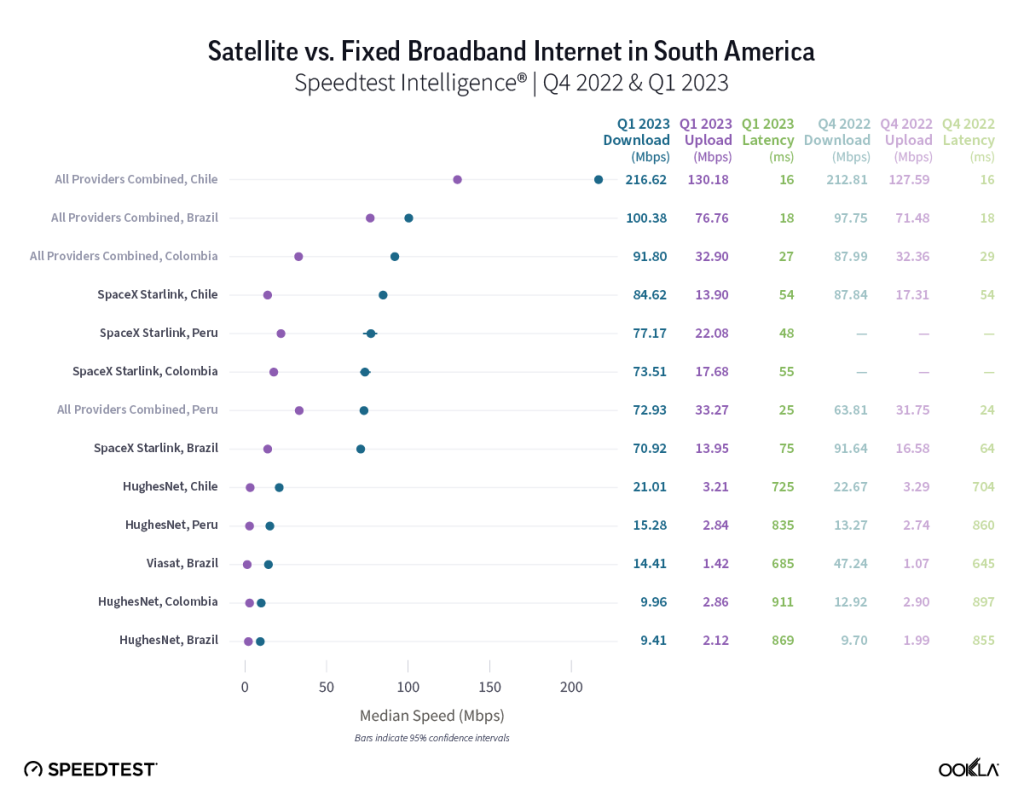
Starlink in Chile was the fastest satellite provider in South America during Q1 2023, edging out Starlink in Peru by about 5% with a median download speed at 84.62 Mbps to 77.17 Mbps.
No satellite provider outperformed all fixed broadband providers combined in Q1 2023, but Starlink in Colombia and Brazil both reached median download speeds above 70 Mbps at 73.51 Mbps and 70.92 Mbps, respectively. HughesNet in Chile broke 20 Mbps at 21.01 Mbps, while Viasat in Brazil only reached 14.41 Mbps.
Satellites were outperformed by fixed broadband over upload speed in South America during Q1 2023, but Starlink had median upload speeds that ranged from 13.90 Mbps to 22.08 Mbps, the fastest being in Peru. HughesNet ranged from 2.12 Mbps to 3.21 Mbps, and Viasat in Brazil was at 1.42 Mbps.
Starlink’s multi-server latency dipped below 60 ms in three South American markets during Q1 2023: Peru (48 ms), Chile (54 ms), and Colombia (55 ms). Brazil followed at 75 ms, which was the next lowest. Viasat and HughesNet trailed far behind.
Starlink in Jamaica was the fastest Caribbean satellite provider
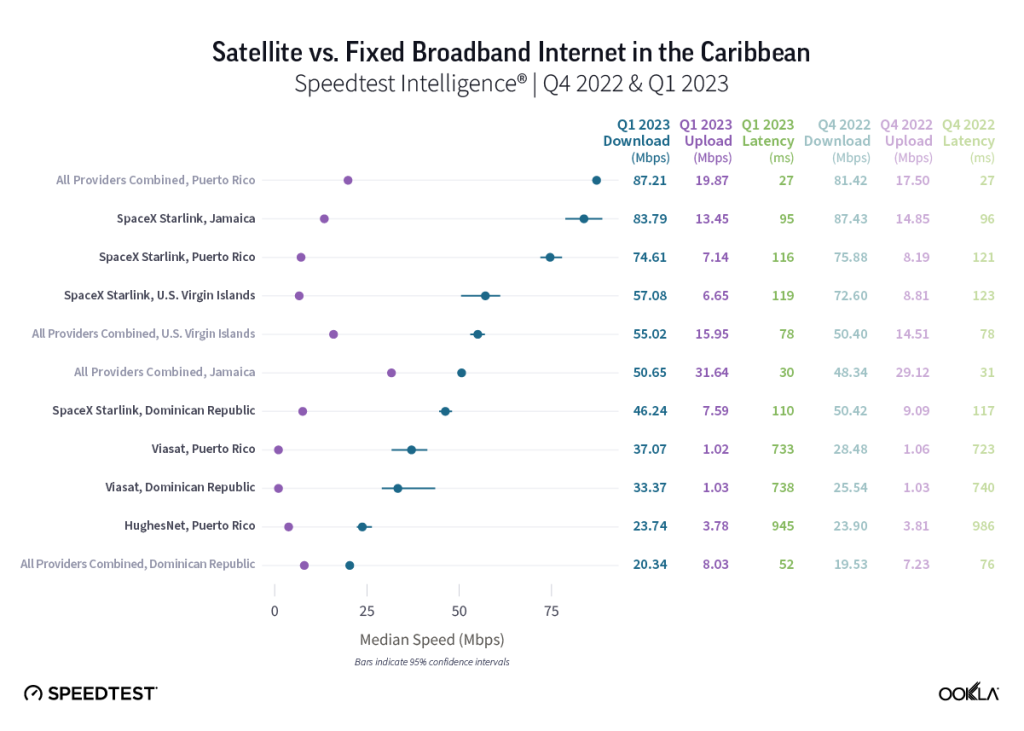
Speedtest Intelligence reveals that Starlink in Jamaica was the fastest satellite provider in the Caribbean at 83.79 Mbps during Q1 2023.
Starlink was faster than all fixed broadband providers in Jamaica, and both Starlink and Viasat were faster than all providers combined in the Dominican Republic during Q1 2023.
Starlink reached median download speeds of over 50 Mbps during Q1 2023 in Jamaica (83.79 Mbps), Puerto Rico (74.61 Mbps), and the U.S. Virgin Islands (57.08 Mbps), while it fell just short of that benchmark in the Dominican Republic (46.24 Mbps).
Viasat had median download speeds of 37.07 Mbps and 33.37 Mbps in Puerto Rico and the Dominican Republic, respectively, during Q1 2023, while HughesNet had a median download speed of 23.74 Mbps in Puerto Rico during Q1 2023.
Upload speeds showed a bit more parity between satellite providers with only Starlink in Jamaica rising above 10 Mbps with a median upload speed of 13.45 Mbps during Q1 2023.
Starlink had median upload speeds ranging from 6.65 Mbps to 13.45 Mbps, HughesNet had a median upload speed at 3.78 Mbps in Puerto Rico, and Viasat had upload speeds of 1.02 Mbps and 1.03 Mbps in Puerto Rico and the Dominican Republic, respectively, during Q1 2023.
For multi-server latency, Caribbean satellite users saw higher multi-server latencies than mainland North and South America with only Starlink in Jamaica breaking under 100 ms. While fast speeds for remote users are always going to be appreciated, multi-server latencies of over 100 ms do make some internet uses much harder to do well like live gaming and video conferencing.
New Q4 2022 Starlink countries show very promising results
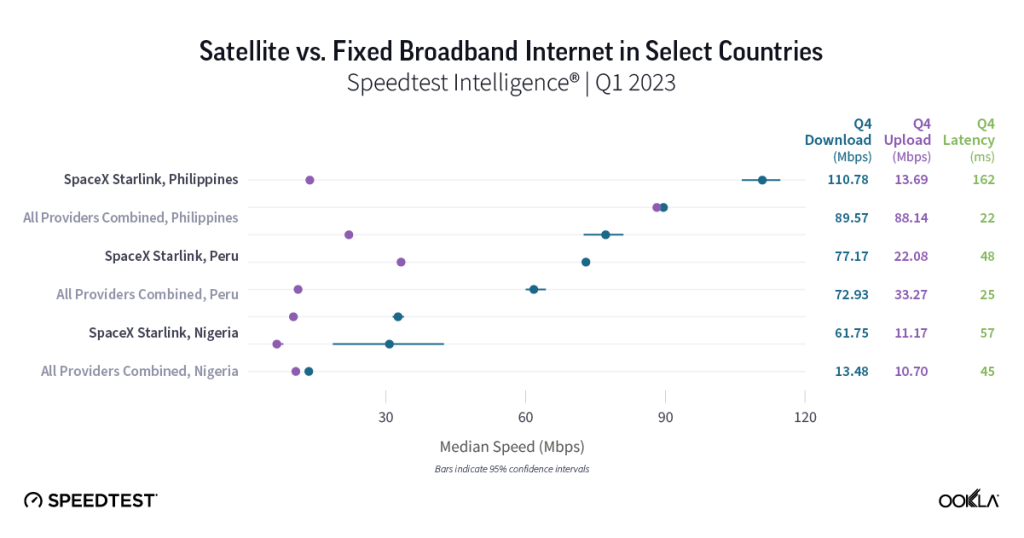
Speedtest Intelligence data shows new Starlink data in three countries during Q1 2023, including Nigeria, Peru, and the Philippines. Median download speeds for Starlink in Nigeria (61.75 Mbps) and the Philippines (110.78 Mbps) were both faster options than all fixed broadband providers combined, while Starlink in Peru was statistically too close to call at 77.17 Mbps for Starlink and 72.93 Mbps for all providers combined.
Starlink had slower upload speeds in all of the new countries except Nigeria, which was too close to call at 11.17 Mbps to 10.70 Mbps. Starlink had a much higher latency than fixed broadband providers in the Philippines (162 ms) in Q1 2023, though it came very close in Nigeria 57 ms to 46 ms.