





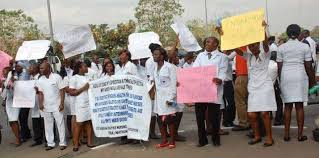
Public hospitals across Nigeria are bracing for significant disruption as nurses under the National Association of Nigeria Nurses and Midwives (NANNM), Federal Health Institutions (FHI) sector, have declared a seven-day nationwide warning strike beginning Wednesday, July 30, 2025.
The industrial action, which threatens to paralyse operations in 74 federal medical institutions—including teaching hospitals, federal medical centres, and specialist health facilities—as well as state and primary healthcare centres, follows the expiration of a 15-day ultimatum issued to the Federal Government on July 14.
At the heart of the strike are longstanding grievances over poor remuneration, chronic staff shortages, unpaid allowances, and deteriorating working conditions. Despite repeated calls for dialogue, union leaders say the government has remained unresponsive.
“The strike is inevitable. The Federal Government and the Federal Ministry of Health have refused to engage us in meaningful negotiations,” said Comrade Morakinyo Rilwan, National Chairman of NANNM-FHI, in an exclusive interview.
Rilwan highlighted several unmet demands, including a dedicated salary structure for nurses, a review of shift and uniform allowances, an increase in core duty allowances, and the establishment of a Nursing Department within the Federal Ministry of Health.
“Nurses are not just any health workers. We are the backbone of patient care—working 24-hour shifts, exposing ourselves to dangers, yet receiving only 6.8% shift allowance instead of the 30% stipulated in a 2009 circular. Even security guards receive the same,” he lamented.
He decried the stagnation in the uniform allowance, which has remained at N20,000 annually for over two decades, despite nurses being required to maintain clean white uniforms that are frequently replaced due to stains and exposure to infectious materials.
“Doctors recently had their lab coat allowances reviewed, but nurses were ignored. This is a clear case of discrimination and neglect,” he added.
- The association is also demanding:
- An increase in core duty allowance from 1.7% to 4%.
- Mass employment of qualified nurses to bridge the staffing gap.
- Full implementation of the 2016 Scheme of Service for Nurses.
Immediate reconstitution of the Nursing and Midwifery Council Board, which has been dissolved for over four years.
Rilwan underscored the urgent need for institutional reforms, noting that despite nurses constituting a large percentage of the health workforce, the absence of a dedicated department in the Ministry of Health hampers their professional recognition.
“We have directors reporting to directors in unrelated departments. This undermines our profession. We want a full-fledged Nursing Department led by a competent nursing director,” he stated.
He also criticised the underemployment of nurses in Nigeria, despite the country producing over 10,000 nursing graduates annually.
“We don’t have a shortage of nurses; we have a shortage of opportunities and fair pay. Many nurses are stuck in private hospitals earning next to nothing or working on short-term contracts in public hospitals,” he added.
Speaking on the severity of the action, NANNM’s National Public Relations Officer, Omomo Tibiebi, confirmed that the strike will be total, affecting all services, including emergency care.
“From 12:01 a.m. on Wednesday, July 30, there will be no services in all affected hospitals across the 36 states and the FCT—including emergency units. No skeletal services will be available,” Tibiebi affirmed.
As the countdown to the strike ticks down, healthcare facilities nationwide are preparing for a potential healthcare crisis—one that could leave patients stranded and lives hanging in the balance if the Federal Government fails to intervene.
Despite President Bola Tinubu’s administration pledging to improve healthcare delivery in Nigeria, nursing professionals continue to decry poor treatment and systemic neglect. While the government has made strides in improving doctors’ welfare—through salary reviews, hazard allowances, and equipment upgrades—many nurses argue that these reforms have largely excluded them.
Healthcare experts have urged the Federal Government to swiftly engage the nurses in constructive dialogue to avert the looming collapse of public health services. The warning strike, if not addressed, could escalate into an indefinite industrial action, further crippling an already fragile healthcare system.