








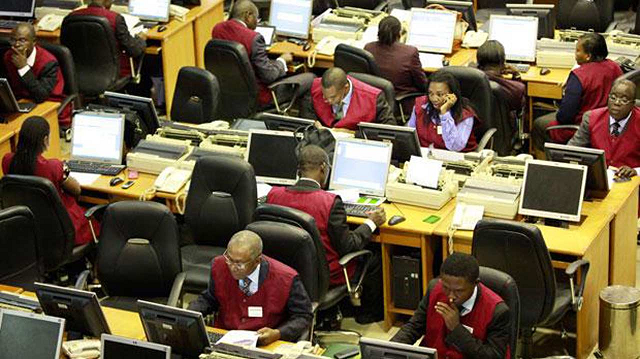
The Nigerian Exchange (NGX) witnessed a landmark surge on Wednesday as investors reaped over ₦1.44 trillion in gains, driven by strong buying pressure across major indices.
Trading resumed with bullish momentum after the holiday break, pushing the market to unprecedented levels. Key market indicators soared by 1.80% during the session, propelling the year-to-date return to 25.30%.
Investor sentiment remained upbeat, with sustained interest in heavyweight stocks like NESTLE, FIRSTHOLDCO, UBA, and 37 other equities—particularly within the banking sector—fueling the gains.
The benchmark All-Share Index rose by 2,587.64 basis points, closing at a record high of 128,967.08 points. Total trading activity experienced a substantial uptick, as both volume and value of trades jumped by 833.60% and 1,087.01%, respectively.
A report from Atlass Portfolio Limited revealed that over 11.67 billion shares worth ₦363.41 billion were exchanged in 38,918 deals, highlighting the intensity of market activity.
UBA led the trading charts by volume, accounting for 12.76% of total transactions, followed by ACCESSCORP (10.10%), UNIVINSURE (10.05%), ZENITHBANK (5.37%), and Nigerian Breweries (4.18%). UBA also dominated in value terms, contributing 19.09% of total traded value.
On the gainers’ chart, NESTLE, EUNISELL, NSLTECH, and OMATEK saw their share prices rise by 10.00% each, followed by TRIPPLEG (+9.92%), FIRSTHOLDCO (+9.90%), IMG (+9.89%), and STANBIC (+9.67%).
However, 44 stocks closed lower, with FTNCOCOA and NPFMCRFBK leading the losers at -10.00% each. Other notable decliners included CILEASING (-9.97%), ELLAHLAKES (-9.93%), and CONHALLPLC (-9.87%).
Despite the negative market breadth of 40 gainers to 44 losers, three of the five key sectors posted gains: banking (+7.05%), consumer goods (+1.33%), and industrial goods (+1.15%). The insurance and oil & gas sectors, however, dipped by -2.94% and -0.19%, respectively.
The market’s total capitalisation surged by ₦1.64 trillion, closing at a new peak of ₦81.58 trillion, as optimism around the Nigerian stock market continues to grow.




 witnessed a landmark surge on Wednesday as investors reaped over ₦1.44 trillion in gains, driven by...)